






















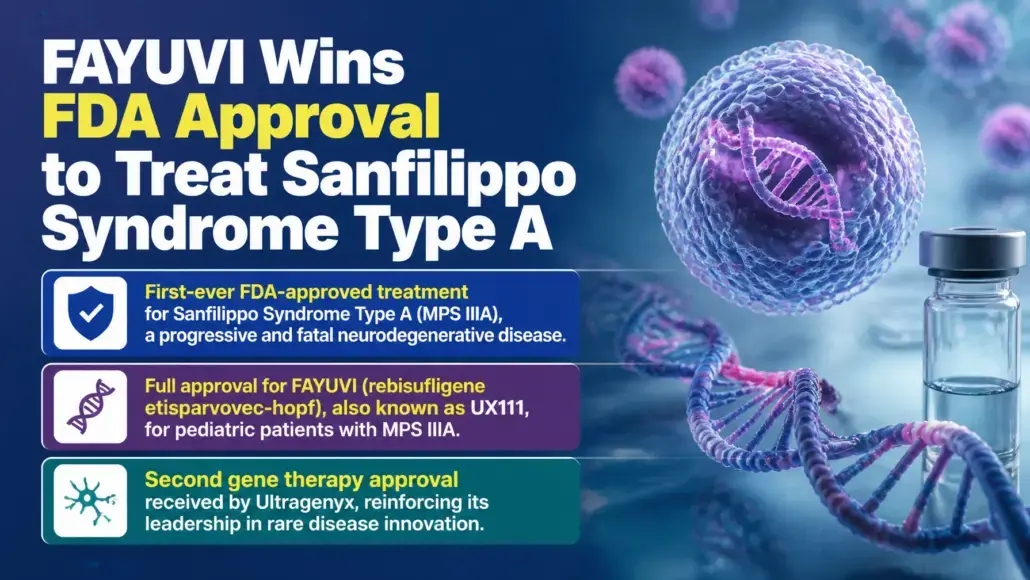
Ultragenyx Pharmaceutical Inc. announced that the U.S. Food and Drug Administration (FDA) has granted standard full approval to FAYUVI (rebisufligene etisparvovec-hopf), also known as UX111, for pediatric patients with mucopolysaccharidosis type IIIA (MPS IIIA, Sanfilippo syndrome Type A). The approval makes FAYUVI the first-ever FDA-approved treatment for Sanfilippo syndrome Type A, a progressive and fatal neurodegenerative disease. It also represents the second gene therapy approval received by Ultragenyx. Along with the approval, the Company received a Priority Review Voucher.
“The approval of FAYUVI reflects years of research from scientists and developers, as well as unwavering support from so many families and patient organizations in the face of a devastating, universally fatal disease with no treatment options. This is a historic milestone for a community that has waited far too long, but has never given up hope,” said Emil D. Kakkis, M.D., Ph.D., chief executive officer and president of Ultragenyx.
“FDA approval is an important first step toward our long-term goal to bring this treatment option to families of children with Sanfilippo syndrome Type A around the world,” he added.
Community Marks Approval After Decades of Effort
The approval also represents a significant milestone for the Sanfilippo syndrome Type A community, according to Glenn O’Neill, president and co-founder of the Cure Sanfilippo Foundation, and Terri Klein, CNPM, MPA, president and chief executive officer of the National MPS Society.
“The U.S. FDA approval of FAYUVI is a milestone that the Sanfilippo syndrome Type A community spent decades fighting to achieve: the first-ever treatment for a disease that relentlessly steals a child’s abilities, independence, and future,” said O’Neill.
Disease Profile and FAYUVI Treatment
Sanfilippo syndrome Type A is an ultra-rare, fatal lysosomal storage disease that primarily affects the brain and is marked by rapid, progressive neurodegeneration beginning in early childhood. Children generally develop progressive global developmental delay before experiencing the loss of cognitive, language, and motor function, ultimately leading to early death.
The disease is estimated to affect approximately 3,000 to 5,000 patients in commercially accessible geographies, with a median life expectancy of 15 years. Sanfilippo syndrome Type A results from a deficiency of the sulfamidase (SGSH) enzyme, causing heparan sulfate substrate to accumulate in cells and resulting in progressive damage to the central nervous system. FAYUVI is a single-dose intravenous AAV9 gene therapy designed to deliver a functional copy of the deficient enzyme gene that can express and replace the SGSH enzyme.
“This gene therapy addresses a pressing unmet clinical need and offers families a promising therapeutic option,” said Kevin M. Flanigan, M.D., director of the Center for Gene Therapy at Nationwide Children’s Hospital and principal investigator on the study that led to its approval.
Clinical Data Support Standard Full Approval
The development of FAYUVI involved substantial difficulties before the therapy reached final delivery. The Company hopes the approval will revitalize investment in other ultra-rare gene therapies. Haiyan Fu, PhD, and Doug McCarty, PhD, developed the therapy during their tenures at Ohio State University/Nationwide Children’s Hospital, after which it was licensed to Abeona. Despite positive clinical data, funding constraints emerged, prompting Abeona to make the pivotal decision to out-license the asset to Ultragenyx and ensure that the treatment could reach patients. Ultragenyx thanked the researchers, the development and leadership team at Abeona, families, patient advocacy groups, and investigators who worked through the obstacles over the years.
The approval of FAYUVI is supported by data from the pivotal Transpher A trial and long-term follow-up studies. The studies demonstrated clinical benefit relative to the decline observed in natural history, together with a durable treatment effect across clinical assessments and multiple biomarkers while maintaining an acceptable safety profile. Clinical data now extend to up to nearly 8 years of follow-up.
Biochemical efficacy in replacing the missing enzyme was shown through a reduction in accumulated cerebral spinal fluid (CSF) heparan sulfate (HS) levels throughout the study and across all age groups. Clinical efficacy was evaluated using patients’ mean change in Bayley-III Cognitive raw score from 24 to 60 months of age. FAYUVI-treated patients from the modified intention-to-treat (mITT) population (N=17) were compared with untreated patients with Sanfilippo syndrome Type A from an external, comparable natural history cohort (N=27). During the study period, FAYUVI-treated patients (mITT) demonstrated a 23.5 point higher (p<0.0001) cognitive score over natural history, providing the efficacy basis for standard full approval.
