















The pharmaceutical industry has traditionally relied on a lengthy cycle of target identification, compound screening, synthesis, testing, and optimization to discover new medicines. While these methods remain essential, the growing complexity of disease biology and chemical space is pushing researchers to seek more efficient ways to create promising therapeutic candidates. Artificial intelligence is increasingly becoming part of this transformation, particularly through its ability to generate and evaluate molecular structures before they are synthesized in the laboratory.
Pharma Advancement notes tha at the center of this shift is de novo drug design, an approach that enables researchers to create new molecules rather than simply selecting candidates from existing chemical libraries. By combining generative models with structural biology, medicinal chemistry, and predictive analytics, pharmaceutical R&D teams can explore molecular possibilities that may be difficult to identify through conventional screening. The result is a more computationally guided discovery process in which molecular design, property prediction, and iterative optimization can occur in increasingly connected cycles.
Moving Beyond Conventional Compound Screening
Traditional drug discovery often begins with large collections of known compounds. Researchers screen these libraries against a biological target, identify promising hits, and then modify their structures through repeated rounds of medicinal chemistry. Although this approach can produce successful candidates, the number of potentially useful molecules that can be physically synthesized and tested represents only a fraction of the enormous chemical space available to researchers.
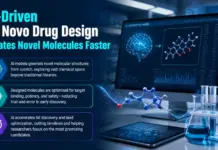
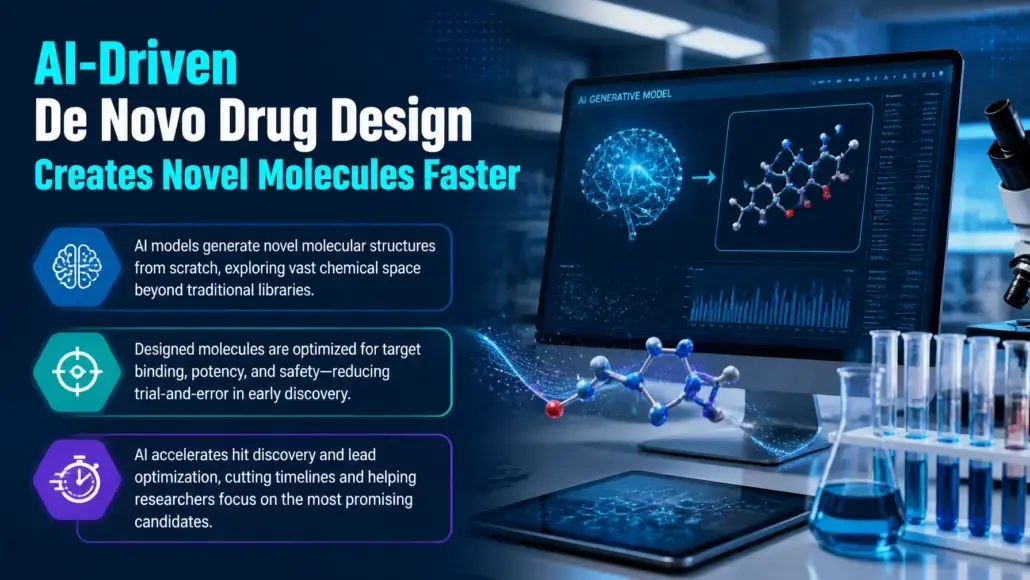
De novo drug design changes the starting point by allowing computational systems to propose molecular structures according to defined objectives. Instead of asking which existing compounds might interact with a target, researchers can ask what type of molecule could be created to achieve a particular biological and chemical profile. AI models can consider structural features, predicted activity, selectivity, solubility, stability, and other characteristics while generating candidate molecules.
This capability is important when conventional libraries do not provide suitable starting points. It can help researchers investigate new chemical scaffolds and generate candidates for difficult targets.
Generative AI Expands Molecular Exploration
Generative AI provides the computational engine behind many emerging approaches to molecular creation. These systems learn patterns from datasets containing chemical structures, molecular properties, biological activity, and other relevant information. Once trained, they can generate new structures that follow learned chemical relationships while meeting specified design constraints.
In de novo drug design, this means a model can be directed toward a target or set of desired molecular characteristics and produce candidate structures for further evaluation. Rather than replacing medicinal chemists, the technology expands the range of ideas they can investigate. Scientists can use generated molecules as starting points, assess their feasibility, and refine them according to experimental findings.
The ability to generate molecules is only one part of the process. A useful candidate must demonstrate potency, selectivity, stability, safety, and developability. AI can support a continuous design-and-evaluation cycle, filtering structures before researchers commit resources to synthesis.
Connecting Molecular Design With Target Biology
The effectiveness of AI-generated molecules depends heavily on the biological context in which they are designed. Understanding the structure and behavior of a target can help researchers define the characteristics a new molecule should possess.
Modern computational methods can analyze protein structures, molecular interactions, genomic information, and other biological datasets to identify relationships that inform compound design. When these insights are integrated into de novo drug design workflows, the generation process can become more target-specific rather than simply producing chemically plausible molecules.
For difficult targets, this integration can open additional avenues for discovery. AI may propose structures designed to interact with particular binding sites or molecular regions, while predictive models can estimate how changes to those structures could influence their activity. Researchers can then prioritize candidates for experimental testing.
Improving Lead Optimization Through Predictive Models
Once promising molecules have been generated, they still require extensive refinement. A compound that shows encouraging activity against a target may have poor absorption, unfavorable metabolism, inadequate solubility, or toxicity concerns. These properties can cause promising candidates to fail later in development if they are not addressed early.
AI can help bring these considerations into the design stage. Predictive models can estimate ADME characteristics, toxicity risks, physicochemical properties, and other measures associated with drug developability. This allows researchers to compare alternative structures and identify modifications that could improve a candidate before it enters extensive laboratory testing.
In this context, de novo drug design becomes an iterative process rather than a single act of molecular generation. A model proposes structures, computational tools evaluate them, researchers select candidates, and experimental results provide new information for subsequent design cycles. This feedback loop can make lead optimization more focused and reduce the number of less promising molecules entering downstream testing.
Exploring Chemical Space With Greater Precision
Chemical space is vast, and conventional laboratory methods cannot examine every possible molecular structure. AI offers a way to navigate this space by prioritizing regions that appear more likely to contain useful candidates.
De novo drug design can combine generative algorithms with molecular simulations, virtual screening, and property prediction to create a more selective search strategy. Instead of producing random structures, models can operate within defined constraints related to target binding, molecular size, chemical stability, or other requirements. Researchers can then rank candidates according to their predicted performance and select a smaller group for synthesis.
This approach may be valuable where finding the right molecular architecture is challenging. Novel structures can provide alternatives when established chemical series reach their limits.
Addressing Challenges in AI-Based Molecular Design
Despite its potential, AI-generated molecules still require rigorous scientific validation. A computational model can produce a structure that appears promising according to its training data and prediction systems but may prove difficult to synthesize or behave differently in a biological environment.
Data quality is another critical consideration. Models depend on the accuracy, consistency, and diversity of the information used during training. Biased or incomplete datasets can limit the ability of an AI system to generate reliable candidates across different target classes and chemical spaces.
Interpretability also remains important. Researchers need to understand why a particular molecule was generated and which predicted properties contributed to its prioritization. Experimental testing remains essential for confirming computational predictions, while medicinal chemistry expertise is needed to assess synthetic feasibility and practical development considerations.
Integrating AI With Human Expertise
The future of AI-driven molecular discovery is likely to depend on closer integration between computational systems and multidisciplinary research teams. AI can rapidly generate possibilities and identify patterns across complex datasets, while chemists, biologists, pharmacologists, and toxicologists provide the scientific judgment needed to evaluate those possibilities.
This collaborative model can make de novo drug design part of a broader discovery ecosystem in which target biology, molecular generation, virtual screening, predictive toxicology, and lead optimization operate as interconnected stages. Experimental results can continually improve computational predictions, creating a feedback mechanism between the laboratory and digital environment.
The Future of Novel Molecule Discovery
As AI models become more capable and pharmaceutical datasets become richer, molecular design is likely to become increasingly integrated with the wider drug discovery workflow. Future platforms may combine structural biology, generative modeling, synthesis planning, and safety prediction within unified systems that help researchers move from a biological hypothesis to experimentally testable compounds more efficiently.
The significance of de novo drug design lies not simply in generating more molecules, but in improving how researchers search for molecules with the right combination of therapeutic and development characteristics. Pharma Advancement believes that by expanding accessible chemical space and enabling more data-driven design cycles, AI is creating new possibilities for pharmaceutical R&D.
The approach will not eliminate the need for laboratory science, clinical research, or expert judgment. Instead, its value lies in helping researchers decide where to focus those resources. As computational and experimental methods become more closely connected, AI-driven molecular creation could become an increasingly important component of the search for novel therapeutics.
