










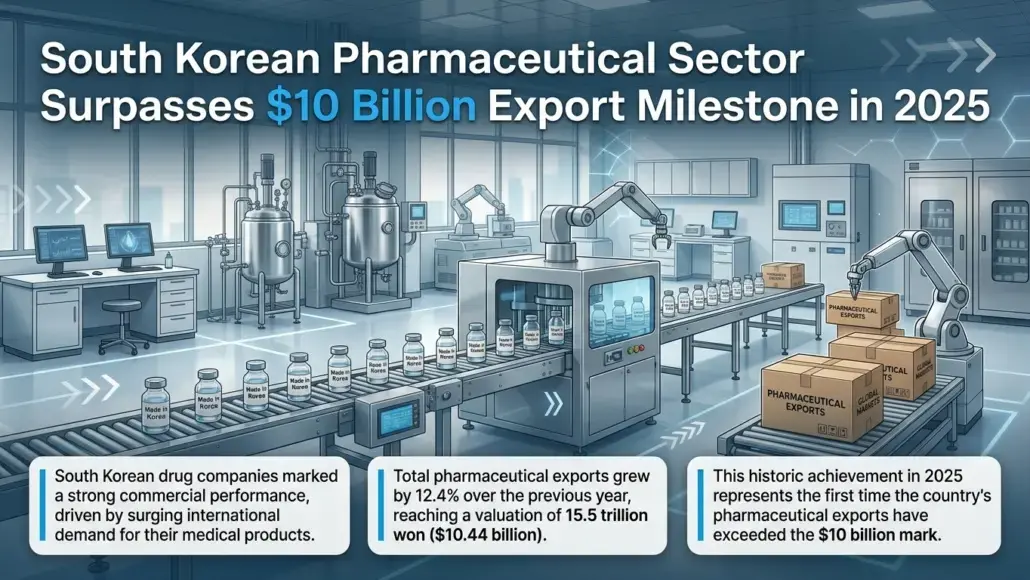
The South Korean pharmaceutical industry reached a significant commercial landmark in 2025, fueled by a sharp rise in international demand for drug exports and a high-performance year for domestic manufacturers. According to official data released by the Ministry of Food and Drug Safety, the nation’s medical exports increased by 12.4 percent year-over-year, totaling 15.5 trillion won ($10.44 billion). This achievement marks the first time the industry has exceeded the $10 billion threshold in outbound shipments.
This surge in international trade, paired with an 8.93 billion dollar import figure, representing a 5.9 percent increase, resulted in a record-high drug trade surplus of 1.51 billion dollars. The growth in Korea drug exports occurred alongside peak activity within the country.
Total pharmaceutical production climbed to 33.85 trillion won, representing the highest volume recorded since the government began tracking industry data in 1998. The overall domestic market value also saw a slight expansion of 0.03 percent, reaching a total of 31.71 trillion won.
Biopharmaceutical Sector Drives International Trade Success
At the center of this industrial momentum is the highly competitive biopharmaceutical sector, which has established the nation as a global center for biosimilar manufacturing and contract development operations. Biopharmaceutical exports reached a record 7.64 billion dollars, accounting for approximately 73 percent of all outbound drug shipments. On the manufacturing side, biopharmaceutical production rose 11.2 percent compared to 2024, reaching a record 7.02 trillion won. This rally was primarily led by recombinant protein drugs and botulinum toxin products.
The rapid expansion of the industry was further evidenced by individual corporate achievements. Celltrion reached a production value of 3.23 trillion won, becoming the first Korean enterprise in the sector to surpass the 3 trillion won manufacturing milestone. A significant portion of this output was directed toward Western economies. The United States remained the primary market for these biologics, followed by Switzerland, Hungary, the Netherlands, and Germany.
Growth in Quasi-Drug Markets and Structural Economic Shifts
Beyond the core therapeutic segments, the domestic quasi-drug market, which includes everyday health products, grew by 4.9 percent in 2025. While the demand for face masks continued to decline, the sector was supported by steady sales of toothpaste and sanitary products. The sustained Korea drug export growth and high levels of pharmaceutical production indicate a robust period for the industry.
Ministry officials observed that the metrics for the year indicate a permanent structural shift toward high-value biopharmaceutical exports. The current data reflects a deeply established level of global competitiveness in biosimilar manufacturing that is increasingly influencing the nation’s export-reliant economy.
