














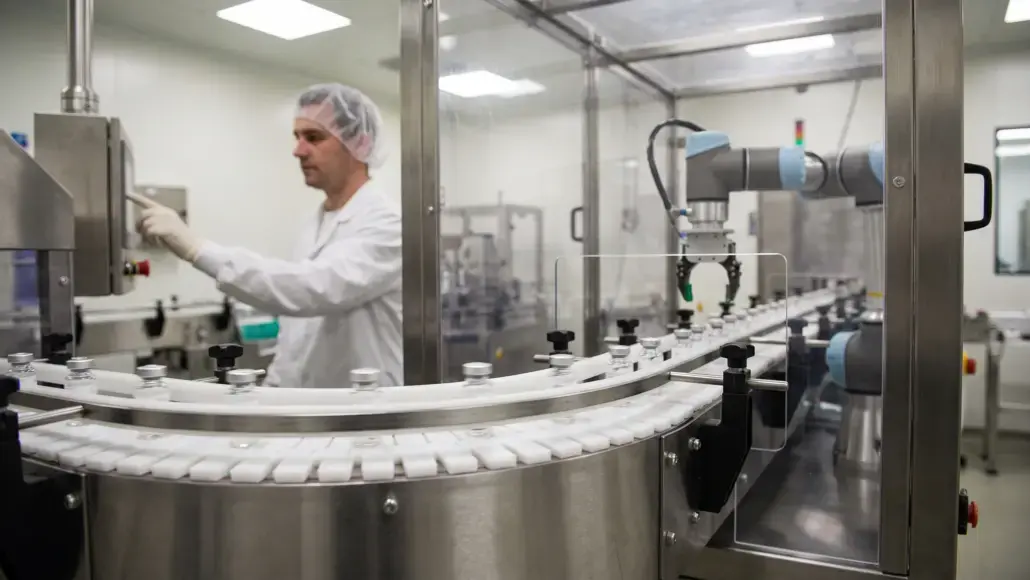
Pharmaceutical manufacturers face a critical operational challenge in maintaining precise product positioning while achieving the high-speed throughput demanded by modern schedules. Precision link conveyors have emerged as essential automation tools for pharmaceutical production, delivering repeatable accuracy while supporting continuous operation across filling, inspection, labeling and packaging stages.
Advanced conveyor systems enable facilities to meet stringent regulatory requirements while minimizing waste, reducing contamination risk and optimizing efficiency.
The Critical Role of Precision in Pharmaceutical Automation
Standard belt conveyor systems differ fundamentally from precision link conveyors, which use rigid, linked chain construction. This mechanical design enables exact, repeatable movement with positional accuracy of ±0.08 mm or better. Manufacturing operations performed directly on the conveyor line depend on this level of precision to ensure products arrive at each production stage in the exact positions required for filling, capping, labeling, inspection and packaging.
Even minor positioning errors can trigger product rejections, production delays, increased waste and higher operating costs. Accurate product spacing allows robotic systems, vision inspection cameras and automated packaging equipment to operate consistently at high speeds without interruptions.
Precision handling becomes especially critical for delicate pharmaceutical products such as vials, syringes, ampoules, blister packs and medical devices that require smooth, controlled movement throughout production cycles. Reliable conveyor performance supports serialization, barcode scanning and product traceability systems that help manufacturers meet stringent FDA and GMP regulatory requirements. High-precision automation reduces manual intervention, improving overall efficiency and product quality.
Common Pain Points in Conveyor System Selection
Engineers evaluating conveyor systems for pharmaceutical applications frequently encounter several operational challenges that can compromise production efficiency and product quality.
Inconsistent Product Positioning
Products that shift, rotate or become unevenly spaced during transport create significant problems for downstream equipment. These positioning errors cause filling, labeling, inspection and packaging equipment to misalign or reject products, resulting in reduced throughput and increased waste.
Frequent Downtime
Belt tracking issues, component wear, mechanical failures and difficult maintenance procedures can bring entire production lines to unexpected halts. Unplanned downtime disrupts production schedules and reduces overall equipment effectiveness.
Sanitation Challenges
Conveyor systems with hard-to-clean components or complex designs complicate cleaning procedures. Maintaining hygienic pharmaceutical environments becomes more difficult when equipment is difficult to access or cannot be easily sanitized to meet strict contamination control standards.
Limited Flexibility
Older or fixed conveyor systems often require expensive modifications when manufacturers introduce new products, packaging formats or production processes. Rigid configurations create barriers to adapting production lines for changing market demands.
Integration Difficulties
Some conveyor systems struggle to communicate effectively with robotics, vision systems, serialization equipment and other automated technologies. Poor integration capabilities limit the effectiveness of coordinated automation workflows.
Product Damage and Quality Concerns
Poor conveyor design or excessive vibration can damage fragile pharmaceutical containers or packaging. These issues lead to quality concerns, material waste and potential regulatory compliance problems.
Scalability Limitations
Manufacturers experiencing production growth often discover that legacy conveyor systems cannot accommodate higher speeds or increased volumes without significant upgrades. Limited scalability forces costly system replacements rather than incremental improvements.
Evaluation Criteria for Conveyor Manufacturers
The following manufacturers can meet pharmaceutical production requirements, including clean room environments, positional accuracy specifications, system reliability and uptime performance. They also offer customization options for unique production needs and integration capabilities with existing automation infrastructure.
Best Precision Link Conveyor Systems for the Medical Industry
Selecting the right precision link conveyors for pharmaceutical production requires careful evaluation of manufacturers specializing in high-accuracy automation systems for regulated environments.
1. Motion Index Drives
Motion Index Drives provides high-performance, custom-engineered indexing systems designed for demanding medical industry applications. The company delivers zero-backlash solutions that ensure high accuracy for production lines requiring precise positioning. Systems are built to withstand high loads and are customized to fit unique application requirements across various production environments.
Motion Index Drives designs precision indexing conveyors that provide repeatable product positioning for automated pharmaceutical production lines. The company offers custom automation solutions that integrate seamlessly with robotic systems, vision inspection equipment and high-speed packaging machinery.
Systems are engineered to maintain tight tolerances, supporting quality control processes and regulatory compliance requirements throughout production cycles.
The company provides modular conveyor configurations that can be adapted to evolving manufacturing requirements as production needs change. Motion Index Drives focuses on reliable, low-maintenance equipment that minimizes downtime in continuous production environments.
This approach supports different operational needs, recognizing that some pharmaceutical processes require precise control at slower speeds while others demand high-speed throughput.
Key features:
- Precision indexing technology: Zero backlash design ensures exact positioning for critical pharmaceutical processes
- Custom automation solutions: Tailored systems designed to meet specific production requirements
- High positional accuracy: Tight tolerances support quality control and regulatory standards
- Robotic and vision system integration: Seamless compatibility with automated inspection and handling equipment
- Modular conveyor designs: Adaptable configurations accommodate changing production needs
2. Montech
Montech develops innovative conveyor systems and transfer solutions designed to improve efficiency, flexibility and precision across pharmaceutical manufacturing and packaging operations. The company manufactures aluminum conveyor systems suitable for clean, controlled production environments where contamination prevention is essential.
Montech offers standardized modular components that allow production lines to be expanded or reconfigured with minimal disruption to ongoing operations. The company specializes in precision transfer systems that ensure the smooth handling of delicate pharmaceutical products throughout production.
Automation components integrate seamlessly with robotic cells and packaging equipment, supporting coordinated production workflows. The company focuses on energy-efficient conveyor designs that help reduce operating costs while maintaining performance standards required for pharmaceutical applications.
Key features:
- Modular aluminum conveyor systems: Standardized components enable flexible production line configurations
- Precision transfer technology: Smooth product handling protects delicate pharmaceutical items
- Clean room-friendly designs: Aluminum construction suits controlled pharmaceutical environments
- Energy-efficient operation: Reduced power consumption lowers operational expenses
- Easy automation integration: Compatible with robotic systems and packaging equipment
3. Industrial Conveyor & Automation
Industrial Conveyor & Automation provides custom conveyor systems and turnkey automation solutions for manufacturers requiring reliable product movement and efficient production workflows, including pharmaceutical applications. The company designs custom conveyor systems tailored to pharmaceutical packaging, inspection and material-handling processes specific to each facility’s operational requirements.
Industrial Conveyor & Automation offers complete automation integration, including conveyors, controls, robotics and end-of-line equipment that work together as coordinated systems. Engineers develop systems to maximize throughput while maintaining consistent product handling and positioning throughout production cycles.
The company provides project management, installation services and ongoing technical support throughout the equipment life cycle. Industrial Conveyor & Automation develops scalable conveyor solutions that can grow as pharmaceutical production operations expand.
Key features:
- Custom-engineered conveyor systems: Tailored designs address specific pharmaceutical production needs
- Turnkey automation integration: Complete solutions including controls, robotics and end-of-line equipment
- Packaging and material handling expertise: Specialized knowledge of pharmaceutical production workflows
- Scalable production solutions: Systems designed to accommodate future growth and capacity increases
- Installation and ongoing support: Comprehensive project management and technical assistance
Feature Comparison of Leading Conveyor Systems
The following table summarizes each manufacturer’s core strengths and ideal applications to help engineers quickly assess which solution best aligns with their facility’s specific requirements.
| Manufacturer | Core Strength | Ideal Application |
| Motion Index Drives | Extreme precision and customization | Complex, high-accuracy pharmaceutical automation requiring zero backlash |
| Montech | Modular flexibility and clean room compatibility | Flexible production lines requiring frequent reconfiguration |
| Industrial Conveyor & Automation | Turnkey integration and scalability | Complete system installations with long-term growth requirements |
Selecting the Right Automation Partner for Your Facility
The optimal precision link conveyor system depends entirely on specific project requirements rather than a single universal solution. Facilities requiring extreme positional accuracy may prioritize zero backlash indexing technology, while operations emphasizing clean room compatibility may benefit from modular aluminum systems.
Manufacturers should evaluate their production lines’ primary pain points, whether positioning accuracy, reconfiguration flexibility or scalability for future growth, before making final decisions.
