







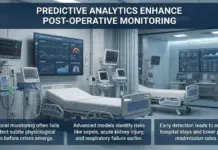















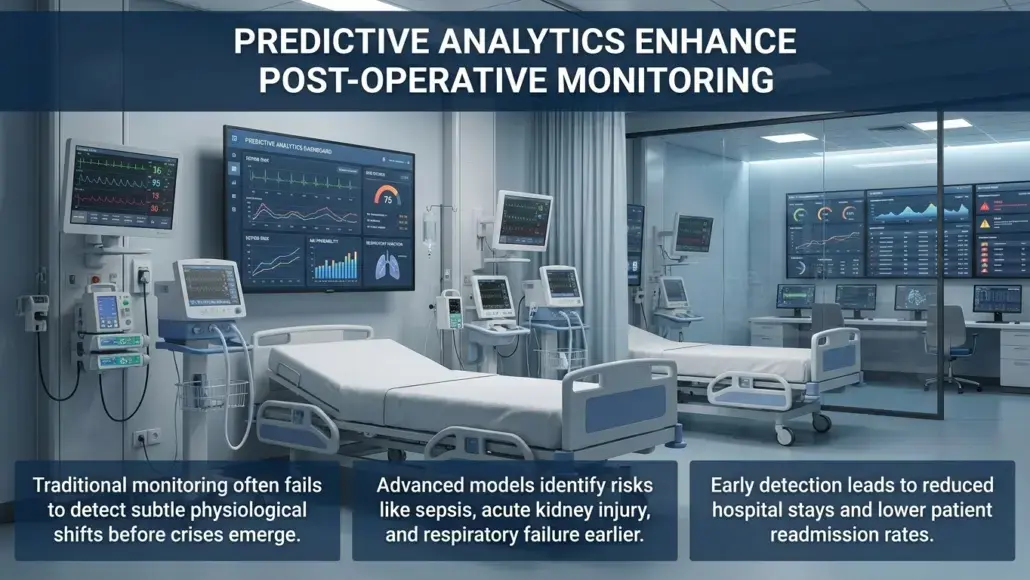
The period following a surgical procedure is one of the most vulnerable stages in a patient’s healthcare journey. Complications such as sepsis, acute kidney injury, and respiratory failure can emerge rapidly, often leading to prolonged hospital stays or readmissions if not detected early. Traditional post operative monitoring relies on periodic vital sign checks, which may fail to capture the subtle physiological shifts that precede a clinical crisis. Advanced predictive models for post operative care are transforming this landscape by providing continuous, real time analysis of patient data to identify high risk individuals before complications become life threatening.
In recent years, Pharma Advancement observes that the integration of these models into clinical workflows has reached a critical milestone, with many academic medical centers reporting significant improvements in patient safety. These AI driven systems analyze a wide range of inputs, including electronic health records, laboratory results, and real time data from wearable monitors. By identifying patterns that correlate with specific complications, these models provide clinicians with a proactive window for intervention. For hospitals, the implementation of these tools is not only a matter of patient care but also a strategic move to reduce the financial burden of surgical complications.
The Evolution of Post Operative Monitoring
Historically, post operative care has been largely reactive. When a patient’s condition deteriorates, the care team responds to the visible symptoms. However, many complications have a latent phase where physiological changes occur but are not yet obvious to the human observer. Advanced predictive models for post operative care aim to exploit this window. By using machine learning to process high frequency data, these systems can detect trends that would be invisible in a standard patient chart.
For instance, a subtle but persistent increase in heart rate combined with a slight decrease in urine output might indicate the early stages of sepsis. A human clinician might see these as isolated fluctuations, but an AI model can recognize them as a collective signature of impending shock. Studies have shown that predictive models can identify sepsis up to 12 hours earlier than traditional methods, allowing for the timely administration of fluids and antibiotics. This early intervention is critical, as every hour of delay in treating sepsis increases the risk of mortality by significant percentages.
Furthermore, these models are becoming increasingly specialized. There are now specific algorithms for different types of surgery, such as cardiac, orthopedic, and gastrointestinal procedures. This specificity allows the model to account for the unique risks associated with each surgery type. For example, a model for cardiac surgery might focus heavily on hemodynamic stability, while a model for gastrointestinal surgery might prioritize signs of anastomotic leak or bowel obstruction. This tailored approach ensures that the alerts generated are highly relevant and actionable for the surgical team.
Reducing Readmissions and Enhancing Recovery
Hospital readmissions after surgery are a major indicator of care quality and a significant driver of healthcare costs. Many readmissions are due to complications that were either not detected before discharge or were not managed effectively at home. Advanced predictive models for post operative care are playing a central role in Enhanced Recovery After Surgery (ERAS) protocols by identifying which patients are at the highest risk for readmission. This allows hospitals to target their post discharge support, such as home health visits or remote monitoring, to those who need it most.

By analyzing pre operative risk factors, intra operative data, and post operative recovery patterns, these models can generate a readmission risk score for every patient. Patients with high scores can be kept in the hospital for additional observation or provided with more intensive follow up care. This proactive management has been shown to reduce surgical readmission rates by up to 20 percent. The ability to predict surgical outcomes is a significant component of precision care models powered by machine learning, ensuring that every patient receives a tailored recovery plan. For patients, this means a smoother recovery and a lower likelihood of returning to the hospital for an emergency.
The data generated by these models also provides valuable feedback for surgical teams. By analyzing which pre operative factors are most predictive of poor outcomes, surgeons can refine their patient selection and pre habilitation strategies. For example, if the data shows that patients with poorly controlled diabetes are at much higher risk for surgical site infections, the team can focus on optimizing blood sugar levels before proceeding with elective surgery. This data driven approach to surgical planning is a key component of the move toward value based care.
The Role of Wearable Technology and Remote Monitoring
A significant driver of the advancement in predictive models is the proliferation of medical grade wearable devices. These tools allow for continuous monitoring of vital signs such as heart rate, oxygen saturation, and respiratory rate, even after the patient has left the surgical ward. The data from these devices is fed directly into advanced predictive models for post operative care, providing a continuous stream of information that allows for hospital at home models of care.
Wearables are particularly effective for monitoring patients who have undergone major surgery but are otherwise healthy. Instead of staying in the hospital for several days for observation, these patients can be safely discharged to their homes with a wearable device. If the predictive model detects a potential complication, it can automatically alert the hospital’s rapid response team, who can then intervene via telehealth or direct the patient to return to the hospital. This not only improves the patient experience but also frees up hospital beds for higher acuity cases.
However, the use of wearables also introduces new challenges, particularly around data volume and alert fatigue. These devices generate millions of data points every day, which can overwhelm clinicians if not managed properly. The predictive model serves as an essential filter, analyzing the raw data and only generating alerts when there is a meaningful change in the patient’s risk profile. Executives must ensure that their monitoring systems are designed with the clinician workflow in mind, ensuring that the technology supports rather than complicates the delivery of care.
Data Governance and Ethical Considerations
The implementation of advanced predictive models for post operative care requires a robust data governance framework. These models rely on large datasets to learn and improve, raising important questions about data privacy and ownership. Hospitals must ensure that patient data is handled securely and in compliance with global regulations. This includes not just the data used to train the models but also the real time data used to monitor patients.

Transparency and explainability are also critical. For a clinician to trust an AI generated alert, they need to understand why the model reached that conclusion. Black box algorithms, where the logic is hidden, are increasingly being replaced by explainable AI that provides a clear rationale for its predictions. This allows the clinician to use their professional judgment to validate the alert and determine the best course of action. Promoting transparency is essential for building the trust needed for widespread adoption of these tools.
Finally, there is the issue of algorithmic bias. If a model is trained on a dataset that is not representative of the patient population, it may provide inaccurate predictions for certain groups. For example, a model trained primarily on data from younger patients may not accurately predict outcomes for elderly individuals. Hospitals must actively monitor their models for bias and ensure that they are providing equitable care for all patients. This requires continuous validation and the inclusion of diverse datasets in the training process.
Global Leaders Spearheading Predictive Post-Operative Surveillance and Intelligent Perioperative Platforms
Commercial advancements in post-operative care and continuous clinical monitoring are driven by major global medical technology enterprises establishing proactive, data-integrated ecosystems. Royal Philips expanded decentralized surveillance by partnering with smartQare to deploy wearable biosensors for seamless monitoring both on general recovery wards and post-discharge, while Masimo secured FDA 510(k) clearance to integrate its W1 medical watch with the SafetyNet platform for continuous physiological tracking across ambulatory and home-recovery environments.
Concurrently, Baxter International launched the Welch Allyn Connex 360 monitor paired with its DeviceBridge architecture to rapidly detect latent physiological deterioration and automate EMR delivery, and GE HealthCare rolled out its CareIntellect AI suite to forecast acute capacity constraints and clinical discharge pathways up to 72 hours in advance. Supporting the operative phase of this continuum, Medtronic introduced the Touch Surgery Aide computing platform to run real-time artificial intelligence algorithms within the operating room, illustrating how continuous sensing, cloud infrastructure, and predictive machine learning are uniting to mitigate post-surgical complications and prevent avoidable hospital readmissions.
Strategic Implementation for Healthcare Leaders
For healthcare executives, the adoption of advanced predictive models for post operative care is a strategic investment in the future of surgical services. Success requires a multidisciplinary approach that involves surgeons, nurses, IT specialists, and data scientists. The goal should be to integrate these models into the existing clinical workflow, ensuring that the insights provided are used to drive real time decision making.
Investment in infrastructure is also necessary. Hospitals need robust data integration platforms that can handle the flow of information from disparate sources. They also need to invest in training for their clinical staff, helping them understand how to interpret AI generated insights and use them to enhance patient care. The focus should be on creating a culture of data driven excellence, where every member of the surgical team is empowered by the latest predictive tools.
In the long run, Pharma Advancement believes that the use of these models will lead to a more predictable and safe surgical environment. The ability to anticipate and prevent complications will improve patient outcomes, reduce costs, and enhance the reputation of the surgical program. For health systems that successfully navigate this transition, the rewards will be significant, both in terms of clinical excellence and financial sustainability. The future of post operative care is predictive, and the journey is just beginning.
References
- World Health Organization
- FDA
- Royal Philips
- Masimo
- Baxter International
- GE HealthCare
- Medtronic
