

























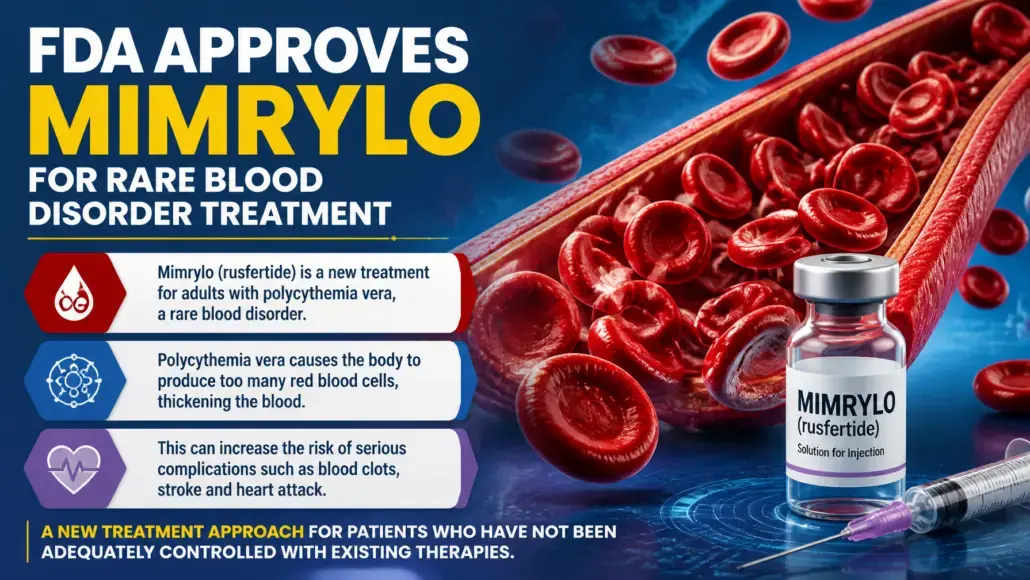
The U.S. Food and Drug Administration (FDA) approved Mimrylo (rusfertide), a new treatment for adults with polycythemia vera, a rare blood disorder in which the body produces excessive amounts of red blood cells. This overproduction can make the blood thicker and raise the likelihood of cardiovascular complications, including blood clots, stroke and heart attack.
Mimrylo provides a new treatment approach for patients whose polycythemia vera has not been adequately controlled through existing therapies. The medicine is the first approved treatment for polycythemia vera designed to mimic hepcidin, a hormone that naturally regulates iron in the body. By restricting the amount of iron available for producing new red blood cells, Mimrylo is intended to reduce their overproduction and help maintain red blood cell levels under control. The treatment therefore gives patients whose disease remains inadequately controlled with existing therapies another option.
“People living with polycythemia vera have long faced the challenge of managing a chronic blood disorder with frequent blood draws to help address the consequences of the red blood cell overproduction,” said Tanya Wroblewski, M.D., Director of the Division of Nonmalignant Hematology within the FDA’s Center for Drug Evaluation and Research.
“Today’s approval of Mimrylo offers a new, first-in-class option that has the potential to meaningfully reduce patient burden,” she added.
A central objective in treating polycythemia vera is maintaining the proportion of red blood cells in the blood, known as hematocrit, below 45% in order to lower cardiovascular risks. Phlebotomy is frequently used to achieve this goal. The procedure removes blood from a vein to reduce the number of red blood cells in the body. For some patients, however, treatment does not prevent the need for repeated phlebotomies, leaving them with an ongoing treatment burden associated with the rare blood disorder.
VERIFY Trial Evaluates Safety and Efficacy
Phase 3 Study Shows Reduced Need for Phlebotomy
The safety and efficacy of Mimrylo were assessed through the VERIFY trial, a multicenter, randomized, double-blind, placebo-controlled phase 3 study involving 293 adults with polycythemia vera. Participants in the trial required frequent phlebotomies despite continuing standard-of-care therapy. They were randomized 1:1 to receive either Mimrylo or placebo over a 32-week period. Treatment with Mimrylo began at 19 mg and was administered subcutaneously (under the skin) once weekly. The dose was then titrated with the objective of maintaining hematocrit levels below 45%.
The trial measured efficacy according to the proportion of patients who did not meet the criteria for phlebotomy between weeks 20 and 32 of the study. During the 32-week period, 76.9% of patients receiving Mimrylo did not require any phlebotomies, compared with 32.9% of patients who received placebo. The most common adverse reactions reported with Mimrylo were injection site reactions and anemia.
Mimrylo received priority review, with the approval granted to Takeda Pharmaceuticals America, Inc.
