



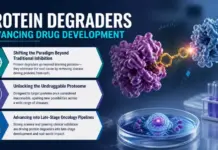
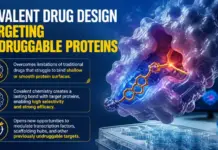
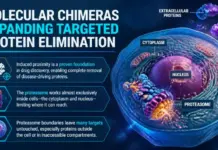







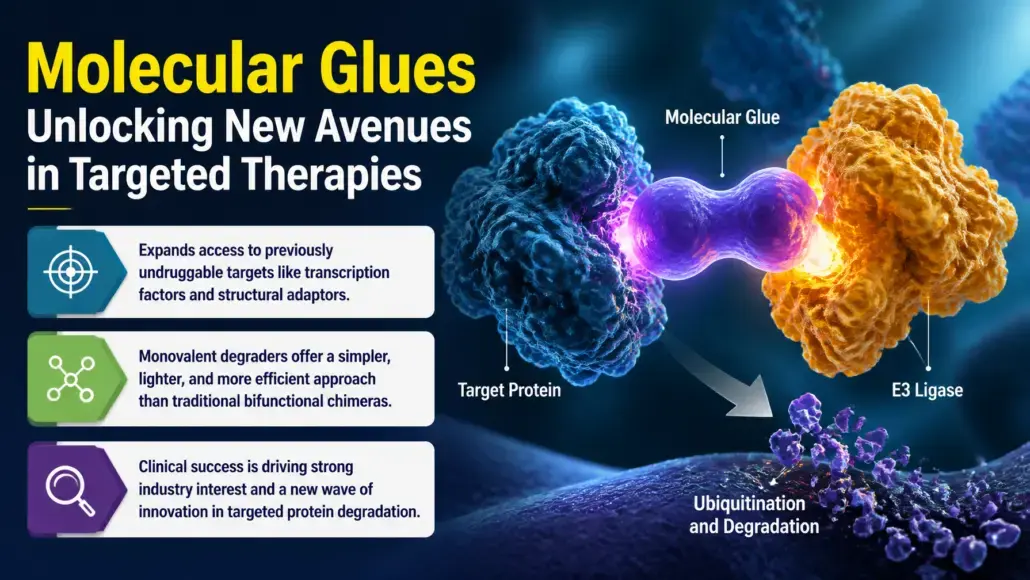
The clinical validation of monovalent protein degraders has ignited unprecedented commercial enthusiasm across the pharmaceutical industry. For decades, drug hunters struggled with targets that lacked conventional ligand-binding pockets, categorizing non-enzymatic transcription factors and structural adaptors as permanently undruggable. While bifunctional chimeras proved that induced proximity could destroy disease proteins, their high molecular weight and intricate linker chemistry frequently complicated drug development.
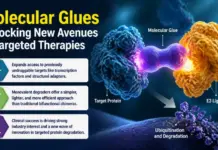
Pharma Advancement observes that molecular glues offer an elegant biological solution to this structural dilemma. Rather than tethering two distinct binding moieties with a synthetic linker, a molecular glue is a compact small molecule that directly modifies the surface topology of an E3 ubiquitin ligase or a target protein. This subtle chemical modification creates a composite, neo-substrate interface that forces two proteins to interact where no natural affinity previously existed.
Once formed, this induced ternary complex triggers the polyubiquitination and proteasomal degradation of the target protein. Because these molecules operate within conventional small-molecule property space, molecular glues unlocking new opportunities in targeted therapies are redefining how drug discovery teams approach intracellular targets across oncology, immunology, and rare diseases.
Structural Mechanics of Induced Proximity
The operational elegance of molecular glues lies in their ability to generate high-affinity protein interfaces using small, drug-like scaffolds. In a typical mechanism, the glue molecule binds within a shallow pocket on an E3 ligase, altering its surface contours and electrostatic properties. This altered surface accommodates a complementary recognition motif on a target protein, inducing rapid ubiquitin transfer.
Unlike traditional occupancy-based therapeutics, molecular glues do not depend on existing active sites. Instead, they exploit latent protein-protein interaction surfaces:
- Monovalent molecular weights typically fall below 500 Daltons, preserving standard oral absorption, cellular permeability, and metabolic stability profiles.
- Cooperative binding energetics stabilize the ligase-substrate complex, allowing potent target degradation even when the glue possesses negligible measurable affinity for the isolated target protein.
- Substrate selectivity is driven by the quaternary geometry of the ternary complex rather than target binding affinity alone, allowing remarkable discrimination between highly homologous protein isoforms.
- Catalytic turnover permits substoichiometric dosing, minimizing systemic chemical exposure while driving sustained target clearance.
These biophysical advantages make molecular glues exceptionally attractive for oral dosing regimens. Because they do not carry the conformational flexibility or metabolic liabilities of long chemical linkers, formulation teams can develop standard solid oral dosage forms using conventional manufacturing infrastructure.
Clinical Milestones from Global Biopharmaceutical Leaders
The commercial maturity of molecular glues is evident across recent late-stage clinical programs and multi-billion-dollar portfolio expansions undertaken by major pharmaceutical corporations.
Bristol Myers Squibb remains at the forefront of clinical-stage molecular glue therapeutics through its expanding portfolio of cereblon E3 ligase modulators. In 2025 and 2026, the company reported pivotal clinical progress with mezigdomide and iberdomide across relapsed or refractory hematologic malignancies. The Phase 3 SUCCESSOR-2 trial confirmed that mezigdomide significantly improved progression-free survival in patients with relapsed multiple myeloma who had exhausted prior proteasome inhibitors, monoclonal antibodies, and earlier immunomodulatory drugs. Bristol Myers Squibb also advanced golcadomide, a selective cereblon-based glue targeting IKZF1 and IKZF3, into global Phase 3 evaluation for aggressive lymphomas, validating monovalent degradation as a core therapeutic pillar in oncology.
Novartis executed a decisive strategic expansion into non-oncology molecular glues by establishing an exclusive worldwide license agreement with Monte Rosa Therapeutics. Under the agreement, Novartis committed 150 million dollars in upfront cash and up to 2.1 billion dollars in development, regulatory, and sales milestones to advance VAV1-directed molecular glue degraders. In 2025, the candidate MRT-6160 entered clinical development for multiple autoimmune diseases, including rheumatoid arthritis and inflammatory bowel disease. By selectively degrading VAV1, a key signaling node in both T-cell and B-cell receptor activation, the molecule selectively dampens pathogenic autoimmune responses without causing broad systemic immunosuppression.
Roche, through its Genentech research arm, broadened its internal molecular glue discovery engine in 2025 through expanded collaborative initiatives focused on neo-substrate degradation in oncology. Genentech researchers deployed high-throughput phenotypic screening combined with quantitative proteomics to identify glue molecules that recruit alternative cullin-RING E3 ligase complexes, moving beyond classical cereblon dependence.
Takeda entered into multiple discovery partnerships to accelerate molecular glue drug development across neurodegenerative conditions and gastrointestinal indications. By screening chemically diverse glue libraries against previously refractory central nervous system targets, Takeda aims to degrade misfolded protein species that accumulate in neurodegenerative disorders.
Sanofi expanded its internal targeted protein degradation efforts by directing chemistry platforms toward molecular glues capable of modulating transcription factor complexes in solid tumors. Sanofi scientific teams are applying cryogenic electron microscopy to map transient glue-ligase-substrate interactions, allowing computational chemists to optimize neo-substrate selectivity prior to in vivo testing.
Expanding Therapeutic Boundaries Beyond Oncology
While initial clinical successes focused on hematologic cancers, the biopharmaceutical sector is directing molecular glues toward wider disease categories where target modulation has historically failed.
Autoimmune and inflammatory disorders represent the most immediate commercial expansion zone. Traditional biologics targeting extracellular cytokines, such as TNF-alpha and interleukin inhibitors, face therapeutic ceilings because they cannot enter cells to block intracellular transcriptional networks. Molecular glues cross the plasma membrane effortlessly, enabling the selective degradation of intracellular signaling adaptors, kinases, and transcription factors that sustain chronic inflammation.
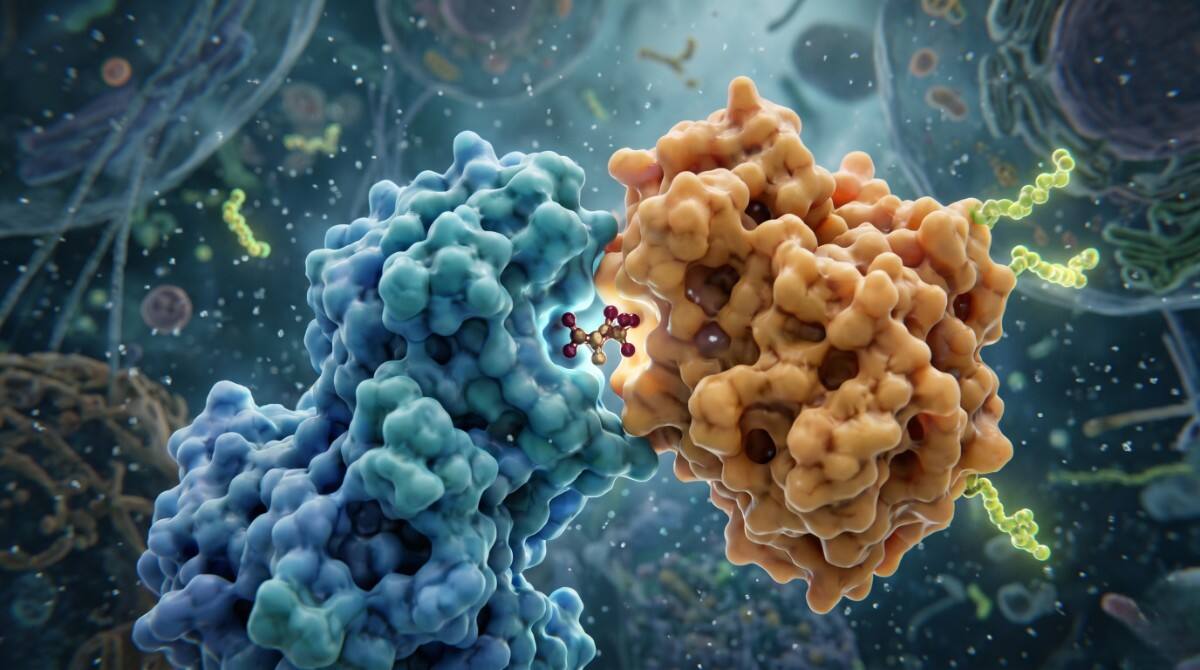
Central nervous system pharmacology represents another major beneficiary of molecular glue architectures. The low molecular weight and balanced lipophilicity of monovalent glues facilitate transit across the blood-brain barrier, a feat that remains exceptionally difficult for bulky heterobifunctional degraders. Global pharmaceutical teams are designing brain-penetrant glues to degrade toxic intracellular aggregates, including mutant huntingtin and pathological tau fragments, offering a potential path forward for neurodegenerative therapies.
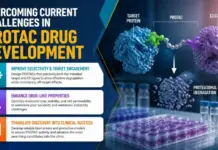
Despite the structural compactness of monovalent degraders, many complex multi-domain oncoproteins lack the surface topologies necessary for cooperative glue engagement, leaving bifunctional architectures indispensable. Achieving predictable therapeutic windows with these larger molecules remains a rigorous bioengineering task, centering on overcoming challenges in PROTAC drug development through rational linker design, ternary complex optimization, and improved cellular permeability.
Rational Discovery and Industrial Screening Engines
Historically, molecular glues were discovered through serendipity rather than deliberate chemical design. The original immunomodulatory drugs thalidomide, lenalidomide, and pomalidomide were used clinically for years before molecular biologists discovered that their therapeutic mechanism relied on cereblon recruitment and subsequent neo-substrate degradation.
Today, global pharmaceutical companies have transformed molecular glue discovery into a systematic, rational discipline:
- High-throughput biophysical screens interrogate massive chemical libraries against E3 ligases in the presence of candidate target proteins to identify cooperative binding events.
- Quantitative mass spectrometry proteomics profiles proteome-wide degradation kinetics, mapping target selectivity and identifying off-target neo-substrates across living cell lines within hours.
- Cryogenic electron microscopy and X-ray crystallography resolve ternary complex structures at atomic resolution, allowing medicinal chemists to guide structure-activity relationships rationally.
- Generative artificial intelligence and molecular dynamics simulations predict which small molecule scaffolds will induce favorable interface interactions between ligases and target surfaces.
These rational discovery engines have dramatically compressed lead optimization timelines. Drug discovery programs that once required five years to identify a validated chemical lead are now producing development candidates within eighteen to twenty-four months.
Commercial Trajectory and Manufacturing Considerations
The commercial outlook for molecular glues reflects strong institutional investment. Industry analyses estimate that the global molecular glue market will expand at a compound annual growth rate exceeding twenty-two percent through 2032, driven by first-in-class launches across solid tumors and autoimmune indications.
From a manufacturing perspective, molecular glues present substantial advantages over complex biologics and large chimeric molecules. Because they are synthesized via standard multi-step small-molecule chemical routes, production processes scale reliably in existing commercial chemical plants. Drug substance batches achieve high purity profiles without requiring specialized high-potency isolation suites or complex solid-phase synthetic steps.
As clinical datasets demonstrate durable efficacy and clean safety profiles in Phase 3 trials, molecular glues unlocking new opportunities in targeted therapies are cementing their position as one of the most versatile modalities in contemporary drug development. By transforming how intracellular proteins are recognized and destroyed, these compact molecules are delivering therapeutic answers for diseases that have resisted treatment for generations.
References
- “Bristol Myers Squibb to Unveil New Data at ASCO 2026 Demonstrating Strength and Breadth of Scientific Innovation Across Oncology Portfolio” – Bristol Myers Squibb
- “Novartis Pays Fifty Million Dollar Milestone as MRT-6160 Enters Phase 1 Clinical Development for Autoimmune Diseases” – Novartis
- “Roche Pipeline Update and Global Development Review 2025” – Roche
- “Takeda Strategic Research Alliances in Targeted Degradation and Molecular Glues” – Takeda
- “Targeted Protein Degradation Market Growth and Therapeutic Analysis Report 2025-2035” – Research Nester
