

























For much of the past two decades, menopause sat at the margins of pharmaceutical development. Almost every woman who reaches midlife goes through it, and many live with symptoms that disrupt sleep, work and wellbeing for years. Yet the pipeline stayed thin, clinical confidence in existing options was shaky, and investors largely looked elsewhere. That is changing. A clearer understanding of menopause hormonal pathways, particularly the neuroendocrine circuits that govern body temperature, has produced the first genuinely new mechanisms in years and prompted a fresh look at how hormone therapy itself can be refined.
Pharma Advancement notes that the field now supports two parallel strategies for menopause treatment. One targets the brain directly with non-hormonal therapies. The other modernises estrogen-based care through better formulations, better patient selection and new molecules. Developers, investors and clinical researchers assessing the market need to understand both.
Why a Large Market Stayed Underserved for So Long
The turning point most clinicians still cite is 2002, when early results from the Women’s Health Initiative linked combined estrogen-progestin therapy to higher risks of breast cancer, stroke and cardiovascular events. Prescribing fell sharply, and a generation of physicians trained with deep caution about hormones. Later analyses showed that age and time since menopause strongly shape the balance of risk and benefit, but the reputational damage lasted.
With hormone therapy under a cloud and few alternatives available, many women managed symptoms alone or went untreated. Research funding and commercial interest followed the same downward curve, leaving a wide gap between the burden of vasomotor symptoms, sleep disruption, mood changes and genitourinary discomfort, and the care women actually received.
What Has Shifted in The Market
Several forces have converged. More women are working through perimenopause and beyond, and employers, patient advocates and policymakers have pushed menopause into public conversation. Women’s health has become a more visible investment theme. Most importantly, regulators have approved new mechanisms, giving the market a commercial proof of concept it previously lacked. Some regulators have also begun reassessing how class-wide safety warnings on hormone therapy are framed, which could influence prescribing confidence.

The Neuroendocrine Science Behind Hot Flashes
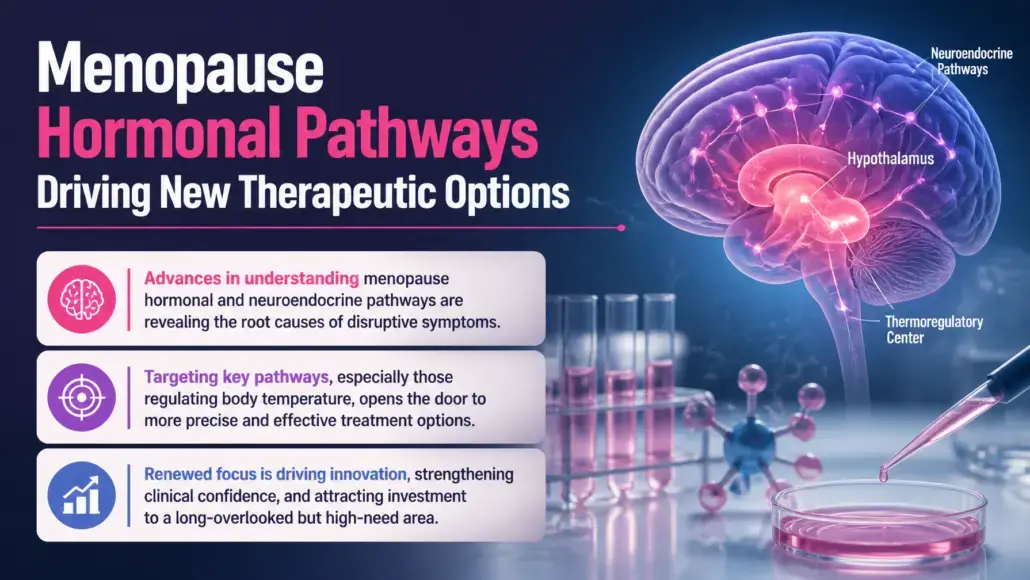
The most consequential advance in hormonal pathway research came from neuroscience rather than gynaecology. Researchers traced hot flashes to a group of hypothalamic neurons known as KNDy neurons, named for the three signalling molecules they produce: kisspeptin, neurokinin B and dynorphin.
How Falling Estrogen Disrupts Thermoregulation
Estrogen normally helps restrain these neurons. As levels decline during the menopausal transition, KNDy neurons become overactive and increase neurokinin B signalling to the brain’s thermoregulatory centre. The body effectively misreads its own temperature and triggers flushing and sweating when no cooling is needed.
From Mechanism to Drug Target
Because neurokinin B acts through the neurokinin 3 (NK3) receptor, blocking that receptor offered a way to quieten the circuit without replacing estrogen. Instead of restoring a hormone throughout the body, developers could intervene at the specific node responsible for the symptom. Open questions remain, including why severity varies so widely between women, how these circuits interact with sleep and mood regulation, and what years of neurokinin modulation mean for long-term safety.
Non-Hormonal Therapies Move From Concept to Clinic
Fezolinetant, a selective NK3 receptor antagonist, became the first therapy built on this mechanism when US regulators approved it in 2023 for moderate to severe vasomotor symptoms. Elinzanetant, which blocks both NK1 and NK3 receptors, has since been approved in several markets, and its development programme has also examined menopause-related sleep disturbance.
Who Stands to Benefit
The clearest beneficiaries are women for whom hormone therapy is unsuitable, including some with a history of hormone-sensitive cancer or elevated thrombotic risk, as well as those who prefer to avoid hormones. This group has long relied on repurposed options: certain antidepressants, one low-dose formulation of which is approved for vasomotor symptoms in the United States, and gabapentin used off-label. These agents help some patients but carry their own side effects, and new non-hormonal therapies are increasingly judged against them.
Safety Under Scrutiny
New mechanisms bring new safety questions. US regulators have added a warning about rare but serious liver injury with fezolinetant and recommend liver blood tests before and during treatment. The episode shows how strongly post-marketing surveillance can shape a product’s label, positioning and prescriber confidence. Investors should treat post-launch safety data as a material factor, not a footnote.
Refining Hormone Therapy for a New Era
Non-hormonal options have not displaced hormone therapy; they have sharpened efforts to improve it. Menopause societies now emphasise that timing, dose, route of administration and individual risk all matter, and that for many healthy women who start treatment close to menopause the benefits can outweigh the risks.
Formulation and Delivery Innovation
Observational research associates transdermal estrogen, delivered by patch, gel or spray, with a lower risk of venous thromboembolism than oral estrogen, making the delivery route a lever for safety. Lower-dose regimens and localised vaginal therapies for genitourinary syndrome of menopause let clinicians treat specific symptoms with limited systemic exposure.
New Molecules and Tissue Selectivity
Researchers are also pursuing estrogens with different tissue profiles. Estetrol, an estrogen produced by the fetal liver during pregnancy, is being investigated for menopausal symptoms on the hypothesis that its distinctive receptor activity could improve the benefit-risk balance. Tissue-selective approaches that pair an estrogen with a selective estrogen receptor modulator aim to relieve symptoms while protecting the endometrium without a progestogen. Both reflect a broader goal: hormone therapy matched more precisely to the patient.
| Approach | Mechanism | Primary Target Population | Key Considerations |
|---|---|---|---|
| Selective NK3 antagonists | Block neurokinin B signalling in the hypothalamus | Moderate to severe vasomotor symptoms, including women avoiding hormones | Liver monitoring; long-term data still accumulating |
| Dual NK1/NK3 antagonists | Block two neurokinin receptors | Vasomotor symptoms, with interest in sleep effects | Newer to market; comparative data limited |
| Transdermal and low-dose estrogen | Systemic estrogen replacement via alternative routes or doses | Symptomatic women without contraindications | Individual risk assessment; timing of initiation |
| Localised vaginal therapies | Targeted treatment of genitourinary tissue | Genitourinary syndrome of menopause | Minimal systemic exposure; often underused |
| Novel and tissue-selective estrogens | Differentiated receptor activity or estrogen-SERM pairing | Patients seeking an improved benefit-risk profile | Evidence base varies by agent and market |
Beyond Hot Flashes: An Expanding Therapeutic Map
Vasomotor symptoms dominate current pipelines, but sleep disturbance, mood changes, cognitive complaints and metabolic shifts are attracting growing research interest. Longer-term questions about bone, cardiovascular and genitourinary health suggest that a deeper understanding of menopause hormonal pathways could eventually inform prevention as well as symptom relief.
The Endpoint Problem
Many of these symptoms are subjective, fluctuating and shaped by factors beyond hormones, which makes them hard to measure in trials. Defining endpoints that regulators accept and patients find meaningful is a central challenge for the next wave of development. Biomarker- or phenotype-guided approaches may help, though the evidence for precision strategies in menopause is still at an early stage.
Clinical Development and Regulatory Realities
Vasomotor trials are known for substantial placebo responses, which narrow the observable treatment effect and demand careful design and sizing. Endpoints typically combine hot flash frequency and severity, increasingly supported by patient-reported outcomes on sleep and quality of life.

Recruitment matters too. Ethnicity, body mass index and natural versus surgical menopause can all influence symptoms and treatment response, so representative trial populations strengthen both regulatory submissions and payer arguments. Because these therapies may be taken for years, regulators expect robust long-term safety data, and payers will want comparative effectiveness and health economic evidence, particularly against low-cost generic hormone therapy.
What Developers and Investors Should Watch
Competition in the neurokinin class is set to intensify as more candidates advance, while next-generation hormonal products seek to rebuild confidence in estrogen-based care. Efficacy alone will not decide the winners. Clinician education remains a significant hurdle, and pricing branded products against generics will test reimbursement strategies in every major market. Partnership and licensing activity between large pharmaceutical companies and specialist women’s health firms is also worth tracking.
The most useful near-term signals will be late-stage trial readouts, emerging safety findings for marketed products, updated guidance from menopause societies and payer coverage decisions.
Pharma Advancement observes that the science has given menopause treatment something it lacked for years: credible, mechanism-driven options on both the hormonal and non-hormonal fronts. For an area long defined by unmet need, that is a substantial opportunity, and it will reward organisations willing to invest in rigorous evidence, careful positioning and genuine engagement with the women these therapies are meant to serve.
