



























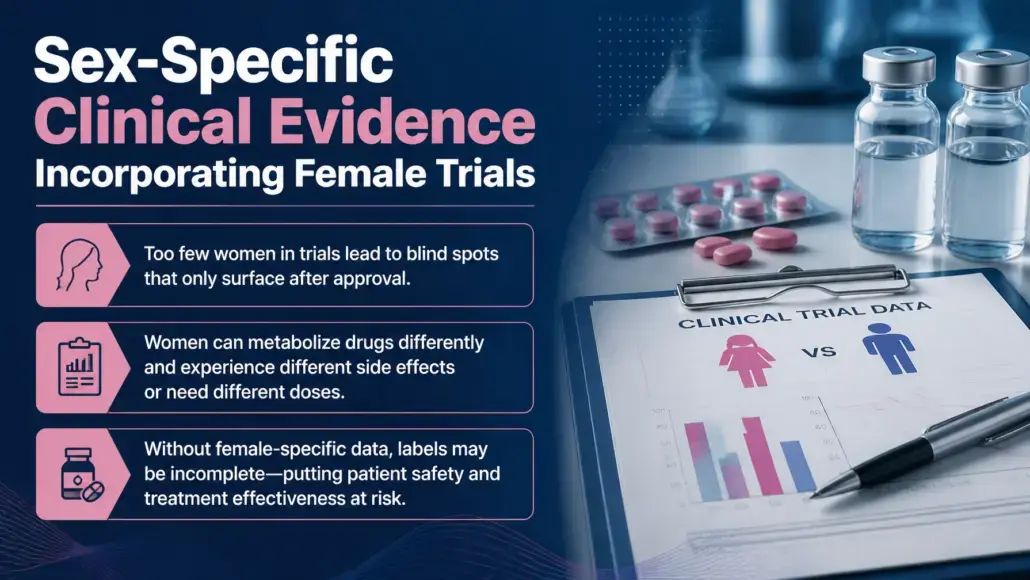
Most drug development teams know that the representation of women in clinical trials still has room to improve. The harder problem is what happens when it doesn’t. A drug can move through Phase I, II and III with too few women enrolled, or with female data never analyzed separately, gain approval, and only then show that women metabolize it differently, experience certain adverse events more often or need a different dose. By that point the label is written, and the evidence gap has become a patient safety question.
Pharma Advancement observes that building sex-specific clinical evidence is not a fix applied at one stage. It runs through the whole program, from the eligibility criteria drafted before the first site opens to the real-world data studies that follow a product for years after launch.
Why Sex-Specific Clinical Evidence Still Lags Behind
Regulators have encouraged the inclusion of women for decades. In the United States, a 1993 FDA guideline reversed an earlier policy that had largely kept women of childbearing potential out of early-phase studies, and the NIH Revitalization Act of the same year required the inclusion of women in NIH-funded clinical research. Representation has improved since then, but it remains uneven across therapeutic areas and trial phases, and early-phase pharmacokinetic studies have often enrolled fewer women than later trials.
The consequences can be concrete. In 2013 the FDA recommended lowering the starting dose of zolpidem for women after data showed that women cleared the drug more slowly, leaving higher blood levels the next morning and raising concerns about impaired driving. The drug had been on the market for roughly two decades. Earlier, a 2001 US General Accounting Office review of prescription drugs withdrawn from the market found that most posed greater health risks for women than for men, although in some cases this reflected the fact that more women took them.
The Problem With Pooled Results
A trial can enroll a reasonable number of women and still fail to produce useful sex-specific evidence. When results are reported only for the pooled population, meaningful differences in exposure, response or tolerability are averaged away. A modest overall benefit may hide a larger effect in one sex and a smaller one in the other, and an adverse event that looks rare overall may be concentrated among women. The data existed, but nobody looked.
Designing Trials That Enroll and Retain Women
Underrepresentation rarely comes from a single decision; small barriers add up. Pregnancy-related exclusions are sometimes broader than the safety profile requires. Upper age limits can shut out postmenopausal women in diseases that mainly affect older adults. Visit schedules may assume participants can take repeated time off work, and caregiving responsibilities, which still fall more heavily on women in many households, make frequent in-person visits harder.
Practical Levers for Sponsors and CROs
The best starting point is a line-by-line review of eligibility criteria, asking whether each exclusion is scientifically justified or simply inherited from an earlier protocol. Decentralized and hybrid elements such as home nursing visits, remote monitoring and local laboratory draws reduce the burden of taking part, while flexible scheduling and support for travel or childcare help retention as well as enrollment.
Enrollment targets should reflect the epidemiology of the disease, not the demographics of whichever sites recruit fastest. Here CROs add real value: a well-run feasibility assessment can identify sites with access to women in the target population, and dashboards that break out enrollment by sex allow course correction while the study is still recruiting.
Powering and Analyzing Studies for Sex Differences
Enrolling women is necessary but not sufficient. The statistical analysis plan determines whether those participants generate evidence or simply add to the total. Sex should be prespecified as an analysis variable, with defined subgroup analyses and, where relevant, a formal test for interaction. Post hoc analyses run after an unexpected result carry limited weight with regulators and reviewers.

Being Realistic About Sample Size
Few programs can afford to power every trial to detect a treatment-by-sex interaction. The practical aim is often to produce estimates for each sex that are precise enough to rule out clinically important differences, and to pool data across studies in a planned way so the program as a whole can answer the question when no single trial can.
Factors That Sit Behind Sex
Sex is often a proxy for other drivers of drug response. Body weight and composition, hormonal status, menopause, pregnancy, lactation and contraceptive use can all affect pharmacokinetics or safety. Collecting these covariates consistently lets analysts explore whether an apparent difference is explained by exposure, physiology or something else. Restraint matters too: underpowered subgroup findings should be reported transparently and treated as hypotheses, not conclusions.
Choosing Endpoints and Safety Measures That Capture Differences
Endpoint selection quietly shapes what a program can learn about women. In early-phase studies, pharmacokinetic and pharmacodynamic sampling that includes enough women can reveal exposure differences long before they become safety problems, and dose-finding that accounts for them may prevent the kind of post-approval label change seen with zolpidem.
Patient-reported outcome instruments should have evidence of validity in both women and men, because symptom presentation differs by sex in several conditions. The same caution applies to composite endpoints, where the components driving the result may differ between sexes.
Safety Collection and Reporting
Adverse event collection should make sex-differentiated signals visible. That means analyzing incidence, severity and time to onset by sex, and watching for events that may be underreported or miscoded, such as menstrual changes. Clinical study reports and submissions should present disaggregated efficacy and safety tables as standard practice. The FDA’s Drug Trials Snapshots, which publicly summarize trial participation by sex and note subgroup differences, have made this kind of transparency more expected.
Extending the Evidence Base With Real-World Data
Even a well-designed trial program cannot answer every sex-specific question before approval. Trials are finite in size and duration, and some populations, such as pregnant women, are often excluded for sound ethical reasons. Real-world data from electronic health records, claims databases, disease registries and pregnancy exposure registries can fill many of those gaps.
Post-marketing studies and pharmacovigilance become far more useful when sex-specific analysis is built in from the start. Sex-stratified disproportionality analyses in spontaneous reporting systems can flag emerging concerns, and planned cohort studies in real-world data sources can then test those signals in larger, more diverse populations than any trial could enroll.
Methodological Safeguards
Real-world data brings its own risks. Confounding by indication, differences in healthcare use between women and men, missing data and inconsistent recording of sex and gender can all distort results. Data specialists should check how sex is captured in each source, assess completeness and use designs such as active-comparator, new-user cohorts to reduce bias. The FDA’s Real-World Evidence framework stresses fit-for-purpose data and transparent protocols, and sex-specific analyses should meet the same standard.
Connecting Trial and Real-World Evidence Across the Lifecycle
The real gains come when pre-approval and post-approval work form one continuous evidence plan. Gaps found during development, such as limited data in older women or none in pregnancy, should translate directly into post-approval commitments and real-world data protocols rather than being rediscovered years later. Consistent definitions for sex, reproductive status and key covariates across trial and real-world datasets make results comparable, and someone needs clear accountability across clinical operations, biostatistics, pharmacovigilance, epidemiology and medical affairs.
| Lifecycle stage | Sex-specific action | Typical owner |
|---|---|---|
| Protocol design | Review eligibility criteria; set enrollment targets aligned with disease epidemiology | Clinical development, CRO feasibility |
| Statistical planning | Prespecify sex-based analyses; plan cross-study pooling | Biostatistics |
| Early-phase studies | PK/PD sampling with adequate female representation | Clinical pharmacology |
| Pivotal trials | Disaggregated efficacy and safety reporting | Clinical and regulatory teams |
| Post-approval | Sex-stratified pharmacovigilance; real-world data cohort studies; pregnancy registries | Pharmacovigilance, epidemiology, RWE teams |
| Communication | Translate findings for labels, prescribers and patients | Medical affairs, regulatory |
Practical Next Steps for Sponsors, CROs and Data Specialists
Strengthening sex-specific clinical evidence does not require overhauling every program at once. A short set of questions at protocol review is a sensible start: Are exclusions justified? Do enrollment targets match the disease population? Are sex-based analyses prespecified? Do endpoints and instruments work for women? Is there a real-world data plan for after approval?
Partnerships help as well. Patient advocacy groups can point to barriers protocol teams may not see, sites serving diverse communities often recruit more representative populations, and the SAGER guidelines offer a common reference for reporting sex and gender in research.
Finally, measure what matters. Tracking women’s participation and the rate of sex-disaggregated reporting across the portfolio turns good intentions into accountability. The goal is simple, even if the work is not: when a medicine reaches patients, prescribers should already know how well it works and how safe it is for women, not find out years later.
