

























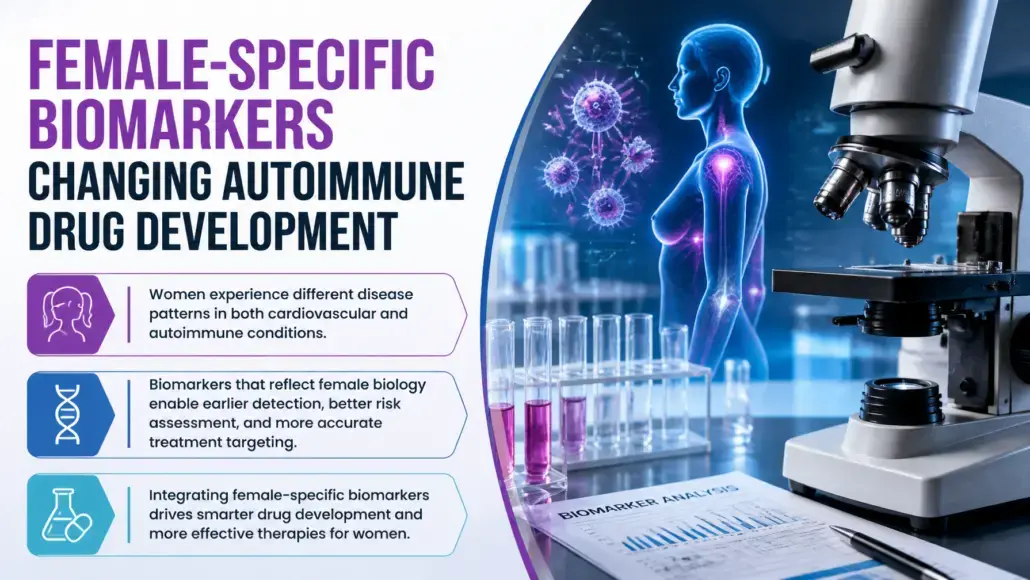
For most of modern pharmaceutical history, the reference patient was male. Dosing was modelled on him, diagnostic thresholds were calibrated to him, and preclinical work often relied on male animals to avoid the perceived noise of hormonal cycles. That assumption is now being dismantled, and two therapeutic areas show why. In cardiovascular medicine, disease often develops and presents differently in women. In autoimmunity, women are affected far more often across many conditions. Both point to the same conclusion: female-specific biomarkers are moving from the margins of drug development to its centre.
Pharma Advancement observes that for diagnostics developers, R&D leaders and translational scientists, the payoff is practical. Biomarkers that account for sex can sharpen patient selection, strengthen target validation and reduce the late-stage surprises that drain budgets and delay programmes.
Why Sex Differences in Drug Development Can No Longer Be Ignored
In 1977 the FDA advised excluding women of childbearing potential from early-phase trials, and it did not reverse that guidance until 1993. Representation has improved since then, but enrolment has not always produced insight. Many trials still examine sex only retrospectively, in subgroups too small to support firm conclusions.

The cost of that gap is visible. In 2013 the FDA halved the recommended starting dose of the sleep drug zolpidem for women after data showed they clear it more slowly and face a greater risk of next-morning impairment. That change came more than two decades after approval. Sex differences discovered after launch are slower and costlier to correct, and more damaging to trust, than those identified during development.
Policy pressure and Precision medicine
The FDA encourages sponsors to enrol adequate numbers of women and to analyse results by sex, and since 2016 the NIH has required applicants to consider sex as a biological variable in vertebrate animal and human research. These expectations push the question upstream into discovery, where biomarker strategy begins. They also reframe precision medicine. Usually associated with genomics and molecular subtyping, it has an even more basic stratifier in sex, which is recorded for almost every patient. Treating sex as a biological variable rather than a demographic checkbox is one of the most accessible ways to match therapies to patients more accurately.
Cardiovascular Disease in Women: A Different Biological Picture
Coronary artery disease was long understood through obstructive plaque in the large epicardial arteries, the pattern most typical in men. Women are more likely to have forms of ischaemic heart disease that do not fit that model, which helps explain why their symptoms have so often been missed.
Presentations that Conventional Models Miss
Coronary microvascular dysfunction, ischaemia with non-obstructive coronary arteries (INOCA), spontaneous coronary artery dissection (SCAD) and heart failure with preserved ejection fraction (HFpEF) all occur disproportionately in women. They involve mechanisms such as endothelial dysfunction, vascular inflammation and myocardial stiffening that angiography-based diagnosis may not detect. A patient can have significant ischaemia alongside an apparently normal angiogram.
Sex-Specific Troponin Thresholds
High-sensitivity cardiac troponin is one of the clearest examples of a sex-aware biomarker already in clinical use. Healthy women tend to have lower circulating troponin than men, so a single cutoff can under-diagnose myocardial infarction in women. For this reason, the Fourth Universal Definition of Myocardial Infarction recommends sex-specific 99th percentile upper reference limits. For drug developers, the lesson reaches beyond troponin: an inclusion criterion or endpoint built on a sex-neutral threshold may quietly exclude or misclassify a meaningful share of female patients.
Female-Specific Risk Enhancers
Some cardiovascular risk factors exist only in women. Hypertensive disorders of pregnancy such as preeclampsia, gestational diabetes, premature menopause and polycystic ovary syndrome are increasingly recognised as markers of higher long-term risk. For trial designers they are candidate enrichment and stratification variables. For biomarker researchers they offer a window into the vascular and metabolic pathways behind female-predominant disease.
| Condition | Typical sex pattern | Biomarker and development implication |
|---|---|---|
| Coronary microvascular dysfunction / INOCA | More common in women | Endothelial and inflammatory markers may support selection better than anatomy alone |
| SCAD | Predominantly affects women | Distinct mechanism that calls for dedicated rather than borrowed endpoints |
| HFpEF | More common in women | Fibrosis, inflammation and metabolic markers relevant to stratification |
| Myocardial infarction diagnosis | Lower baseline troponin in women | Sex-specific thresholds affect enrolment and event adjudication |
Autoimmunity’s Sex Skew and What It Reveals About Mechanism
Women account for the large majority of patients in many autoimmune conditions, with systemic lupus erythematosus, Sjögren’s disease and autoimmune thyroid disease among the most heavily skewed. That imbalance is increasingly read as a clue to mechanism, and therefore to targets.
The X Chromosome As a Source of Immune Difference
Females carry two X chromosomes, one of which is largely silenced, but some immune genes escape that silencing. TLR7, an RNA sensor implicated in lupus, is a well-studied case: in some female immune cells it is expressed from both copies, which may amplify inflammatory signalling. Researchers are also investigating whether complexes formed by XIST, the long non-coding RNA that drives X-inactivation, can act as autoantigens. The work is still emerging, but it suggests sex-linked pathways could serve as both biomarkers and therapeutic targets.
Hormones Across the Life Course
Oestrogen, progesterone and androgens all modulate immunity, and activity in several autoimmune diseases shifts around puberty, pregnancy, the postpartum period and menopause. That complicates validation, because a marker measured before menopause may behave differently afterwards. Yet life stage can also help explain why some patients respond to a therapy and others do not.
Implications for Target Validation
If a pathway depends partly on X-linked gene dosage or hormonal modulation, its relevance may differ between the sexes. A target validated mainly in male models, or in pooled data where women’s signals are diluted, may look weaker or stronger than it really is in the population that most needs the drug.
Putting Sex-Aware Biomarkers to Work in Trial Design
The most immediate value of female biomarkers lies in patient selection. In cardiovascular programmes, that could mean enrolling women with documented microvascular dysfunction rather than relying on broad diagnostic labels. In autoimmune studies, it might mean interpreting interferon-signature or other pathway markers in light of sex and hormonal status.

Design choices matter as much as the markers themselves. Recording menopausal status, hormone therapy and contraceptive use lets teams model these factors as covariates instead of leaving them as unexplained variance. Where a sex difference is biologically plausible, studies should be powered to detect it prospectively rather than relying on post hoc analysis. Endpoints deserve the same scrutiny, since measures developed largely in men may under-capture disease activity or symptom burden in women.
Pharmacokinetics and Safety Margins
Differences in body composition, drug-metabolising enzyme activity and renal clearance mean the same dose can produce different exposures in women and men. Sex-stratified pharmacokinetic sampling in early-phase studies, paired with pharmacodynamic biomarkers, gives an early read on whether dose adjustment is needed. Because women have been reported to experience adverse drug reactions more often than men, this is a safety question as much as a scientific one.
Reducing Late-Stage Attrition Through Earlier Decisions
Phase III failure is among the most expensive outcomes in pharmaceutical R&D, and insufficient efficacy is a leading cause. Sex-blind development can contribute when an effect present in one sex is diluted by its absence in the other, or when a safety signal surfaces only in a larger, more diverse population. The remedy is to decide earlier: test female animals and cell lines of known sex in preclinical work, carry biomarker signals through translational bridging studies, and design Phase II trials that can show whether a sex-specific effect is real before the largest investment is committed.
The Opportunity for Diagnostics Developers
As sponsors adopt sex-aware strategies, demand will grow for companion and complementary diagnostics that identify the right patients reliably. The technical hurdles are real. Reference ranges may need to be set separately by sex and sometimes by life stage, assays must withstand hormonal fluctuation, and many legacy datasets were never disaggregated by sex. Developers investing in sex-disaggregated biobanks, real-world data partnerships and multi-omics platforms will be well placed, especially if they engage early with regulators on validation expectations and with payers on clinical utility.
What R&D Leaders Should Do Now
Start with an honest pipeline audit: where do target selection, preclinical models or endpoints treat male biology as the default? Next, bring translational scientists, clinical teams and diagnostics partners together from the outset, because female-specific biomarker strategy works best when it is planned jointly. Then make sex-disaggregated data collection and reporting standard across every programme rather than a feature of a few.
Female-specific biomarkers in drug development are not about creating separate medicines for women. They are about understanding disease well enough that every patient receives a therapy designed with their biology in mind. In cardiovascular and autoimmune medicine, where sex differences are pronounced, that understanding is fast becoming a competitive advantage.
