







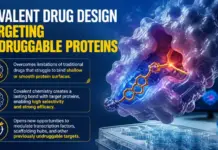












The clinical transition of targeted protein degradation from academic curiosity to late-stage oncology pipelines is fundamentally shifting pharmaceutical portfolio strategy. For decades, conventional small molecules functioned almost exclusively through occupancy-driven pharmacology. Drug hunters sought deep hydrophobic cavities where an inhibitor could fit tightly, block enzymatic activity, and halt disease signaling. That classical model left an estimated eighty percent of the human proteome categorized as untreatable because transcription factors, non-enzymatic scaffolding proteins, and structural complexes typically possess flat surfaces lacking defined catalytic clefts.
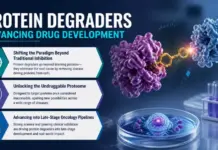
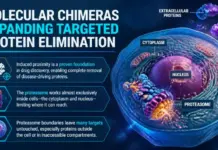
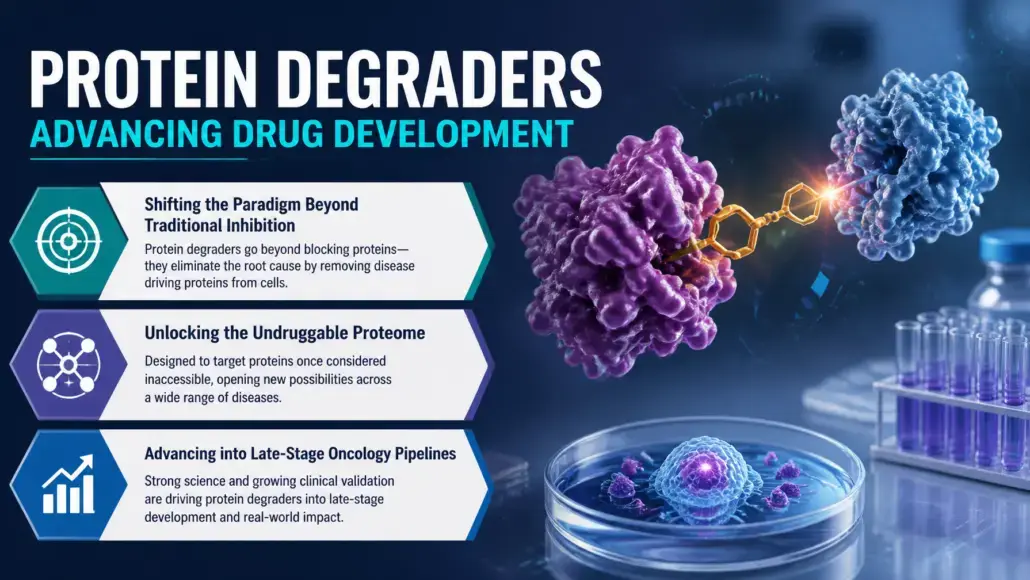
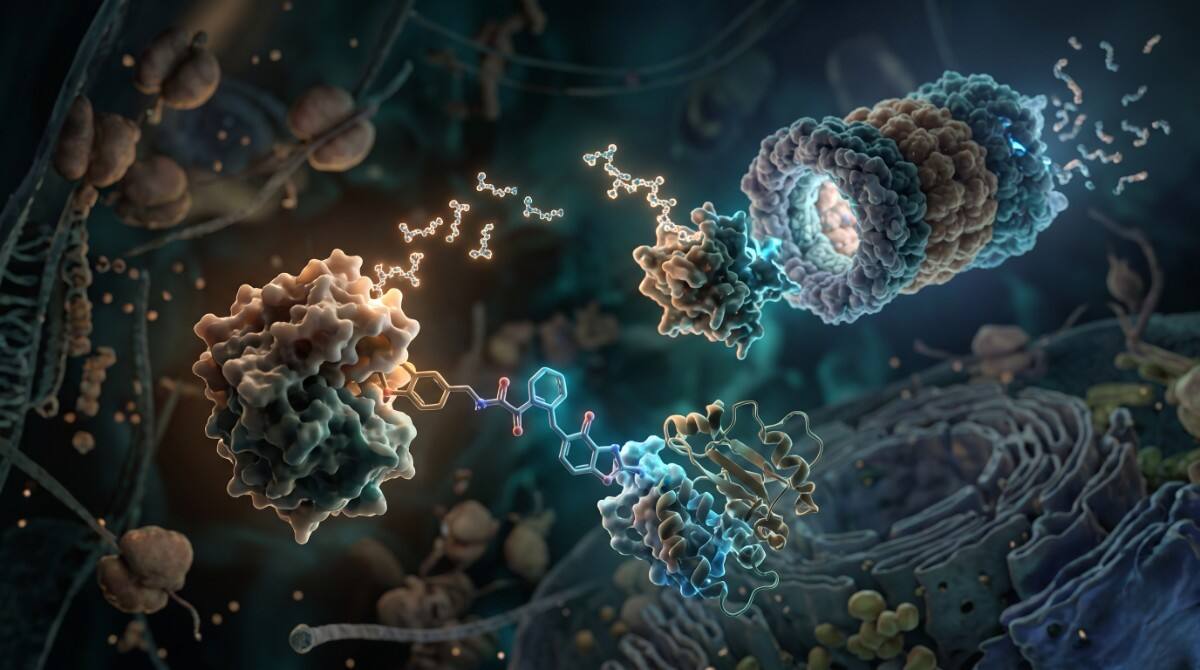
Targeted protein degradation bypasses the requirement for sustained active-site occupancy. By harnessing the cellular ubiquitin-proteasome system, bifunctional degraders and related modalities recruit an E3 ubiquitin ligase to a designated disease-associated protein. The resulting proximity triggers polyubiquitination, tagging the target for destruction inside the 26S proteasome. Once ubiquitination occurs, the degrader dissociates unharmed and initiates another catalytic cycle on a neighboring target molecule.
This catalytic event-driven pharmacology allows low drug concentrations to deplete pathological proteins completely. As global biopharmaceutical developers demonstrate across clinical trials, protein degraders advancing drug development are moving beyond preliminary proof-of-concept into registrational trials across breast cancer, prostate malignancies, and hematologic conditions.
Catalytic Destruction Reshaping Therapeutic Architecture
The pharmacological distinction between inhibition and degradation translates into concrete clinical benefits. Occupancy-driven inhibitors demand high sustained systemic exposure to keep target binding sites occupied. High systemic concentrations frequently trigger off-target toxicities, narrow therapeutic windows, and accelerate resistance mutations that prevent the inhibitor from binding.
In contrast, protein degraders act catalytically. A single degrader molecule can induce the elimination of hundreds of target proteins over its pharmacodynamic lifecycle. Because the molecule does not need to maintain continuous stoichiometric occupancy, drug developers can achieve profound target knockdown at nanomolar or picomolar systemic concentrations.
Targeted destruction also eliminates every functional domain of a pathogenic protein simultaneously. Many oncoproteins possess both enzymatic functions and scaffolding properties. While an enzymatic inhibitor halts only the catalytic pocket, the remaining scaffolding architecture often continues to recruit downstream signaling partners, driving disease progression. Degradation removes the entire protein structure from the cell, eliminating scaffolding functions and preventing pathway reactivation.
Recent clinical and preclinical data reflect this structural advantage across major disease categories:
- Complete depletion of disease-driving proteins prevents compensatory pathway upregulation, a frequent failure point in classical kinase inhibitor regimens.
- Catalytic recycling allows lower systemic dosing, potentially mitigating systemic adverse events associated with high-dose small molecule exposures.
- Degraders can eliminate mutant variants that have acquired active-site resistance mutations, provided the degrader can still induce ternary complex formation.
- Event-driven mechanisms enable transient target engagement to achieve sustained biological suppression, decoupling target knockdown duration from systemic drug half-life.
Clinical Milestones Across Global Oncology Pipelines
The competitive momentum in targeted protein degradation is visible in late-stage oncology trials conducted by leading biopharmaceutical enterprises. Global pharmaceutical companies are committing substantial capital to demonstrate that degraders can outperform current standard-of-care agents in head-to-head clinical trials.
Pfizer and Arvinas advanced vepdegestrant, an orally bioavailable proteolysis targeting chimera targeting the estrogen receptor, into the global Phase 3 VERITAC-2 trial for patients with ER-positive, HER2-negative advanced breast cancer. Clinical results presented in 2025 demonstrated that vepdegestrant significantly prolonged progression-free survival in patients harboring ESR1 mutations compared to standard intramuscular fulvestrant. Because ESR1 mutations commonly drive resistance to conventional aromatase inhibitors and selective estrogen receptor modulators, the ability to destroy the estrogen receptor protein provides a clear therapeutic alternative.
Bristol Myers Squibb has established a commanding clinical footprint in the degrader landscape through its cereblon E3 ligase modulator programs. In the Phase 3 SUCCESSOR-2 trial, Bristol Myers Squibb evaluated mezigdomide in combination with standard regimens for patients with relapsed or refractory multiple myeloma. Clinical readouts reported in 2025 and 2026 confirmed that mezigdomide achieved deep, durable responses in heavily pretreated patient cohorts, including individuals whose disease had proved refractory to earlier immunomodulatory therapies.
Concurrently, Sanofi partnered with Kymera Therapeutics to advance KT-474, a first-in-class degrader targeting IRAK4, into mid-stage clinical studies for inflammatory conditions including hidradenitis suppurativa and atopic dermatitis. Data reported from Phase 2 evaluations in 2025 confirmed robust target degradation in peripheral blood and skin tissue without inducing the dose-limiting toxicities often observed with broad-spectrum kinase inhibitors. This milestone demonstrated that targeted protein degradation holds clinical relevance well beyond oncology, opening opportunities across immunology and rheumatology.
Bayer reinforced its commitment to targeted protein degradation by acquiring exclusive global commercialization rights to ARV-766 from Arvinas in an agreement valued at up to 1.1 billion dollars. ARV-766 is an oral androgen receptor degrader engineered to degrade both wild-type androgen receptors and prevalent point mutations, such as AR-L702H and AR-T878A, which confer resistance to enzalutamide and abiraterone in metastatic castration-resistant prostate cancer.
Roche, through its Genentech division, expanded multiple discovery partnerships focusing on tissue-selective degradation platforms. By integrating proprietary E3 ligase ligands with specialized tumor-targeting antibodies, Roche aims to restrict degrader activity strictly to malignant tissue, sparing healthy organs from potential toxicities.
Expanding Beyond Classical Oncology Targets
While oncology remains the commercial testing ground for targeted degradation, the broader biopharmaceutical industry is applying the modality to previously unreachable therapeutic spaces. Neurological disorders driven by toxic protein accumulation represent an urgent commercial frontier. Diseases such as Alzheimer’s and Parkinson’s involve misfolded proteins, including tau and alpha-synuclein, that lack conventional druggable pockets.
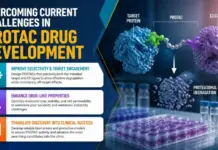
Applying protein degraders to the central nervous system requires overcoming blood-brain barrier transport limitations. Traditional heterobifunctional degraders carry molecular weights ranging between 700 and 1100 Daltons, outside historical Lipinski Rule of 5 parameters for brain penetration. To resolve this obstacle, biopharma chemistry teams are exploring modified linkers, compact ternary designs, and active transporter-mediated delivery mechanisms.
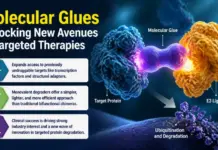
While heterobifunctional chimeras require distinct binding sites on both the target and the ligase, biopharma pipelines are simultaneously pursuing monovalent alternatives. Rather than constructing bulky linkers, drug developers are turning to molecular glues by reshaping protein surfaces to induce productive target degradation.
Strategic Dealmaking and Infrastructure Investments
Capital allocation patterns across major pharmaceutical companies confirm that targeted protein degradation is now viewed as an essential therapeutic modality alongside monoclonal antibodies, antibody-drug conjugates, and gene therapies. Global market analyses indicate that the targeted protein degradation sector exceeded 700 million dollars in 2025, with industry projections forecasting expansion beyond 3.4 billion dollars over the coming decade as registrational trials read out.
Pharmaceutical business development teams are structuring high-value licensing transactions that combine biotech chemistry platforms with commercial manufacturing scale:
- Multi-target collaboration agreements frequently exceed one billion dollars in potential milestone commitments, reflecting big pharma confidence in degrader platforms.
- Specialized contract development and manufacturing organizations are investing in high-potency active pharmaceutical ingredient suites tailored for complex bifunctional syntheses.
- Intellectual property strategies are shifting toward novel E3 ligase recruiters to bypass crowded cereblon and von Hippel-Lindau patent estates.
- Regulatory frameworks are maturing as global health agencies establish standardized characterization protocols for ternary complex pharmacokinetics.
The commercial viability of protein degradation platforms ultimately depends on reproducible manufacturing and predictable formulation chemistry. Bifunctional degraders present distinct physicochemical properties, including low aqueous solubility and high molecular flexibility. Addressing these formulation hurdles early in lead optimization allows development teams to avoid bioavailability failures during clinical escalation.
Future Trajectory of Degradation Pharmacology
The long-term development of targeted protein degradation will be defined by the discovery of novel E3 ligases. Human biology encodes more than 600 E3 ubiquitin ligases, yet the overwhelming majority of clinical programs still rely on cereblon or von Hippel-Lindau. While both ligases have yielded active drug candidates, they also present biological constraints, including ubiquitous tissue expression and documented tumor resistance mechanisms involving ligase downregulation.
Pharma research divisions are systematically screening tissue-restricted and tumor-specific ligases, such as DCAF1, KEAP1, and RNF4. Enlisting a ligase that is uniquely expressed in malignant cells or diseased tissue creates an intrinsic safety mechanism, ensuring that target degradation occurs only where pathology resides.
Artificial intelligence and computational structural biology are accelerating this search. Machine learning algorithms model ternary complex interfaces before chemical synthesis begins, predicting cooperativity between target proteins and candidate ligases. By shortening the design cycle from months to weeks, computational modeling is lowering the cost of discovering potent degrader molecules.
As these technological tools mature, Pharma Advancement believes that protein degraders advancing drug development will continue to expand the boundaries of modern pharmacotherapy. By systematically removing pathological proteins rather than transiently inhibiting their active sites, biopharmaceutical pipelines are unlocking therapeutic possibilities across conditions that were once considered permanently druggable dead ends.
References
- “Arvinas and Pfizer’s Vepdegestrant Significantly Improves Progression-Free Survival for Patients with ESR1-Mutant, ER+/HER2- Advanced Breast Cancer in Phase 3 VERITAC-2 Study” – Pfizer
- “Bristol Myers Squibb to Unveil New Data at ASCO 2026 Demonstrating Strength and Breadth of Scientific Innovation Across Oncology Portfolio” – Bristol Myers Squibb
- “Bayer Acquires Exclusive Global License for Arvinas’ Novel Investigational Androgen Receptor Degrader ARV-766” – Bayer
- “Sanofi and Kymera Announce Advancement of KT-474 Phase 2 Clinical Programs in Dermatology” – Sanofi
- “Targeted Protein Degradation Market Size, Share, and Growth Analysis Report 2025-2035” – Research Nester
