







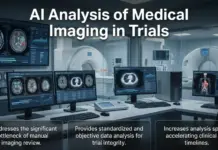
















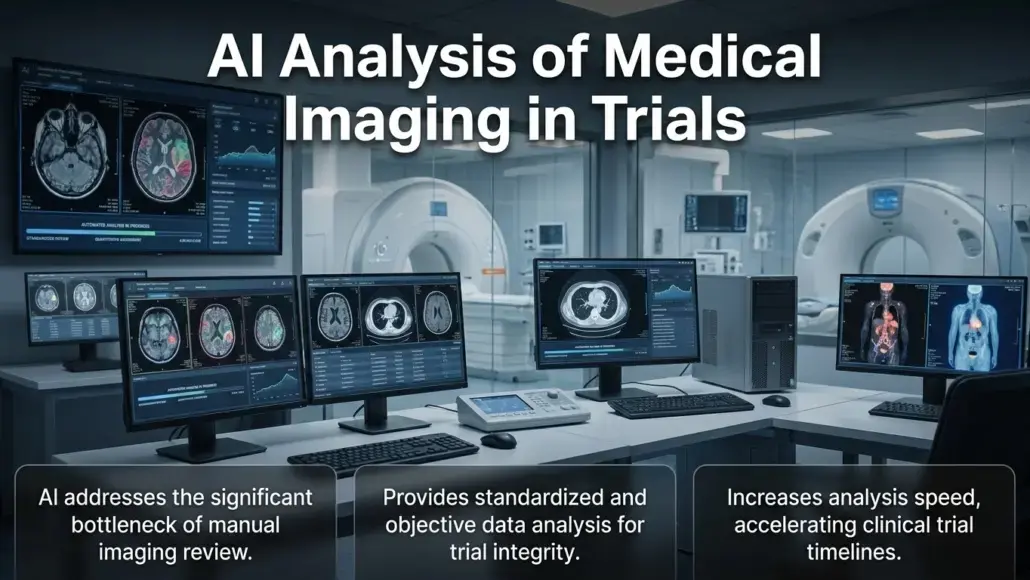
Clinical trials are the engine of pharmaceutical innovation, but they are also increasingly complex and expensive. One of the most significant bottlenecks in modern trials is the interpretation of medical imaging, such as MRI, CT, and PET scans. Traditionally, this process relies on manual review by expert radiologists, which is time consuming and subject to variability. AI analysis of medical imaging in trials is transforming this landscape by providing high speed, standardized, and objective assessments of treatment efficacy. Pharma Advancement notes that by leveraging deep learning and computer vision, these tools are enabling researchers to detect subtle changes in disease progression that were previously difficult to quantify.
In 2024, the use of AI in clinical imaging reached a turning point, with a significant increase in the number of trials incorporating automated analysis into their primary or secondary endpoints. Industry reports suggest that AI integration can accelerate imaging review timelines by up to 50 percent, allowing for faster decision making during the development process. For B2B stakeholders, the value proposition is clear: shorter trial durations, lower operational costs, and higher quality data for regulatory submissions. As the industry moves toward precision medicine, the ability to extract granular data from medical images is becoming a key competitive advantage.
Standardizing Biomarker Detection and Volumetric Analysis
The primary application of AI in this field is the automated detection and measurement of imaging biomarkers. In oncology, for instance, the Response Evaluation Criteria in Solid Tumors (RECIST) is the standard for measuring how a patient responds to a drug. However, manual measurement of tumors is subject to inter observer variability, where different radiologists might produce slightly different results. AI analysis of medical imaging in trials provides a standardized approach, using machine learning models to identify and segment tumors with high precision.
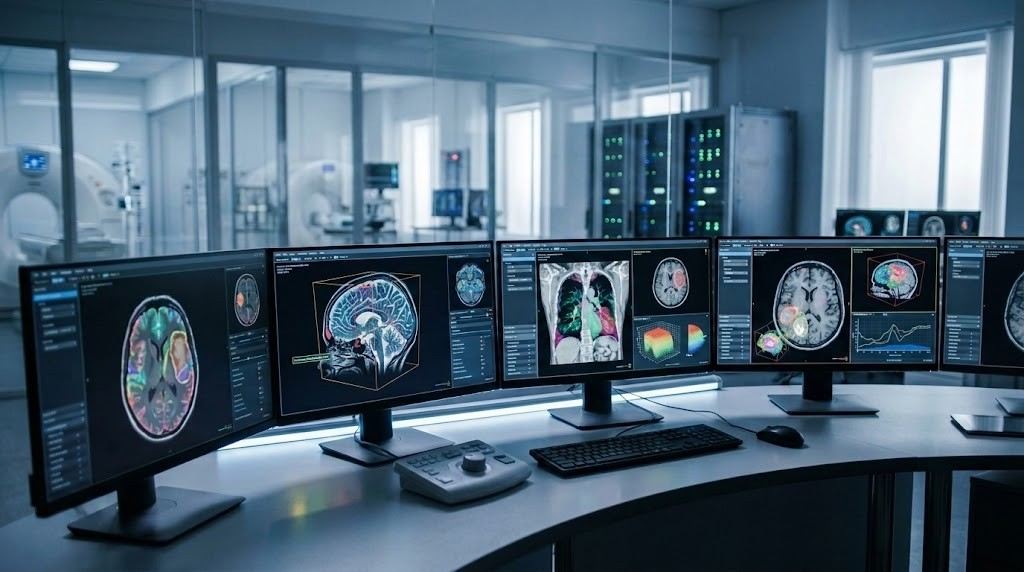
Beyond simple diameter measurements, AI can provide 3D volumetric analysis. This offers a much more accurate picture of tumor burden, as it accounts for the irregular shapes of many cancers. By tracking the volume of a tumor over time, researchers can gain a deeper understanding of how a drug is affecting the disease. This granular data is highly valuable during early stage trials, where it can be used to identify promising candidates and optimize dosing. Studies show that AI driven volumetric analysis is more sensitive to treatment response than traditional 2D measurements, potentially allowing for conclusions to be reached with smaller patient cohorts.
Furthermore, these tools are being used to identify new imaging biomarkers that correlate with clinical outcomes. By analyzing thousands of images, machine learning models can identify subtle patterns in texture, density, or vascularization that are invisible to the human eye. These radiomic features can provide insights into the underlying biology of the disease and help predict which patients are most likely to respond to a specific therapy. The integration of radiomics into clinical trials is a major step toward the goal of personalized medicine.
Accelerating Patient Screening and Enrollment
One of the most challenging aspects of a clinical trial is finding the right patients to participate. Many trials have strict inclusion and exclusion criteria based on specific imaging features. Manually screening thousands of scans to find a handful of eligible patients is an enormous task. AI analysis of medical imaging in trials automates this process by identifying patients who meet the criteria in a fraction of the time. This not only speeds up the enrollment process but also ensures that the trial is testing the drug in the most appropriate population.
In some cases, AI can even identify patients who are at high risk of disease progression, allowing for their inclusion in prevention trials. For example, in Alzheimer’s research, machine learning models can analyze brain scans to identify individuals with early signs of neurodegeneration long before symptoms appear. By focusing on these high risk individuals, researchers can increase the likelihood of demonstrating a drug’s effectiveness. Reports indicate that AI driven screening can reduce the time needed for trial enrollment by 25 to 30 percent, a massive advantage in the competitive race to bring new therapies to market.
The use of AI for screening also improves the diversity and representativeness of the trial population. By automating the search across a wider range of healthcare systems, AI can identify eligible patients who might otherwise have been missed. This is increasingly important as regulators like the FDA emphasize the need for clinical trials to reflect the diversity of the patient populations they serve. As data sharing and interoperability improve, we can expect to see AI playing an even larger role in building the patient cohorts of the future.
Strengthening Data for Regulatory Submissions
Regulatory agencies around the world are increasingly open to the use of AI in clinical trials, provided the tools are properly validated. AI analysis of medical imaging in trials provides a clear, quantifiable trail of evidence that is highly valuable during the submission process. Because the analysis is standardized and objective, it reduces the risk of bias that can occur with manual review. This can lead to a more efficient review process and a higher probability of approval for promising drugs.
The FDA has already cleared hundreds of AI driven medical devices and software applications, many of which are being used in the context of drug development. To support this trend, the agency has published frameworks for the development and validation of AI tools, emphasizing the need for transparency, robustness, and ongoing monitoring. Pharmaceutical companies that can demonstrate they are using state of the art AI for their imaging analysis are well positioned to navigate the regulatory landscape.
Beyond the primary efficacy data, AI also provides a wealth of secondary information that can be used to support a drug’s value proposition. For instance, AI can be used to measure the impact of a therapy on a patient’s quality of life, such as improvements in mobility or lung function, by analyzing imaging data. This real world evidence is becoming essential for securing reimbursement from payers, who want to see that a new treatment delivers meaningful benefits to patients.
Challenges in Data Security and Ethical Integration
The widespread adoption of AI in clinical imaging is not without its challenges. The most pressing is the issue of data security and privacy. Medical images are highly sensitive personal data, and any system that processes them must comply with strict regulations like HIPAA and GDPR. This includes ensuring that images are properly de identified and that the transmission of data is encrypted. Furthermore, as trials become more global, navigating the different data protection laws of various countries becomes increasingly complex.
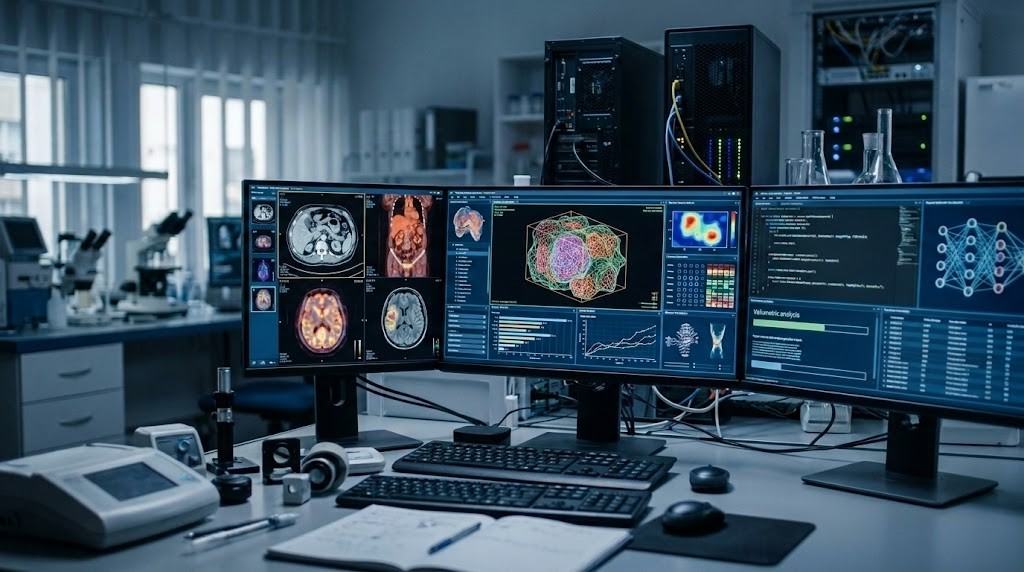
Another challenge is the black box nature of many deep learning models. For a researcher or a regulator to trust the results of an AI analysis, they need to understand how the model reached its conclusion. The field of explainable AI is working to address this by developing tools that provide a visual or textual explanation of the model’s output. For example, an AI system might highlight the specific regions of an image that led it to identify a tumor. Promoting transparency is essential for building the trust needed for AI to become a standard part of the clinical trial process.
Finally, there is the need for continuous validation. AI models can drift over time as new imaging technologies or patient populations are introduced. It is therefore essential to monitor the performance of these tools throughout the duration of a trial and beyond. This requires a robust quality management system and a commitment to ongoing research and development. Pharmaceutical companies must work closely with their technology partners to ensure that the AI tools they use remain accurate and reliable.
Accelerating Clinical Precision Through Imaging AI
The integration of artificial intelligence into medical imaging is actively reshaping clinical trials and diagnostics, driven by massive investments from global life science and technology giants. To standardize trial endpoints and automate data management, Medidata (a Dassault Systèmes company) recently launched its AI-driven Medidata Plus platform, scaling intelligent medical imaging management for faster therapeutic approvals. Recognizing the value of these endpoints, Thermo Fisher Scientific made a massive $8.9 billion acquisition of Clario, consolidating its position in advanced clinical imaging and AI-assisted trial data.
In the anatomic pathology space, Labcorp expanded its partnership with PathAI to deploy FDA-cleared AI digital pathology algorithms nationwide, effectively replacing subjective manual review with highly standardized, AI-assisted image analysis. To identify precise patient populations earlier in their disease progression, Tempus AI integrated Median Technologies’ AI-powered lung cancer screening into its Pixel imaging platform. Finally, Bayer continues to expand its digital healthcare footprint by scaling its Calantic™ Digital Solutions, an AI platform designed to curate and seamlessly orchestrate third-party diagnostic imaging algorithms directly into clinical workflows. All of the aforementioned companies are verified as massive global enterprises with significantly more than 500 employees.
The Strategic Path Forward for R&D Executives
For R&D executives, the integration of AI analysis of medical imaging in trials is a strategic imperative. The transition to data driven drug development is well underway, and companies that fail to adopt these tools risk being left behind by faster, more efficient competitors. Success requires a commitment to building a modern imaging infrastructure and a culture that embraces the power of AI.
This includes investing in cloud based platforms that can handle the massive amounts of data generated by medical imaging. It also requires building strong partnerships with specialized AI vendors and academic research centers. Furthermore, executives should focus on developing the talent needed to bridge the gap between clinical research and data science. In the long run, the use of AI will lead to a more efficient and effective drug development process, bringing life saving therapies to patients more quickly.
The future of clinical trials is digital, and medical imaging is at the heart of this transformation. Pharma Advancement believes that by leveraging the power of AI to extract the maximum amount of information from every scan, we can gain a deeper understanding of human health and disease. The journey is challenging, but the potential to improve the lives of millions of patients is immense. The era of AI driven clinical imaging has arrived, and the possibilities for innovation are endless.
References
- Society for Imaging Informatics in Medicine
- FDA
- EMA
- World Health Organization
- Medidata
- Thermo Fisher Scientific
- Labcorp
- Tempus AI
- Bayer
