















Closed-loop powder containment is rapidly becoming the most critical infrastructure requirement for the handling and conveying of Active Pharmaceutical Ingredients (APIs), particularly as the industry shifts toward the production of high-potency drugs and personalized biologics. In the high-stakes world of API manufacturing, the primary objective is to maintain total isolation between the product and the environment. Any exposure—whether it is a worker inhaling a microscopic dust particle or a sensitive API being degraded by ambient moisture—can have catastrophic consequences for both health and product quality. Closed-loop powder containment addresses these risks by creating a fully sealed, recirculating transport environment that ensures the API remains under total control from the reactor to the formulation suite. This technology is not just a safety feature; it is the fundamental containment shield that enables the modern pharmaceutical industry to handle the world’s most powerful and sensitive substances.
Pharma Advancement notes that the drive toward closed-loop systems is fueled by the emergence of Highly Potent Active Pharmaceutical Ingredients (HPAPIs), which have Occupational Exposure Limits (OELs) in the nanogram per cubic meter range. Traditional open or semi-enclosed conveying methods are simply not capable of providing the level of protection required for these substances. Closed-loop powder containment provides a zero-leakage environment by maintaining a constant state of negative pressure or an inert gas atmosphere within the convey lines. This ensures that any potential leak path is always inward, preventing the escape of hazardous dust into the cleanroom. This shift from localized containment to a system-wide closed-loop approach is a major evolution in pharmaceutical occupational safety and clean manufacturing.
The Technical Engineering of Closed-Loop Containment Systems
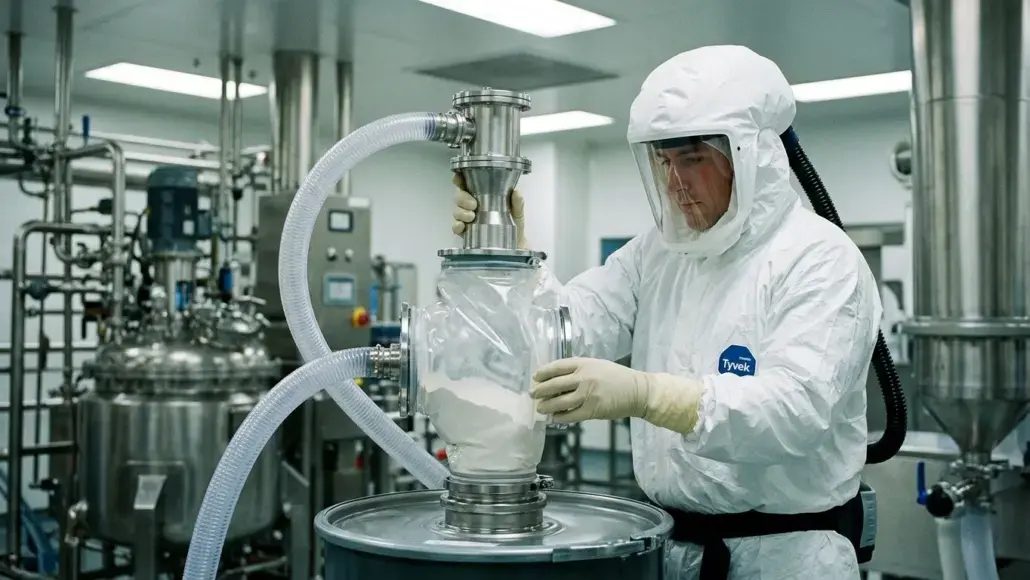
The successful implementation of closed-loop powder containment requires a holistic approach to engineering that integrates the conveyor, the containment hardware, and the pressure control systems. Unlike a standard conveyor that simply moves material, a closed-loop system is a pressure-vessel that must be able to withstand both vacuum and positive pressure. The loop begins at the material source—such as a centrifuge or a bulk bag unloader—where the API is introduced into the system through a high-containment valve, such as a split-butterfly or a rotary-containment valve. These valves ensure that there is no open air transfer at any point in the process.
The convey lines themselves are constructed from high-quality, orbital-welded stainless steel with specialized interior finishes that prevent powder adhesion. The closed-loop refers to the fact that the conveying air or gas (such as nitrogen) is not exhausted into the room but is instead filtered and recirculated back to the start of the system. This not only prevents the release of API dust but also allows for a highly controlled environment where factors like humidity and oxygen levels can be precisely managed. This is crucial for APIs that are moisture-sensitive or prone to oxidation. High-Efficiency Particulate Air (HEPA) filters—often arranged in push-through or bag-in-bag-out configurations—ensure that the recirculating gas remains perfectly clean, providing multiple layers of protection for both the product and the facility.
Enhancing Occupational Safety and Regulatory Compliance
In the pharmaceutical industry, occupational safety is not just an ethical requirement; it is a strict regulatory mandate. Regulatory bodies such as OSHA and the EMA have increasingly strict guidelines for the handling of hazardous pharmaceutical dusts. Closed-loop powder containment provides the highest level of technical control in the hierarchy of safety, moving beyond the reliance on Personal Protective Equipment (PPE) toward an inherently safe engineering solution. By keeping the hazard inside the pipe, these systems eliminate the need for workers to wear cumbersome moon suits and respirators during routine operations, significantly improving their comfort, productivity, and overall well-being.
Moreover, the containment integrity of a closed-loop system can be continuously monitored and validated. Differential pressure sensors and mass-flow meters provide a real-time health check of the system. If the pressure drops or a filter begins to clog, the system can automatically trigger an alarm and move to a safe state, preventing any accidental exposure. This level of active monitoring is essential for meeting the data integrity and validation requirements of modern GMP standards. A closed-loop system provides a robust and defensible containment strategy that can withstand the most rigorous regulatory audits, ensuring that the facility remains operational and compliant in an increasingly scrutinized global market.
Improving API Conveying Efficiency and Product Purity
Beyond safety, closed-loop powder containment offers significant advantages in terms of process efficiency and product purity. Traditional powder handling often involves manual decanting and transfer steps, which are not only slow but also high-risk for contamination. Closed-loop systems automate these transfers, providing a high-speed, on-demand supply of API to the formulation line. This reduces the cycle time of the production process and eliminates the waiting time associated with manual handling. The consistency of the pneumatic transfer also ensures that the blend uniformity of the API is maintained, which is critical for the quality of the final dosage form.
Furthermore, the clean-room environment is preserved by the total containment of the system. In a traditional plant, even a small amount of nuisance dust can settle on surfaces, requiring constant and intensive cleaning of the entire room. Closed-loop powder containment eliminates this housekeeping burden, allowing for a cleaner and more efficient manufacturing environment. This reduction in environmental contamination also significantly lowers the risk of cross-product contamination, which is the primary concern for multi-product facilities. By providing a dedicated and sealed transport route for each API, closed-loop systems allow manufacturers to produce multiple potent products in the same facility with absolute confidence in their purity.
Integration with Vacuum Conveying and Smart Control Systems
Closed-loop powder containment is often integrated with pneumatic vacuum conveying technology to provide a gentle and efficient method for moving the API. The vacuum provides the driving force for the transfer, while the closed-loop ensures the containment. The combination of these two technologies creates a smart material handling system that can be precisely tuned for different powder characteristics. For example, the system can adjust its velocity to prevent the attrition or breakage of fragile crystals, ensuring that the physical properties of the API remain unchanged during transport.
The integration with smart control systems and AI-driven analytics allows for predictive containment. By analyzing the pressure and flow data from thousands of transfers, the system can identify the early signs of a potential seal failure or a filter bypass. This allows for proactive maintenance, ensuring that the containment shield is never compromised. In a smart pharma factory, the closed-loop system is not an isolated piece of equipment; it is a vital part of the ‘digital twin’ of the entire facility, providing real-time data on the flow of the most valuable and hazardous materials in the plant. This connectivity ensures that the facility operates at the peak of both safety and efficiency.
The Future of Containment: Continuous Manufacturing and Personalized Medicine
Looking ahead, the role of closed-loop powder containment will be central to the two most significant trends in pharmaceutical manufacturing: Continuous Manufacturing and Personalized Medicine. In a continuous manufacturing environment, the API must be fed into the process at a perfectly constant rate over long periods. Closed-loop systems provide the stable and reliable material supply needed for this to work, with the added benefit of maintaining containment over weeks or even months of operation. This move away from batch processing toward flow processing is the key to reducing the cost and increasing the quality of medications.
In the world of personalized medicine, such as gene and cell therapies, the production volumes are much smaller, but the value and sensitivity of the material are much higher. Closed-loop powder containment provides the sterile-grade isolation needed for these high-value materials, often in a disposable or single-use format. These disposable loops consist of pre-sterilized plastic tubing and containers that can be discarded after a single batch, eliminating the need for cleaning and validation entirely. This containment-as-a-service model is the future of agile, patient-centered manufacturing, allowing for the rapid and safe production of customized medications in small-scale, regional hubs.
Conclusion: The Essential Shield of High-Potency Pharma
In conclusion, closed-loop powder containment is an essential technology for the future of the pharmaceutical industry. By providing a total isolation between the hazardous API and the environment, it ensures the highest levels of occupational safety and product purity. Its ability to handle high-potency substances with zero-leakage reliability makes it the foundational infrastructure for the next generation of HPAPI and biologic medications.
As the industry continues to move toward more complex and potent drug formulations, the adoption of advanced closed-loop systems will become a non-negotiable requirement for success. It is an investment that protects the company’s most valuable assets: its people, its products, and its reputation for quality. By building a closed-loop future, pharmaceutical manufacturers are not just moving powder; they are ensuring that the promise of modern medicine can be realized with maximum safety and minimum risk. Pharma Advancement believes that closed-loop powder containment is the ultimate shield of the pharmaceutical plant, enabling the safe and efficient delivery of health to patients around the world.
