












In the high-stakes environment of sterile pharmaceutical manufacturing, the ability to detect and mitigate contamination risks is the foundation of patient safety. Traditional environmental monitoring (EM) methods, while effective for decades, are increasingly seen as reactive and labor-intensive. These legacy processes often involve manual sampling, the physical transportation of agar plates, and multi-day incubation periods, providing a “rear-view mirror” look at the cleanroom state. As the industry moves toward Pharma 4.0, advanced environmental monitoring is emerging as a critical enabler of sterility control. By integrating real-time particle counting, rapid microbiological methods (RMM), and automated data management, these advanced systems provide a dynamic, continuous view of the cleanroom health. This shift from “periodic checking” to “continuous oversight” allows manufacturers to identify and resolve potential issues before they ever impact product quality, ensuring the highest possible levels of sterility assurance.
The Technological Leap Toward Real-Time Detection
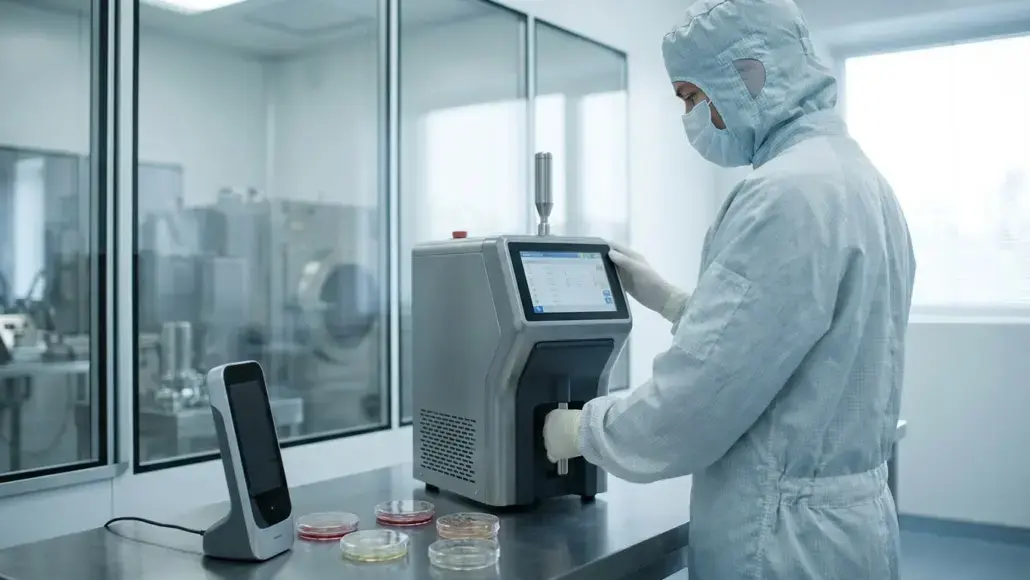
The core of advanced environmental monitoring is the transition from manual, retrospective testing to automated, real-time detection. In a traditional cleanroom, particle counts are often taken at specific intervals or at the start and end of a shift. Advanced systems utilize fixed, continuous particle counters that are integrated directly into the facility’s digital network. These sensors provide a second-by-second stream of data on both viable and non-viable particles in the Grade A critical zones. This real-time visibility is a game-changer if a particle spike occurs due to an operator’s movement or a mechanical glitch, the system can trigger an immediate alarm, allowing the process to be paused before the product is compromised.
Furthermore, the emergence of Rapid Microbiological Methods (RMM) is addressing the “incubation bottleneck.” Technologies such as laser-induced fluorescence (LIF) can detect the presence of microorganisms in the air or on surfaces almost instantly, based on the unique fluorescence emitted by biological cells. While these methods are still being fully integrated into regulatory frameworks, they offer a powerful tool for investigative monitoring and rapid root-cause analysis. Advanced environmental monitoring thus provides a proactive defense against contamination, moving the industry closer to the goal of “real-time release” where the quality of the product is confirmed throughout the manufacturing process rather than just at the end.
Integrating EM Data into a Holistic Contamination Control Strategy
The revised EU GMP Annex 1 places a heavy emphasis on the creation of a comprehensive Contamination Control Strategy (CCS). Advanced environmental monitoring is a primary pillar of this strategy. However, the true value of advanced EM lies not just in the hardware, but in how the data is utilized. Modern environmental monitoring systems (EMS) consolidate data from across the entire facility, including particle counts, temperature, humidity, and differential pressures. This data is then analyzed to identify subtle trends and patterns that might indicate a developing risk.
For instance, an advanced EMS can correlate a slight increase in humidity with a rise in microbial counts in a specific room, or identify a recurring particle spike associated with a particular maintenance activity. This “holistic” view allows quality managers to move beyond individual deviations and address the underlying environmental factors that contribute to contamination risk. Advanced environmental monitoring thus transforms EM from a compliance “box-ticking” exercise into a strategic tool for continuous improvement. By providing a clear, data-driven picture of the facility’s state of control, these systems support the site-wide CCS and provide a robust rationale for regulatory submissions.
Automating the Documentation Lifecycle for Data Integrity
Data integrity is a major focus for regulatory agencies, and manual environmental monitoring is an area of significant risk. The transcription of data from paper logs into spreadsheets, the labeling of thousands of plates, and the manual entry of incubation results are all opportunities for error. Advanced environmental monitoring platforms eliminate these risks by automating the entire documentation lifecycle. Every sample point is mapped in the software, and every result is timestamped and attributed to a specific user and device.
This digital workflow ensures that the data meets the ALCOA+ principles from the moment of capture. Barcoded samples and automated plate readers ensure that results are correctly recorded and linked to the original sampling event. Furthermore, these systems provide automated “out of specification” (OOS) and “out of trend” (OOT) alerts, ensuring that the appropriate investigations are triggered immediately. In an environment of advanced environmental monitoring, the documentation is as clean as the air in the cleanroom. This transparency not only reduces the risk of human error but also builds a high level of confidence with inspectors, who can easily verify the integrity and completeness of the EM history.
The Human Factor: Training and Behavior in a Monitored Environment
While the technology is vital, the “human factor” remains a critical variable in sterility control. Humans are the primary source of contamination in a cleanroom, and advanced environmental monitoring can be a powerful tool for improving operator behavior. Some advanced systems utilize “real-time feedback” where visual displays in the cleanroom show the current particle levels. This allows operators to see the direct impact of their movements and gowning breaches, reinforcing the importance of proper aseptic technique.
Beyond immediate feedback, the data from an advanced EMS can be used to tailor training programs. If the data shows a recurring issue in a specific area or during a specific task, the quality team can conduct targeted training or “re-gowning” drills. Advanced environmental monitoring thus creates a more self-aware and accountable workforce. When operators understand that their environment is being continuously monitored and that the data is being used to support their success, they are more likely to internalize the principles of sterility assurance. This synergy between advanced technology and human behavior is the hallmark of a high-performance sterile manufacturing facility.
Future Horizons: AI, Predictive Analytics, and Beyond
As we look to the future, the integration of Artificial Intelligence (AI) and machine learning into advanced environmental monitoring will further enhance sterility control. AI algorithms can analyze years of EM data to identify incredibly subtle trends that a human might miss. They can predict “high-risk periods” based on factors such as season, facility age, or personnel turnover, allowing for the proactive deployment of additional cleaning or monitoring resources. We may even see the rise of “self-healing” facilities, where the EMS can automatically adjust HVAC settings or trigger localized decontamination cycles in response to detected risks.
Furthermore, the miniaturization of sensors and the rise of wearable technology may allow for “personnel-specific” monitoring, providing even more granular data on the potential for contamination. While these technologies are still on the horizon, the foundation is being laid today through the adoption of advanced environmental monitoring systems. The goal is to create an environment that is so well-understood and so closely monitored that the risk of contamination becomes statistically negligible. In this future, the “sterility assurance level” will be a dynamic, real-time metric, providing absolute confidence in the safety and efficacy of every dose of medicine produced.
Conclusion: The New Benchmark for Sterility Assurance
Advanced environmental monitoring is no longer a luxury it is a fundamental requirement for the modern sterile facility. By providing real-time detection, holistic data integration, and automated documentation, these systems provide a level of oversight that traditional methods simply cannot match. This technological evolution is a key driver in the pursuit of higher sterility assurance levels and a more resilient pharmaceutical supply chain. As the industry continues to move toward more complex therapies and more rigorous regulatory standards, advanced environmental monitoring will remain the essential tool for protecting the patient and ensuring the absolute integrity of sterile operations. The future of sterility control is digital, continuous, and proactive, and it is being built today on the foundation of advanced monitoring technology.
