







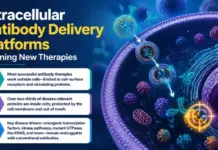











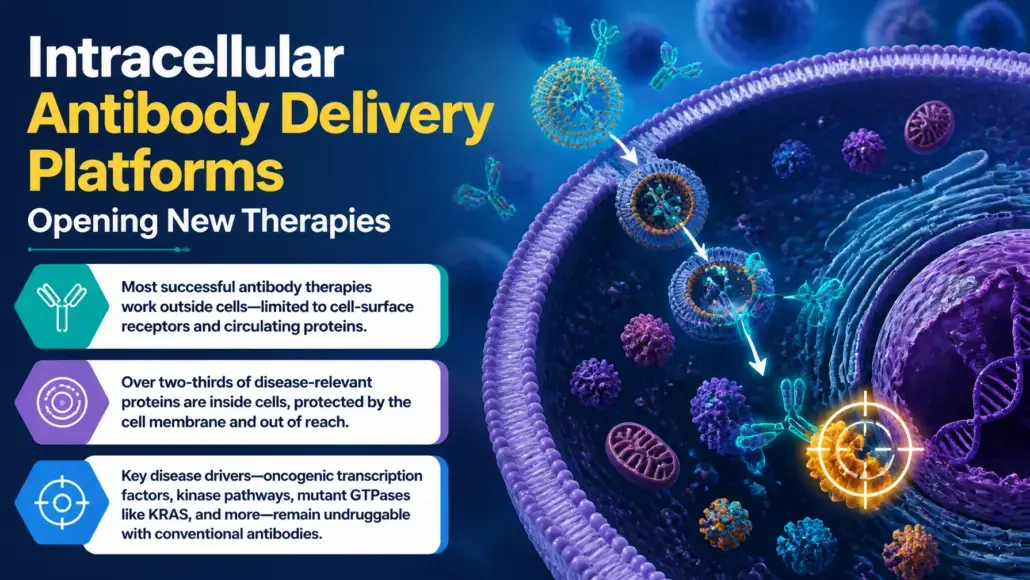
Monoclonal antibodies represent the most commercially successful class of modern biopharmaceuticals, yet their therapeutic activity has been confined almost exclusively to cell-surface receptors and circulating soluble proteins. Over two-thirds of the disease-relevant human proteome operates inside the cell, shielded behind the impermeable hydrophobic barrier of the plasma membrane. Oncogenic transcription factors, intracellular kinase signaling cascades, mutant GTPases such as KRAS, and pathological neurodegenerative protein aggregates have remained largely inaccessible to macromolecular biologics. Intracellular antibody delivery platforms are dismantling this biological barrier, opening a vast therapeutic landscape where high-affinity antibody architectures can neutralize cytosolic and nuclear disease drivers directly.
Delivering an intact immunoglobulin into the cytoplasm requires overcoming formidable biophysical hurdles. A standard immunoglobulin G molecule possesses a molecular weight of approximately one hundred and fifty kilodaltons, a dense hydrophilic exterior, and a net surface charge that prevents passive diffusion across lipid bilayers. Furthermore, when cells take up macromolecules via endocytosis, therapeutic antibodies frequently become entrapped within acidic endosomal vesicles and undergo rapid degradation within lysosomes. Modern delivery strategies are engineered to achieve two critical mechanistic steps: selective cellular internalization and efficient endosomal escape into the functional cytoplasm.
Vector Technologies and Cytoplasmic Delivery Mechanisms
To transport therapeutic antibodies across cell membranes without disrupting cellular viability, biopharmaceutical engineers have developed diverse chemical, physical, and biological vector systems. These platforms protect antibody binding structures while facilitating controlled cytosolic translocation.
Four primary vector technologies dominate current translational research:
- Lipid nanoparticles formulated with ionizable lipids encapsulate antibodies or antibody-derived fragments, maintaining neutral surface charges at physiological pH before acquiring positive charges in acidic endosomes to induce endosomal membrane destabilization.
- Cell-penetrating peptides and supercharged peptide tags conjugated to antibody frameworks exploit macropinocytosis and temporary membrane inversion to promote cytosolic release.
- Engineered virus-like particles and bacterial toxin-derived delivery scaffolds utilize non-pathogenic viral capsid proteins to inject functional protein cargos directly into recipient cells.
- Polymeric nanocarriers and pH-responsive nanogels contract and expand across microenvironmental pH gradients, bursting endosomal membranes through proton sponge mechanisms.
Each vector design must balance delivery efficiency with cellular tolerability, ensuring that transient membrane disruption does not trigger inflammatory immune responses or non-specific cellular lysis.
Intrabodies and mRNA-Encoded Intracellular Biologics
An increasingly powerful alternative to delivering pre-formed recombinant antibody proteins involves delivering nucleic acid instructions that direct the patient’s own cellular machinery to synthesize intracellular antibodies, termed intrabodies. By delivering modified messenger RNA encapsulated in lipid nanoparticles, researchers bypass the physical challenge of transporting bulky, folded protein complexes across external cell membranes.
This nucleic acid-driven approach provides distinct pharmacological advantages:
- Transfected host cells express single-chain variable fragments or single-domain nanobodies directly within the cytoplasm or endoplasmic reticulum, ensuring natural protein folding and post-translational modification.
- Subcellular localization signals, such as nuclear localization sequences or mitochondrial targeting tags, can be engineered into the intrabody sequence to direct the therapeutic protein into specific cellular organelles.
- Sustained intracellular protein expression avoids the rapid degradation that often affects injected recombinant proteins, maintaining therapeutic neutralizing concentrations for several days following a single administration.
- Rapid platform adaptivity allows medicinal chemists to modify antibody sequences computationally and formulate new mRNA-lipid nanoparticle candidates within weeks.
Messenger RNA encoding intracellular antibodies represents a converging frontier where the precision of protein-based biologics integrates with the scalable manufacturing economics of genetic medicine.
Precision Targeting of Refractory Oncogenic Drivers
The primary oncological impetus for intracellular antibody delivery centers on mutant driver proteins that resist conventional small-molecule inhibition. The RAS family of small GTPases, particularly mutant KRAS, has driven human cancer biology for decades. While allele-specific covalent inhibitors have established clinical proof of concept for select mutations such as KRAS G12C, other prevalent variants such as G12D and G12V possess smooth protein surfaces that lack deep allosteric pockets for small-molecule docking.
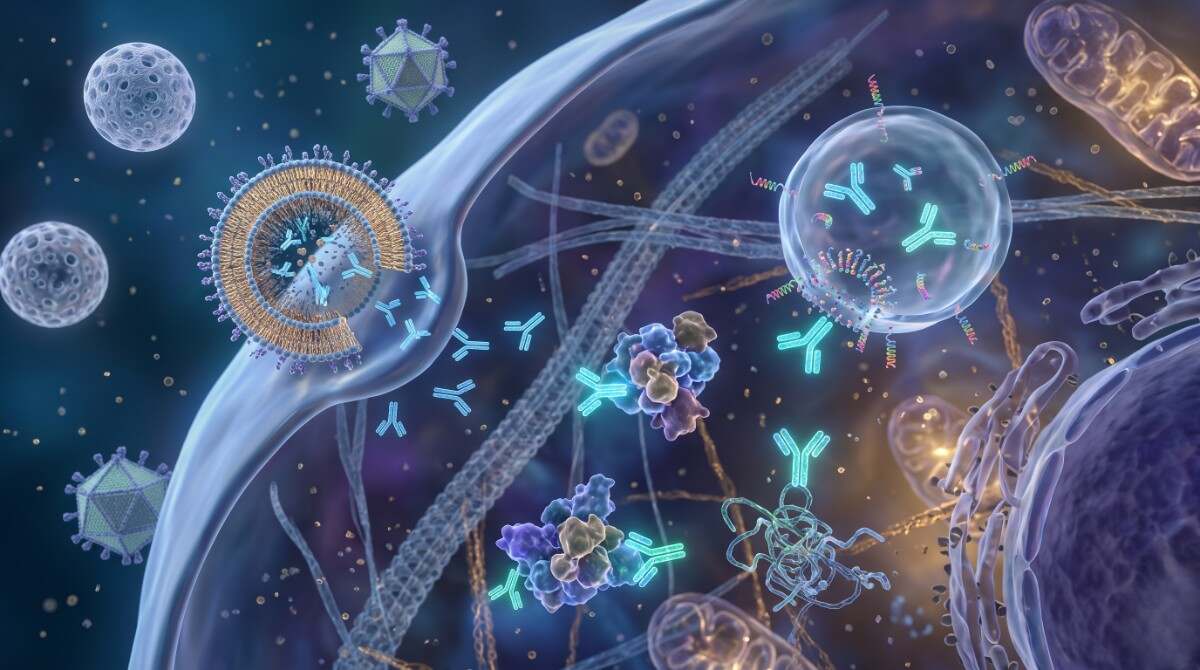
Intracellular antibodies provide extensive binding interfaces that cover the nucleotide-binding switch regions of KRAS, blocking effector protein recruitment and arresting downstream RAF-MEK-ERK signaling cascades. Furthermore, intracellular antibodies can be engineered as targeted protein degraders by appending E3 ubiquitin ligase-recruiting motifs to the antibody framework. Once bound to the intracellular target, these chimeric constructs, known as antibody-based proteolysis-targeting chimeras, direct the cellular proteasome to degrade the oncogenic driver irreversibly.
Beyond oncogenic signaling enzymes, intracellular antibody delivery platforms allow direct neutralization of pathogenic transcription factors such as MYC, beta-catenin, and signal transducer and activator of transcription 3. Neutralizing these master regulators at the protein level terminates aberrant gene transcription programs that drive metastatic dissemination and drug resistance across solid tumors.
Endosomal Trapping and Immunogenic Barriers
Despite substantial engineering progress, achieving high cytosolic delivery efficiency remains a significant technical challenge. In most nanocarrier-mediated delivery systems, less than five percent of internalized antibody cargo successfully escapes the endosomal compartment into the active cytoplasm, with the remainder being shuttled into lysosomes for enzymatic destruction.
Biophysical innovations are steadily improving endosomal escape efficiencies:
- Photochemical internalization uses light-activated photosensitizers embedded within endosomal membranes to generate localized reactive oxygen species that rupture vesicle membranes on demand upon light exposure.
- Synthetic peptide motifs derived from viral fusion proteins, such as influenza hemagglutinin subunit HA2, undergo conformational rearrangements in acidic endosomes, inserting hydrophobic helical domains into the lipid bilayer to form transient escape pores.
- Endosomolytic small molecules co-formulated within delivery complexes transiently disrupt membrane integrity, releasing entrapped macromolecular biologics before acidification reaches lysosomal levels.
- Optimization of antibody surface hydrophobicity and electrostatic dipole moments reduces non-specific binding to endosomal lumen walls, facilitating unimpeded diffusion into the cytosol.
As scientists master intracellular targeting mechanisms, the resulting molecular recognition tools are expanding into non-invasive whole-body imaging, illustrating how Radiopharmaceutical Drug Development Beyond Conventional Oncology is creating complementary avenues to map and modulate deep biological targets across complex organ systems. Systemic theranostic radioisotopes and intracellular targeting vectors share a common objective: navigating complex biological barriers to selectively engage disease-defining molecular nodes.
Clinical Translation Horizons and Manufacturing Paradigms
The clinical trajectory of intracellular antibody delivery will be shaped by standardized regulatory testing frameworks and reproducible bioanalytical assays. Regulatory authorities require clear evidence that cytosolic delivery vectors release their therapeutic protein cargo without inducing systemic immune activation, chronic complement activation, or off-target tissue accumulation.
Commercial scalability will depend on modular formulation technologies. Standardizing microfluidic encapsulation processes for lipid nanoparticles and establishing high-yield purification protocols for engineered nanobodies will reduce manufacturing costs and accelerate batch turnaround times.
Pharma Advancement observes that by unlocking thousands of previously untouchable cytosolic and nuclear targets, intracellular antibody delivery platforms are poised to expand the therapeutic reach of modern medicine. As delivery efficiency improves and vector safety profiles are refined, these technologies will provide clinicians with powerful tools to neutralize refractory oncogenic, viral, and degenerative disease drivers directly at their source.
