

























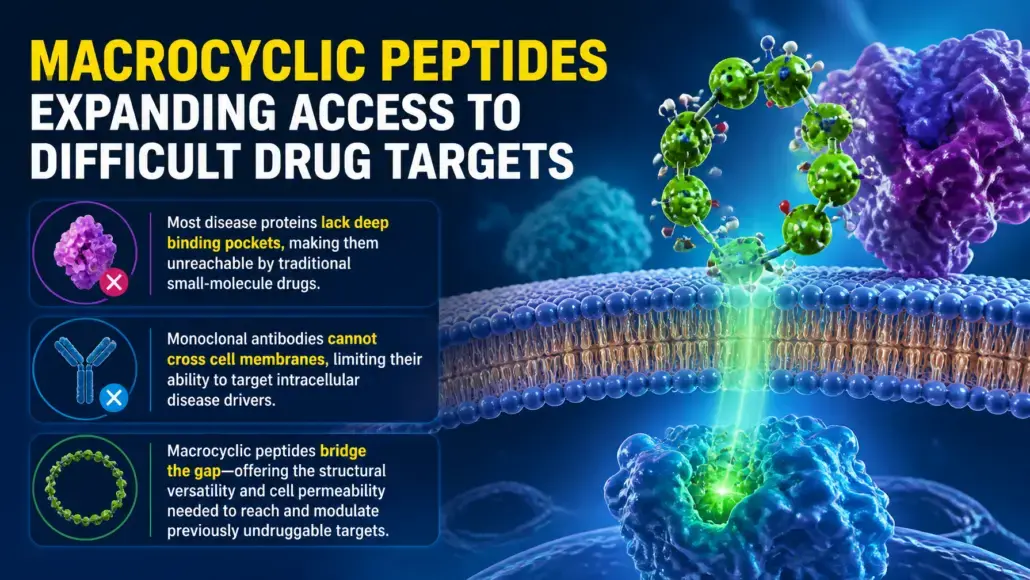
Small molecules and monoclonal antibodies have long defined the structural boundaries of medicinal chemistry, yet they leave vast swaths of human biology therapeutically inaccessible. An estimated eighty percent of disease-associated proteins lack the deep hydrophobic binding pockets required for traditional small-molecule inhibition, existing instead as flat, featureless protein-protein interaction interfaces. Concurrently, monoclonal antibodies cannot cross intact cell membranes to engage intracellular pathological drivers. Macrocyclic peptides for difficult targets are bridging this historical structural divide, establishing a versatile drug class that combines the high affinity of biologics with the oral bioavailability and membrane permeability of synthetic chemicals.
A macrocyclic peptide is characterized by a closed ring topology formed through covalent linkages between distant amino acid residues or synthetic backbones. This cyclic architecture restrains conformational flexibility, reducing the entropic penalty associated with target binding while shielding sensitive amide bonds from proteolytic degradation. Pharma Advancement observes that by projecting functional side chains across extensive contact surfaces ranging from five hundred to one thousand square angstroms, macrocycles can selectively disrupt sprawling protein-protein interaction networks that resist small-molecule intervention.
Structural Mechanics and the Undruggable Space
The human interactome comprises thousands of critical regulatory protein complexes that drive oncogenesis, autoimmune pathology, and neurodegeneration. Transcription factors, chromatin remodeling complexes, and cytokine receptor interfaces function primarily through broad, shallow contact regions devoid of defined catalytic clefts. When standard small molecules attempt to bind these interfaces, they lack sufficient contact surface area to achieve meaningful thermodynamic binding free energy.
Macrocyclic peptides for difficult targets overcome these spatial constraints through unique biophysical attributes:
- Extensive molecular surface area enables macrocycles to engage multiple dispersed binding hotspots simultaneously, achieving picomolar and low-nanomolar binding affinities.
- Rigidified backbone scaffolds freeze the molecule into bioactive conformations, minimizing entropic loss upon binding to target protein surfaces.
- Resistance to gastric and systemic proteases prevents rapid enzymatic cleavage, allowing cyclic structures to maintain metabolic integrity within harsh physiological environments.
- Incorporation of non-canonical amino acids, N-methylated residues, and synthetic hydrocarbon staples further optimizes metabolic stability and enhances target selectivity.
These structural features enable researchers to pharmacologically modulate intracellular oncogenes, signaling scaffolds, and cytokine receptors that were historically designated as entirely undruggable.
Chameleonic Properties and Oral Bioavailability
Achieving oral bioavailability and passive cell membrane permeability has historically represented the most daunting obstacle in peptide drug design. Molecules with molecular weights exceeding five hundred daltons and numerous polar hydrogen bond donors generally violate classical Lipinski rules, preventing efficient absorption across the intestinal epithelial barrier.
Macrocyclic peptides overcome these pharmacological barriers by functioning as molecular chameleons:
- In aqueous biological fluids, the cyclic peptide exposes polar and charged groups to maximize aqueous solubility and prevent aggregation in gastric juices.
- Upon encountering the lipophilic interior of a cellular lipid bilayer, the flexible macrocyclic ring undergoes an intramolecular conformational rearrangement.
- This conformational shift internalizes polar amide hydrogens through internal hydrogen bonding networks, exposing lipophilic side chains to the external lipid environment.
- The temporarily hydrophobic surface allows the macrocycle to passively diffuse across the intestinal epithelium and penetrate targeted cell membranes before reverting to its bioactive conformation in the cytoplasm.
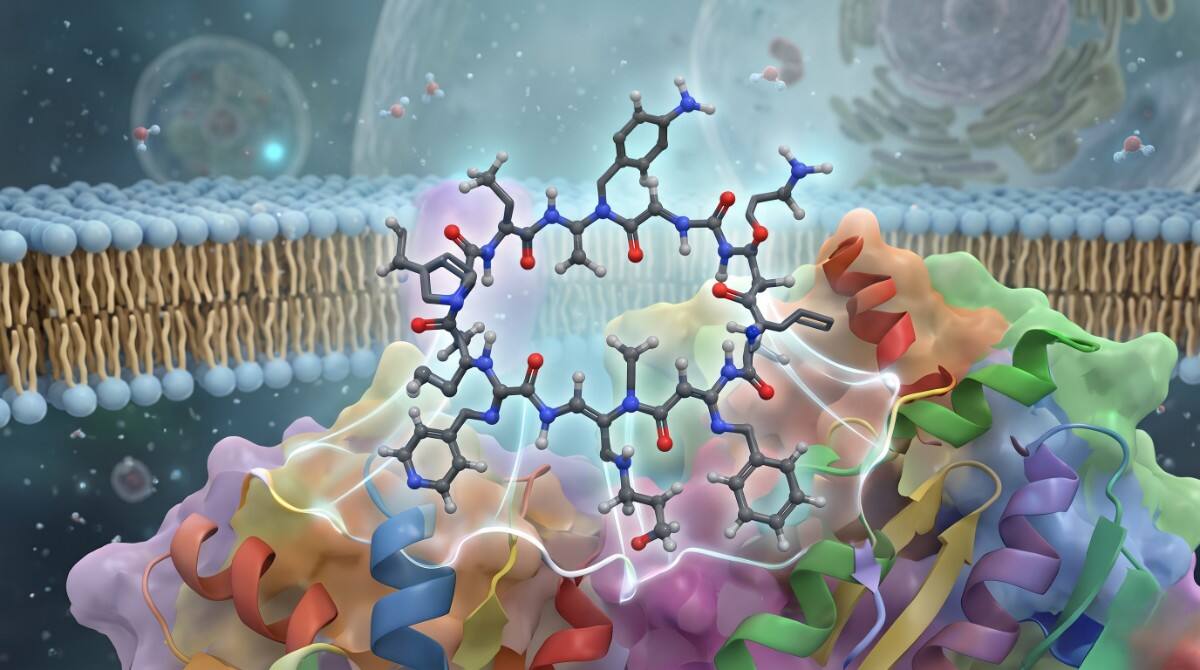
This dynamic conformational plasticity allows macrocyclic peptides with molecular weights between eight hundred and two thousand daltons to achieve oral bioavailability profiles comparable to conventional small-molecule tablets.
Biophysical assays including parallel artificial membrane permeability tests and cellular thermal shift assays confirm these dynamic structural shifts. By quantifying transcellular diffusion across artificial lipid bilayers and validating intracellular target engagement in living cells, translational scientists can optimize oral absorption profiles while preserving high target selectivity.
Advanced Screening Platforms and Discovery Technologies
The rapid expansion of macrocyclic pipelines is driven by technological revolutions in molecular display technologies and computational modeling. Historically, screening cyclic peptide libraries was constrained by slow chemical synthesis and limited structural diversity.
Modern discovery engines generate and interrogate billions of unique macrocyclic structures simultaneously:
- Messenger RNA display and ribosomal translation systems, such as flexible in vitro translation platforms, enable the synthesis of vast combinatorial libraries containing trillions of diverse cyclic peptides incorporating non-natural amino acids.
- Phage display platforms incorporating chemical linkers and synthetic cross-linkers yield bicyclic and polycyclic architectures with constrained binding epitopes.
- Machine learning algorithms and structural biology tools predict macrocyclic conformations, internal hydrogen bonding networks, and passive membrane permeability before chemical synthesis occurs.
- Automated high-throughput cyclic peptide synthesizers streamline lead optimization cycles, allowing medicinal chemists to refine oral absorption, target affinity, and metabolic clearance within months.
These integrated discovery technologies allow biopharmaceutical teams to generate potent, selective macrocyclic leads against newly discovered disease targets in a fraction of the time required by traditional screening campaigns.
Furthermore, continuous flow synthesis platforms and automated purification protocols are lowering commercial scale-up barriers, enabling global contract manufacturing organizations to supply multi-kilogram quantities of complex cyclic peptides under good manufacturing practice standards.
While macrocyclic architectures expand the boundaries of chemical space, certain cytoplasmic multiprotein complexes require the broader paratope surface area of macromolecular biologics, highlighting why Intracellular Antibody Delivery Opening New Therapeutic Possibilities is emerging as an indispensable complementary modality. Where macrocycles target compact contact surfaces, intracellular delivery vectors allow full immunoglobulins and nanobodies to neutralize complex multi-subunit cytosolic targets.
Commercial Implications and Future Industry Trajectory
The clinical and commercial maturation of macrocyclic peptides is fundamentally altering pharmaceutical portfolio strategies. In chronic disease management, oral tablets provide decisive adherence advantages over injectable therapies, reducing clinical administration burdens and eliminating specialized cold-chain logistics.
Patent exclusivity represents another strategic asset. The unique conformational space and specialized non-natural chemical motifs of macrocyclic peptides establish robust intellectual property barriers that are significantly more difficult for generic manufacturers to replicate than simple small molecules.
As computational design tools improve and commercial supply chains for non-canonical amino acids scale, macrocyclic peptides will solidify their position as an essential pillar of drug discovery. Pharma Advancement notes that by unlocking difficult protein-protein interactions through convenient oral dosage forms, these versatile molecules are transforming how the biopharmaceutical industry approaches previously untreatable human diseases.
