




















The gene therapy revolution has arrived, bringing with it the potential to cure previously untreatable genetic disorders by addressing their root cause at the molecular level. However, the path from scientific breakthrough to widespread clinical availability is blocked by a significant industrial hurdle: the production of viral vectors. These engineered viruses—most commonly Adeno-Associated Virus (AAV) and lentivirus—serve as the delivery vehicles for therapeutic genetic material. As the pipeline of gene therapies matures from early-stage clinical trials to large-scale commercial launches, the global viral vector manufacturing demand has surged to unprecedented levels, forcing the industry to fundamentally rethink its production strategies.
Historically, viral vector production was a niche endeavor, often conducted in academic labs or small-scale pilot facilities. These early processes were characterized by low yields and labor-intensive methods that were never intended for commercial use. Today, the landscape is entirely different. With hundreds of gene therapies in active development, the need for billions of vector genomes is creating a massive supply-demand imbalance. Meeting this viral vector manufacturing demand requires a transition from bespoke laboratory techniques to industrial-grade bioprocessing platforms that can deliver the scale, quality, and consistency required by global regulatory agencies.
The Shift from Adherent to Suspension Culture Systems
For many years, the industry relied heavily on adherent cell culture systems for vector production. In this model, cells are grown on flat surfaces, such as T-flasks or stacked plates. While effective for small batches, adherent systems are notoriously difficult to scale. Increasing production often means simply adding more plates, which leads to massive footprints and high labor costs. To truly address the rising viral vector manufacturing demand, the industry is shifting toward suspension culture systems. In suspension culture, cells are grown in a three-dimensional environment, typically within a stirred-tank bioreactor.
This transition is a game-changer for scalability. By moving from two dimensions to three, manufacturers can achieve significantly higher cell densities and, consequently, a much larger volume of vector per batch. A single 2,000-liter stirred-tank bioreactor can produce as much material as thousands of stacks of adherent plates, all while requiring a fraction of the manual labor. This industrialization of cell culture is the primary mechanism through which the industry is attempting to satisfy the growing viral vector manufacturing demand, providing a clear path toward the commercial volumes needed to treat large patient populations for conditions like muscular dystrophy or hemophilia.
Optimizing the Bioreactor Environment for Maximum Yield
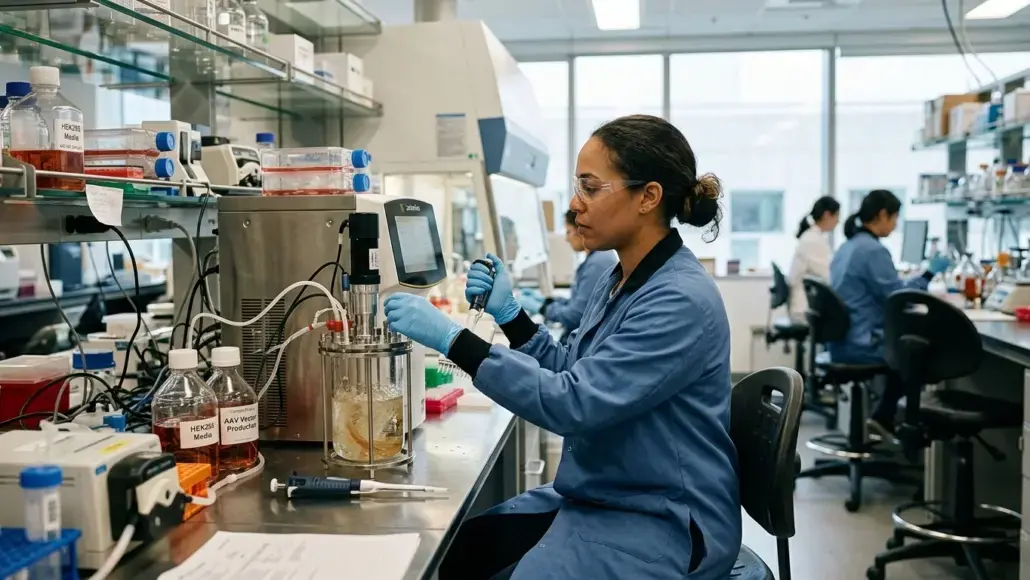
Simply moving to suspension culture is not enough; the bioreactor environment must be meticulously optimized to ensure the highest possible yields of functional vectors. Stirred-tank bioreactors provide a highly controlled setting where critical parameters such as dissolved oxygen, pH, temperature, and nutrient concentrations can be managed with extreme precision. Advanced sensors and automated control systems allow engineers to maintain the cells in a constant state of peak productivity. This level of control is essential for meeting viral vector manufacturing demand, as even a slight deviation in the culture environment can lead to a significant drop in vector potency.
Furthermore, the industry is increasingly adopting single-use technologies (SUT) within these bioreactor systems. Single-use bioreactors utilize disposable plastic liners instead of traditional stainless steel tanks, eliminating the need for complex cleaning and sterilization between batches. This not only reduces the risk of cross-contamination but also allows for faster turnaround times between production runs. As companies scramble to build out their capacity, the flexibility and speed of single-use systems are proving to be invaluable tools in the effort to keep pace with viral vector manufacturing demand.
Overcoming the Downstream Processing Bottleneck
While the focus is often on the upstream phase of cell culture, the downstream phase of purification is equally critical—and often more challenging. Once the vector is produced in the bioreactor, it must be separated from the host cells, culture media, and other impurities. This is particularly difficult for viral vectors, which are large and delicate biological entities. Traditional chromatography and filtration methods often result in significant loss of product, with some processes achieving less than 30% recovery of the functional vector. To meet the viral vector manufacturing demand, innovation in downstream processing is a top priority.
New chromatography resins and membrane filtration technologies are being developed specifically for the unique physical and chemical properties of AAV and lentiviral vectors. These advanced tools allow for higher binding capacities and faster flow rates, significantly increasing the throughput of the purification process. Additionally, the move toward continuous processing—where the product flows seamlessly from one purification step to the next without being held in large tanks—is showing promise in further improving yields and reducing costs. By optimizing every step of the downstream workflow, manufacturers can ensure that every liter of culture produced in the bioreactor translates into the maximum number of therapeutic doses, directly addressing the core challenges of viral vector manufacturing demand.
The Role of Analytical Science in Quality Assurance
As production scales up, maintaining the quality and safety of the final product becomes increasingly complex. Regulators require detailed characterization of the viral vector, including its purity, potency, and the ratio of full versus empty capsids (viral shells that do not contain the therapeutic gene). Traditionally, these analyses were time-consuming and required specialized equipment. However, the need to meet viral vector manufacturing demand is driving the development of more rapid and robust analytical tools.
Mass spectrometry, analytical ultracentrifugation (AUC), and cryo-electron microscopy are now being used to provide deep insights into the structure and function of the vector in real-time. By integrating these analytical tools directly into the manufacturing process, companies can identify and resolve quality issues before they lead to batch failure. This Quality by Design (QbD) approach ensures that the scale-up process does not come at the expense of safety or efficacy. In the high-stakes world of gene therapy, where a single batch can be worth millions of dollars, the ability to guarantee quality is a vital component of meeting the global viral vector manufacturing demand.
Future-Proofing the Supply Chain for Commercial Success
The sudden surge in demand for viral vectors has also placed a strain on the global supply chain for critical raw materials, such as plasmids, cell culture media, and single-use components. To ensure long-term success, companies must move beyond short-term fixes and focus on building a resilient and scalable supply chain. This involves forming strategic partnerships with suppliers, investing in domestic manufacturing capabilities, and exploring alternative production platforms, such as stable cell lines that eliminate the need for repeated plasmid transfection.
The development of stable cell lines is particularly exciting, as it could fundamentally change the economics of vector production. By integrating the vector components directly into the genome of the host cell, manufacturers can produce vectors in a way that is more akin to traditional protein production, significantly reducing complexity and cost. As these and other innovations mature, they will provide the foundation for a more sustainable and industrial-grade response to viral vector manufacturing demand. The goal is to move from a state of constant scarcity to a future where gene therapies are as widely available as any other pharmaceutical product.
Conclusion: Meeting the Genomic Challenge
The challenge of meeting viral vector manufacturing demand is a testament to the incredible progress that has been made in the field of gene therapy. It is a good problem to have, reflecting the transition of these therapies from scientific curiosities to life-changing medicines. However, solving this problem requires a concerted effort from across the industry, combining bioprocessing innovation, analytical excellence, and supply chain resilience. By embracing industrial-scale technologies and moving away from the limitations of the past, we are building the infrastructure that will deliver the cures of tomorrow.
As we look ahead, the lessons learned in viral vector manufacturing will likely pave the way for the next generation of genomic medicines, including CRISPR-based therapies and mRNA-encoded proteins. The focus on scale, quality, and efficiency is creating a robust foundation for a new era of biotechnology. In this era, the ability to manufacture at scale will be just as important as the ability to design the therapy itself. By successfully addressing the viral vector manufacturing demand, we are ensuring that the promise of the genomic revolution is finally within reach for patients around the world.
