







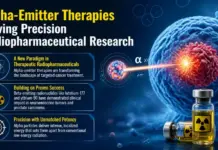


















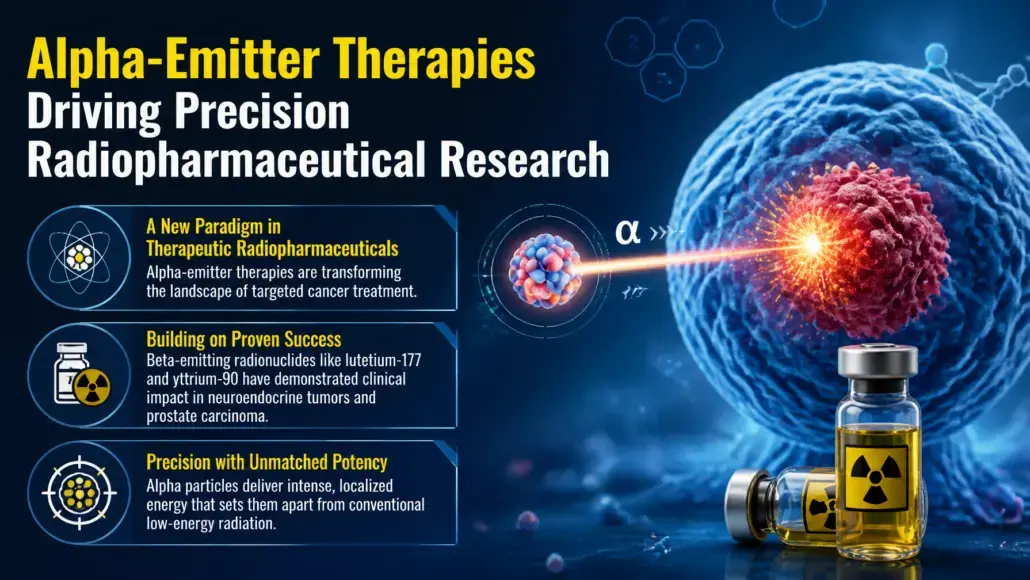
Therapeutic radiopharmaceuticals are undergoing an energetic paradigm shift. While beta-emitting radionuclides such as lutetium-177 and yttrium-90 established commercial proof of concept in neuroendocrine tumors and prostate carcinoma, precision alpha-emitter therapies are transforming clinical expectations for cytotoxic potency. Alpha particles possess physical characteristics that distinguish them fundamentally from conventional low-energy transfer radiation, providing intense localized energy deposition capable of sterilizing refractory micro-metastatic lesions and single-cell disease dissemination.
The physics governing alpha decay dictates its clinical value proposition. An alpha particle, consisting of two protons and two neutrons, carries an electric charge of plus two and a kinetic energy between five and nine megaelectronvolts. When an alpha particle travels through biological matter, it expends this massive kinetic payload over an ultra-short path length of fifty to one hundred micrometers, equivalent to just two to ten cell diameters. This concentrated energy release generates dense tracks of severe ionization, producing complex, unrepairable double-strand DNA breaks regardless of cellular oxygenation status or cell cycle phase.
Biophysical Superiority Over Beta Radiations
The primary clinical limitation of beta radiation relates to its modest linear energy transfer. Beta particles travel several millimeters through tissue, diluting their ionizing energy across hundreds of bystander cells and relying primarily on indirect, oxygen-dependent free radical formation to cause single-strand DNA breaks. Cancer cells frequently overcome this damage through up-regulated endogenous enzymatic repair pathways, giving rise to radiotherapeutic resistance.
Alpha emission overcomes these biological escape mechanisms through direct physical destruction:
- Linear energy transfer values for alpha particles average eighty to one hundred kiloelectronvolts per micrometer, roughly four hundred times higher than beta emissions.
- A single alpha particle traversal through a cell nucleus has a high probability of inducing lethal, clustered double-strand DNA breaks that overwhelm enzymatic repair mechanisms.
- Cell killing by alpha radiation occurs independently of microenvironmental hypoxia, making it lethal against hypoxic tumor cores that resist external beam radiotherapy and chemotherapy.
- Because cell destruction does not depend on active mitotic division, quiescent cancer stem cells and slowly cycling tumor cell subsets remain fully susceptible to alpha-induced apoptosis.
These physical attributes make alpha radiation ideal for eradicating minimal residual disease, micro-metastases, and circulating tumor cells before macroscopic organ colonization takes place.
Isotope Selection and Nuclear Supply Chain Constraints
Translating alpha emitters into clinical practice requires balancing half-life duration, daughter isotope stability, availability, and radiochemical coordination chemistry. Four principal alpha-emitting radionuclides dominate current pharmaceutical investigation: actinium-225, lead-212, astatine-211, and thorium-227.
Actinium-225 has emerged as the leading clinical isotope for systemic targeted radioligands. With a ten-day half-life, actinium-225 allows sufficient time for centralized pharmaceutical manufacturing, global freight logistics, and multi-day pharmacokinetics within patients. Its decay cascade generates four successive alpha particles, releasing approximately twenty-eight megaelectronvolts of cumulative ionizing energy per decay event.

However, the daughter recoil effect represents an engineering challenge in actinium chemistry:
- The radioactive decay of actinium-225 releases kinetic recoil energy exceeding one hundred kiloelectronvolts, which ruptures standard chemical chelator bonds.
- Free daughter isotopes, including francium-221 and bismuth-213, detach from the carrier molecule and enter systemic circulation.
- Unbound daughter isotopes can redistribute into off-target organs, creating potential nephrotoxic and salivary gland toxicity risks unless targeting constructs clear rapidly.
- Rapid cellular internalization of the radiopharmaceutical traps daughter isotopes inside tumor cells, ensuring that lethal energy remains contained within the malignant target.
Lead-212 presents an attractive alternative with a 10.6-hour half-life, serving as an in vivo alpha generator via beta decay to bismuth-212. Astatine-211, an alpha-emitting halogen with a 7.2-hour half-life, offers no radioactive daughters but requires regional cyclotron production and specialized carbon-astatine bonding chemistry.
Global isotope supply remains the principal operational bottleneck. Historical actinium-225 extraction depended on the radioactive decay of legacy thorium-229 stockpiles, yielding limited annual patient doses worldwide. Commercial radiopharmaceutical expansion is driving multi-million-dollar capital investments into high-energy proton accelerators, spallation targets, and electron cyclotrons to scale isotope supplies for global clinical trials.
Targeting Scaffolds and Chelator Innovation
The clinical efficacy of targeted alpha-emitter therapies depends on the carrier molecule that guides the radionuclide to its biological receptor. Radiopharmaceutical developers must match the physical half-life of the isotope with the biological pharmacokinetics of the targeting vehicle.
Monoclonal antibodies provide high target selectivity and retention, but their prolonged multi-day systemic circulation exposes radiosensitive bone marrow to continuous non-specific irradiation. Small molecules, engineered antibody fragments, and peptides offer faster blood clearance, reducing off-target exposure while allowing deep penetrative distribution into dense tumor tissue.
This requirement for rapid clearance and deep tissue penetration is accelerating research into agile delivery vehicles, illustrating why Peptide-Drug Conjugates Emerging as a New Therapeutic Platform are attracting intense development interest from translational oncologists. Peptides deliver payloads into cellular targets within minutes and clear through the kidneys swiftly, creating an ideal pharmacokinetic profile for pairing with high-potency cytotoxic payloads.
Concurrently, chelator engineering is addressing the retention of recoiling daughter radionuclides. Macrocyclic chelators such as DOTA and crown ethers have been modified to accelerate actinium chelation kinetics under milder temperature conditions, protecting heat-sensitive peptide targeting scaffolds from thermal denaturation during radiolabeling.
Nanoparticle carriers and multi-layer liposomes are also under active evaluation to sequester recoiling daughters. By encapsulating actinium-225 inside functionalized lipid or metal oxide cages, researchers can retain secondary daughter decays within the nanoparticle shell, preventing systemic redistribution of free radioisotopes to healthy renal tubules.
Clinical Translation Horizons and Market Trajectory
Clinical trials evaluating alpha-emitting radioligands are moving into earlier lines of cancer therapy. Initial clinical validations emerged from compassionate-use studies where patients refractory to lutetium-177 achieved complete biochemical remissions following actinium-225 radioligand administration, demonstrating the capability of high linear energy transfer to overcome entrenched radioresistance.
Current clinical trials are testing alpha radiopharmaceuticals as first-line therapies and in rational combinations with immune checkpoint inhibitors. Ionizing radiation from alpha particles induces immunogenic cell death, releasing tumor-associated neoantigens, calreticulin, and high-mobility group box 1 proteins. This inflammatory debris activates dendritic cells and recruits cytotoxic T lymphocytes into previously immunosuppressive tumor microenvironments.
Looking ahead, manufacturing decentralization and automated benchtop synthesizers will streamline hospital-based radiopharmacy workflows. As clinical trial pipelines mature and secondary cyclotron networks expand, Pharma Advancement observes that precision alpha-emitter therapies will establish standard-of-care status, providing oncology with an ultra-targeted modality capable of sterilizing refractory disease with microscopic precision.
