














AI-driven predictive maintenance is rapidly becoming the gold standard for operational excellence in the pharmaceutical manufacturing sector, particularly within the high-stakes environment of high-speed tablet conveyors. In a world where production downtime can cost thousands of dollars per minute and jeopardize the supply of life-saving medications, the ability to anticipate and prevent equipment failure is an invaluable asset. Traditionally, maintenance strategies have been either reactive—fixing machines after they break—or preventative—replacing parts on a fixed schedule regardless of their actual condition. Neither of these approaches is optimized for the complexity of modern Industry 4.0 facilities. AI-driven predictive maintenance, however, utilizes real-time data and machine learning algorithms to monitor the health of conveyor systems, allowing for targeted interventions that maximize equipment reliability and minimize disruption.
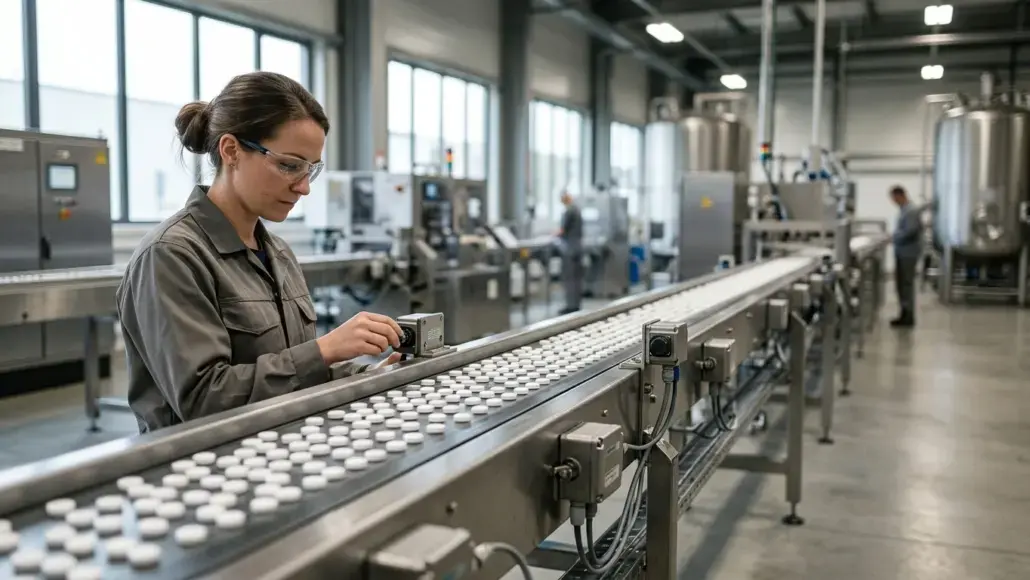
The high-speed tablet conveyor is a critical node in the oral solid dosage (OSD) production line. It is responsible for moving thousands of delicate tablets per minute between tablet presses, dedusters, coating machines, and packaging lines. Any vibration, misalignment, or mechanical wear in the conveyor can lead to tablet breakage, contamination, or a total system shutdown. By implementing AI-driven predictive maintenance, manufacturers can “listen” to the subtle mechanical signals that precede a failure—signals that are often invisible or inaudible to human operators. This transition from “fix-it-when-it-breaks” to “predict-and-prevent” is a fundamental shift that is driving the next generation of pharmaceutical manufacturing efficiency.
The Technical Architecture of AI-Driven Predictive Maintenance
To implement AI-driven predictive maintenance effectively, a robust technical architecture must be established. This begins with the installation of a comprehensive sensor network across the conveyor system. These sensors monitor a wide array of physical parameters, including vibration, temperature, acoustic emissions, and motor current. For a high-speed conveyor, even a slight increase in the vibration frequency of a bearing or a minor rise in the temperature of a drive motor can indicate the early stages of a mechanical fault. These sensors provide a continuous stream of high-fidelity data, which is then transmitted to a centralized data lake or cloud-based processing platform.
The second pillar of this architecture is the application of machine learning (ML) algorithms. These algorithms are trained on historical data to recognize the patterns associated with “normal” operation and those that precede specific failure modes. Over time, the AI system learns to distinguish between benign anomalies—such as a temporary load increase—and genuine indicators of wear. When the system detects a deviation that matches a known failure pattern, it generates an alert, providing maintenance teams with a detailed diagnosis and a recommended timeframe for action. Pharma Advancement notes that this data-driven approach ensures that maintenance is performed only when necessary, but always before a failure occurs, optimizing both equipment reliability and resource allocation.
Predictive Analytics and Vibration Analysis in Conveyor Systems
Vibration analysis is perhaps the most critical component of AI-driven predictive maintenance for conveyor systems. Every rotating component in a conveyor—from the drive motors to the rollers and pulleys—generates a unique “vibration signature.” By using piezoelectric accelerometers, the AI system can decompose these complex signals into their constituent frequencies. A healthy system will show a stable signature, while a worn bearing will produce a distinct spike at a specific frequency. Machine learning models are exceptionally good at identifying these spectral changes, often detecting them weeks or even months before a catastrophic failure would have occurred.
In the context of tablet conveyors, vibration analysis also helps in maintaining product quality. Excessive vibration doesn’t just damage the conveyor; it can also cause the tablets themselves to chip or degrade as they move along the line. By using AI-driven predictive maintenance to keep vibration levels within a narrow “green zone,” manufacturers can ensure that every tablet reaches the packaging stage in perfect condition. This integration of equipment health monitoring and quality assurance is a hallmark of the smart factory, where every data point is leveraged to improve the final output. The synergy between predictive analytics and mechanical engineering is what makes this technology so transformative for the pharmaceutical industry.
Enhancing Pharmaceutical Manufacturing Efficiency through Industry 4.0
The adoption of AI-driven predictive maintenance is a key part of the broader transition to Industry 4.0 in pharmaceutical manufacturing. In an Industry 4.0 environment, the factory is a fully connected ecosystem where machines, products, and systems communicate with each other in real-time. By integrating conveyor data with the broader manufacturing execution system (MES), manufacturers can achieve a level of visibility and control that was previously impossible. For example, if the AI system predicts that a conveyor motor will need maintenance in 48 hours, the MES can automatically adjust the production schedule to ensure that the maintenance happens during a planned changeover, minimizing the impact on overall throughput.
Furthermore, AI-driven predictive maintenance contributes to a more sustainable manufacturing model. By extending the life of conveyor components and reducing the number of unnecessary part replacements, manufacturers can significantly reduce their environmental footprint and waste. In the pharmaceutical sector, where specialized parts often come from global supply chains with high carbon costs, this efficiency is both an economic and an ethical imperative. The “digital twin” of the conveyor system—a virtual model that mirrors the physical asset’s real-time condition—allows engineers to simulate different operating scenarios and optimize the conveyor’s performance for maximum energy efficiency and minimal wear.
Reducing Downtime and Improving Equipment Reliability
The most immediate benefit of AI-driven predictive maintenance is the dramatic reduction in unplanned downtime. In a high-volume tablet production facility, an unexpected conveyor failure can lead to a “cascade effect,” where multiple machines upstream and downstream are forced to stop. The cost of clearing a jammed line, disposing of potentially contaminated product, and restarting the process can be immense. AI-driven predictive maintenance eliminates these “surprises” by providing early warnings. Maintenance teams can plan their interventions during scheduled downtime, ensuring that they have the right parts and tools on hand to fix the problem quickly and correctly the first time.
Improved equipment reliability also has a positive impact on employee safety and morale. Emergency repairs are often high-stress situations where the pressure to get the line running again can lead to shortcuts or accidents. By moving toward a planned maintenance model, manufacturers can create a safer and more controlled work environment. Maintenance technicians can transition from being “firefighters” to being data-driven specialists who focus on high-value tasks and system optimization. This cultural shift is essential for attracting and retaining the skilled talent needed to operate and maintain the complex technology of the modern pharmaceutical plant.
The Future of AI in Pharmaceutical Conveyor Systems
Looking ahead, the role of AI in conveyor systems will continue to expand. We are moving toward a future of “self-healing” or “self-optimizing” conveyors. In this vision, the AI-driven predictive maintenance system won’t just report a problem; it will actively intervene to mitigate it. For instance, if the system detects early-stage wear in a drive belt, it could automatically adjust the motor’s speed or tension to reduce the stress on that belt, extending its life until the next scheduled maintenance window. This level of autonomous control would represent the ultimate expression of equipment reliability and operational resilience.
We may also see the integration of augmented reality (AR) with AI-driven maintenance. A maintenance technician could wear an AR headset that overlays real-time conveyor health data and step-by-step repair instructions directly onto the physical machine. The AI system would guide the technician through the process, verifying that each step is completed correctly. This “human-in-the-loop” approach would combine the analytical power of AI with the tactile skills of a human expert, further reducing the risk of error. As the pharmaceutical industry continues to evolve, AI will remain the driving force behind a more efficient, reliable, and patient-centered manufacturing ecosystem.
Conclusion: A Strategic Imperative for Modern Pharma
In conclusion, AI-driven predictive maintenance is not just a technological luxury; it is a strategic imperative for any pharmaceutical manufacturer looking to thrive in the modern era. By leveraging the power of real-time data, machine learning, and predictive analytics, manufacturers can transform their tablet conveyor systems into highly reliable and efficient assets. The benefits—reduced downtime, improved product quality, enhanced safety, and greater sustainability—are clear and compelling. As we continue to move toward the vision of the fully autonomous smart factory, the ability to predict and prevent equipment failure will be the defining characteristic of the world’s leading pharmaceutical plants.
The journey toward full AI integration requires investment in both technology and people, but the return on that investment is a more resilient and responsive supply chain that can meet the global demand for medicine with confidence. Pharma Advancement believes that AI-driven predictive maintenance is the key to unlocking the full potential of high-speed tablet conveyors, ensuring that these critical machines remain the reliable backbone of pharmaceutical production for years to come. In the end, this technology is about more than just maintaining machines. It is about maintaining the promise of health and well-being for patients around the world by ensuring that their medications are always available, safe, and of the highest quality.
