


















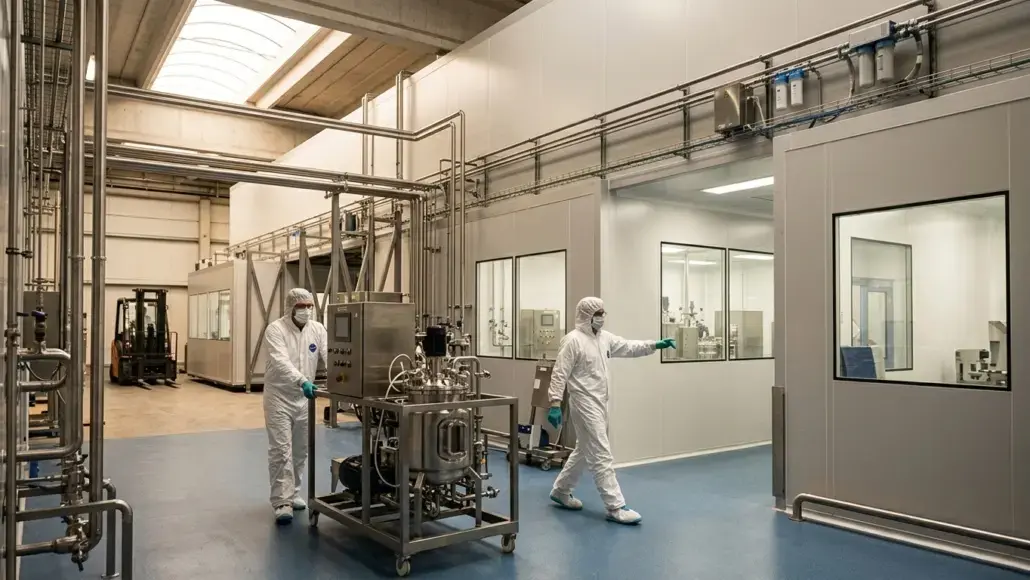
The pharmaceutical industry is currently witnessing a paradigm shift in how manufacturing infrastructure is conceptualized and executed. For decades, the development of a new Good Manufacturing Practice (GMP) production site was viewed as a Herculean task— a multi-year journey fraught with engineering complexities, regulatory hurdles, and the inherent unpredictability of traditional ‘stick-and-brick’ construction. However, the rise of advanced therapies, particularly in the cell and gene therapy (CGT) sectors, has rendered these legacy timelines obsolete. Today, Pharma Advancement believes that the ability to rapidly expand production capacity is not just a logistical goal but a competitive necessity. This is why modular GMP facility scaling has become the gold standard for organizations looking to bridge the gap between clinical development and commercial success.
Traditional construction methods, while reliable for conventional facilities, often struggle to keep pace with the volatile demands of the modern bioprocessing landscape. Building a facility from the ground up involves a linear sequence: site preparation, foundation work, structural framing, and the installation of complex mechanical, electrical, and plumbing (MEP) systems, followed by months of rigorous validation. In contrast, modular construction allows for a parallel workflow that fundamentally alters the project economics. By moving the majority of the construction process into a controlled factory environment, companies can ensure that their cleanroom components are being fabricated simultaneously with site preparation. This synergy is the primary driver behind why modular GMP facility scaling is enabling projects to reach completion in half the time compared to traditional methods.
The Strategic Shift Toward Prefabricated Cleanrooms
The move toward modularity is driven by a need for both speed and predictability. In the high-stakes environment of pharmaceutical manufacturing, a delay of even a few months can result in millions of dollars in lost revenue and, more importantly, a delay in life-saving treatments reaching patients. Prefabricated cleanroom systems offer a level of precision that is nearly impossible to achieve on a construction site. These units are built to exacting standards, often featuring integrated HVAC systems, air filtration, and digital monitoring tools that are pre-tested before they ever leave the factory floor. This level of quality control ensures that modular GMP facility scaling is not just about moving fast, but about moving with confidence.
Furthermore, the modular approach addresses the validation bottleneck. In a traditional build, the validation process—comprising Installation Qualification (IQ), Operational Qualification (OQ), and Performance Qualification (PQ)—only begins after the physical structure is complete. With modular units, much of the documentation and pre-qualification can be handled at the factory. When these units arrive at the client’s site, they are essentially plug-and-play, allowing the validation team to focus on the integration of the units rather than building the systems from scratch. This streamlined approach to regulatory compliance is a key reason why modular GMP facility scaling is being adopted by both emerging biotechs and established pharmaceutical giants.
Standardization: The Engine of Rapid Expansion
One of the most significant advantages of modularity is the ability to leverage standardized designs. In the past, every cleanroom was a custom project, requiring unique engineering and design solutions. This customization led to high costs and long lead times. Today, modular providers offer a catalog of pre-qualified designs that are optimized for specific bioprocessing tasks, from viral vector production to fill-finish operations. By utilizing these standardized templates, companies can bypass the lengthy design phase and move straight into production. This standardization is the backbone of modular GMP facility scaling, providing a repeatable model for global expansion.
This repeatability is particularly valuable for companies looking to establish a presence in multiple geographic markets. Instead of navigating the nuances of local construction practices in different countries, a firm can deploy the same modular design across its global network. This ensures consistency in quality and operational procedures, making it much easier to transfer processes between sites. When a company masters the art of modular GMP facility scaling, it creates a scalable blueprint that can be replicated as demand grows, providing a strategic moat against competitors who are still tied to traditional construction models.
Flexibility and Future-Proofing in a Dynamic Market
The biopharmaceutical market is notoriously unpredictable. A therapy that looks promising in Phase II may fail in Phase III, or a breakthrough in processing technology might suddenly render an existing facility layout inefficient. Traditional facilities are notoriously difficult to modify; once the walls are up and the pipes are laid, any change is a major undertaking. Modular facilities, however, are designed with flexibility in mind. The modular nature of the walls and utility connections allows for relatively easy reconfiguration or expansion. This adaptability is a core tenet of why modular GMP facility scaling is the preferred choice for forward-thinking manufacturers.
If a company needs to add a new bioreactor suite or increase its storage capacity, modular units can be added to the existing structure with minimal disruption to ongoing operations. This ‘Lego-like’ scalability allows firms to scale their infrastructure in lockstep with their clinical and commercial progress. They can start with a small clinical-scale facility and then add modules as they transition to full-scale commercial manufacturing. This phased approach to capital expenditure reduces financial risk while ensuring that the company always has the capacity it needs. In essence, modular GMP facility scaling provides an insurance policy against the uncertainty of the drug development lifecycle.
Sustainability and the Environmental Impact of Modularity
Beyond speed and flexibility, the shift toward modular construction also offers significant environmental benefits. Traditional construction sites are major sources of waste, noise, and carbon emissions. Modular construction, by virtue of its factory-based approach, is inherently more efficient. Material waste is minimized through precise engineering, and the controlled environment allows for better management of energy and resources. For a pharmaceutical industry increasingly focused on Environmental, Social, and Governance (ESG) goals, the adoption of modular GMP facility scaling represents a clear path toward more sustainable operations.
The reduction in onsite activity also means fewer disruptions to the local community and a smaller carbon footprint associated with worker transportation and heavy machinery usage. When the modular units are delivered, they are often assembled in a matter of days or weeks, significantly reducing the duration of onsite construction noise and traffic. As companies look to align their infrastructure growth with their sustainability commitments, the case for modular GMP facility scaling becomes even more compelling. It is a rare example of a solution that improves the bottom line while also benefiting the planet.
Conclusion: Embracing the Modular Future
As we look toward the future of biomanufacturing, it is clear that the days of the monolithic, site-built facility are numbered. The speed at which new therapies are being developed requires a manufacturing response that is equally rapid and agile. Modular GMP facility scaling has proven to be the most effective way to meet this challenge, providing a path to market that is faster, safer, and more predictable than anything that has come before. By embracing prefabrication, standardization, and flexible design, pharmaceutical companies can ensure that they are ready to meet the needs of patients, regardless of how the market evolves.
The transition to modularity is more than just a change in construction technique; it is a fundamental shift in mindset. It requires moving away from the bespoke mentality and toward a more industrial, scalable approach to facility development. For those who successfully navigate this transition, the rewards are clear: faster speed to market, reduced capital risk, and a more sustainable manufacturing footprint. In the race to bring the next generation of therapies to the world, Pharma Advancement believes that modular GMP facility scaling is the engine that will drive the industry forward.
