






















In the pharmaceutical industry, where the production of life-saving medications must adhere to uncompromising standards of quality and sterility, the reliability of facility utilities is not merely a technical requirement it is a strategic imperative. Utilities such as Water for Injection (WFI), purified air, and clean steam are the lifeblood of the manufacturing floor. Any failure in these systems can halt production instantly, leading to the loss of high-value batches, regulatory non-compliance, and, most critically, a shortage of essential medicines for patients. Pharma utility redundancy is the primary defense against such disruptions. By designing systems with built-in backups and fail-safes, manufacturers can ensure business continuity, protecting their investments and their reputation for reliability in an increasingly volatile global market.
The Economic and Clinical Stakes of Utility Failure
To understand the value of pharma utility redundancy, one must first appreciate the consequences of failure. A pharmaceutical manufacturing process is a tightly controlled sequence of events. If a cleanroom loses its pressure differential because of an HVAC failure, or if a WFI loop drops below its validated temperature, the entire environment is compromised. For many modern biologics and cell therapies, the production cycle can last for weeks, with costs per batch reaching into the millions. A utility failure at the final stage of production is an economic catastrophe.
Beyond the financial loss, the clinical impact of a supply disruption can be devastating. Many pharmaceutical products have no direct substitutes, and a manufacturing shutdown can lead to nationwide or even global shortages. Regulatory agencies like the FDA and EMA view the reliability of manufacturing as a key component of public health. Consequently, a facility that experiences frequent utility-related shutdowns may face increased scrutiny, leading to warning letters or even the suspension of manufacturing licenses. Pharma utility redundancy is, therefore, a fundamental requirement for risk mitigation, ensuring that the supply of medicine remains steady and secure.
Strategic Approaches to Redundancy in Critical Systems
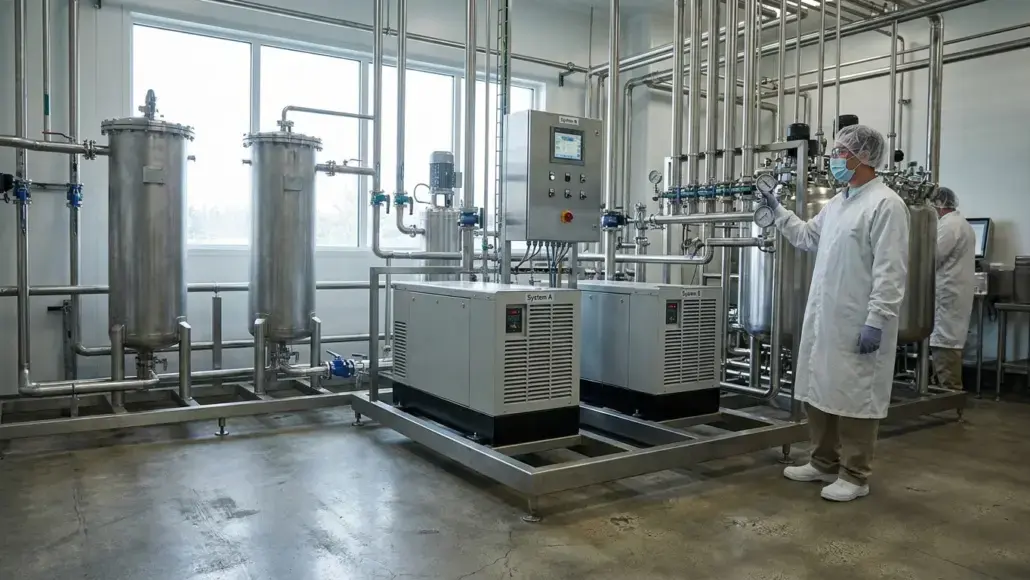
True pharma utility redundancy goes beyond simply having a second pump or a backup generator. It involves a holistic “N+1” or even “N+2” design philosophy, where “N” represents the capacity required to support full production, and the additional units provide the redundancy. For example, in a WFI system, this might mean having two independent generation units and two separate distribution loops. If one unit requires maintenance or experiences a failure, the second can take over the full load without any interruption to the manufacturing floor. This level of redundancy allows for “maintenance without shutdown,” a critical capability for facilities that operate 24/7.
In the case of HVAC systems, redundancy is often achieved through the use of redundant fan arrays and dual-source power supplies. If a motor fails in a fan array, the remaining fans can increase their speed to maintain the required airflow and pressure differentials. Furthermore, the integration of Uninterruptible Power Supplies (UPS) and rapid-start diesel generators ensures that critical utility systems remain powered during municipal grid failures. Pharma utility redundancy must also account for the diversity of supply; for instance, a facility might have a primary connection to a municipal water source and a secondary, on-site well to ensure a continuous supply of raw water for purification.
Balancing Redundancy with Operational Efficiency
One of the challenges in implementing pharma utility redundancy is balancing the need for backup capacity with the desire for operational efficiency. Maintaining redundant equipment that rarely runs can be expensive and can lead to its own set of problems, such as stagnant water in a backup loop or “seizing” of idle pumps. Modern facilities address this through “active redundancy” and lead-lag configurations. Instead of having one unit running and one sitting idle, both units run at 50% capacity. This ensures that all equipment remains in good working order and that a failure in one unit only requires the other to ramp up, rather than having to perform a cold start.
Furthermore, the use of smart controls and automation allows for the seamless transition between primary and redundant systems. Digital monitoring can detect a drop in performance such as a slight increase in the temperature of a chilled water loop and automatically bring the redundant unit online before the system exceeds its validated limits. This proactive approach to pharma utility redundancy minimizes the stress on the system and ensures that production remains within the “sweet spot” of its operating parameters. By integrating redundancy into the digital management of the facility, manufacturers can achieve resilience without sacrificing efficiency.
The Role of Redundancy in Regulatory Compliance
Regulatory bodies are increasingly focusing on the resilience of pharmaceutical infrastructure as a key part of Good Manufacturing Practice (GMP). Annex 1 of the EU GMP, for example, emphasizes the importance of maintaining a validated state at all times. A facility that lacks adequate pharma utility redundancy is inherently more prone to deviations, which can complicate the validation process and increase the burden of quality investigations. Redundancy provides a “buffer” that allows for minor equipment issues to be resolved without impacting the quality of the product or the integrity of the manufacturing environment.
Moreover, having a robust redundancy strategy is a critical component of a site’s Contamination Control Strategy (CCS). If a utility system fails and a cleanroom is compromised, the subsequent cleaning and re-validation process can be extensive. Redundancy prevents these “events” from happening in the first place, thereby maintaining the facility in a constant state of control. When regulators inspect a plant, a well-documented and tested redundancy plan serves as a powerful indicator of the company’s commitment to quality and business continuity. It demonstrates that the manufacturer has considered the risks and has invested in the infrastructure necessary to protect the patient.
Future Trends: Decentralized Utilities and Smart Grids
As we look to the future, the concept of pharma utility redundancy is evolving to include decentralized and modular utility solutions. Instead of one massive, centralized WFI or HVAC plant, facilities are being designed with smaller, localized units that serve specific production lines. This “cellular” approach to utilities provides an inherent level of redundancy; if one unit fails, only a small portion of the plant is affected. This modularity also allows for easier expansion and faster commissioning of new capacity.
We are also seeing the integration of pharmaceutical facilities into “smart microgrids,” where on-site renewable energy sources, such as solar arrays and battery storage, provide a redundant and sustainable power supply. This not only improves business continuity by reducing reliance on the municipal grid but also supports the industry’s sustainability goals. The future of pharma utility redundancy is one of intelligence and integration, where physical backups are combined with digital foresight to create a manufacturing environment that is truly “always on.”
Conclusion: Investing in Reliability
Pharma utility redundancy is not an area where manufacturers can afford to cut corners. While the initial capital investment in redundant systems may be significant, the cost of a single major utility failure can far outweigh those expenses. Business continuity is built on the foundation of reliable infrastructure, and in the pharmaceutical world, that reliability is a prerequisite for success. By prioritizing pharma utility redundancy, companies protect their products, their financial health, and their commitment to the patients who depend on them. A resilient facility is a confident facility, capable of navigating the challenges of modern manufacturing and delivering the high-quality medicines that the world needs.
