







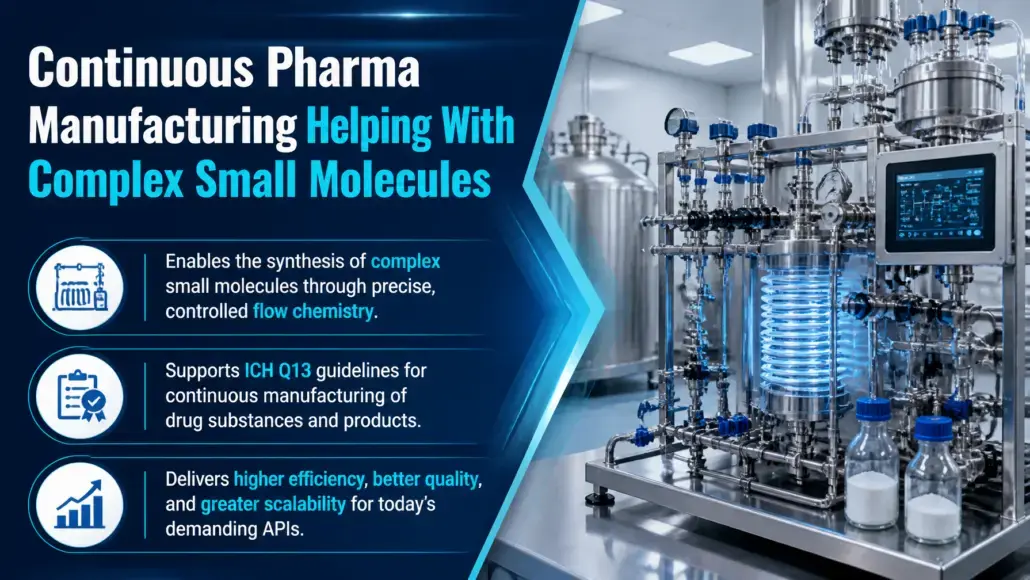
Commercial pharmaceutical manufacturing is undergoing a decisive transition as drug developers shift complex active pharmaceutical ingredient synthesis from legacy multi-vessel batch campaigns to integrated flow chemistry platforms. Driven by the international adoption of the International Council for Harmonisation ICH Q13 guidelines on the continuous manufacturing of drug substances and drug products, pharmaceutical companies and contract development and manufacturing organizations are dismantling decades-old operational paradigms. Synthetic routes for modern drug candidates routinely demand seven to twelve discrete chemical transformations, frequently involving unstable intermediates, hazardous reagents, and narrow thermal margins that strain traditional batch reactors. Continuous processing resolves these bottlenecks by conducting reactions within precisely regulated fluidic channels, maintaining steady-state conditions that elevate product yield while compressing development timelines.
The traditional batch model relies on massive stirred tanks where reagents are combined over hours, creating thermal and concentration gradients that generate unintended degradation products. When dealing with complex molecular architectures such as stereochemically dense heterocycles, kinase inhibitors, or cytotoxic payloads, even minor localized temperature spikes degrade batch quality. Pharma Advancement notes that by replacing large reaction vessels with continuous flow reactors, process engineers restrict active reaction volumes to milliliters or liters at any given second. This architectural shift eliminates hazardous runaway risks and delivers uniform mixing throughout the synthetic pathway.
Engineering Precision Across Continuous Reaction Platforms
Continuous small molecule manufacturing relies on distinct reactor geometries configured to match specific reaction kinetics, thermodynamics, and fluid dynamics. Microreactors, tubular plug flow reactors, and cascades of continuous stirred-tank reactors operate in concert to execute continuous multi-step synthesis without intermediate stoppage.
Key mechanical and operational attributes of these systems include:
- Microchannel reactors with internal hydraulic diameters below one millimeter, providing surface-area-to-volume ratios exceeding ten thousand square meters per cubic meter for near-instantaneous thermal dissipation.
- Tubular plug flow designs engineered with specialized static mixing elements to ensure uniform residence time distributions during extended reaction phases.
- Cascaded continuous stirred-tank systems equipped with real-time slurry handling mechanics to prevent particulate clogging during organometallic precipitation steps.
- Automated fluidic switching manifolds that divert transient off-spec material automatically during operational startup and shutdown phases.
These fluidic architectures allow chemical engineers to safely access extreme synthetic regimes that are practically impossible in conventional hundred-liter stirred tanks. High-energy chemistry, including exothermic nitrations, organolithium halogen-metal exchanges, diazotizations, and ozonolysis, proceeds under exact stoichiometric control. Liquid residence times are measured in seconds or minutes rather than hours, dramatically curtailing the exposure of sensitive functional groups to aggressive reaction environments.
Operational Economics and Infrastructure Modernization
The commercial justification for transitioning to continuous processing extends well beyond reaction safety. Pharmaceutical manufacturing facilities have historically required expansive, capital-heavy infrastructure dedicated to running large, isolated campaigns, followed by lengthy cleaning and validation protocols. Continuous processing fundamentally alters these unit economics by decoupling volumetric throughput from equipment footprint.
Substantial efficiency gains achieved across commercial facilities include:
- Reduction of commercial cleanroom production footprints by 40 to 60 percent, lowering initial capital expenditure for new active pharmaceutical ingredient facilities.
- Compression of overall synthesis cycle times from several weeks down to less than twenty-four hours from raw material introduction to isolated intermediate.
- Elimination of physical scale-up risk through numbering up parallel microfluidic channels or increasing volumetric flow rates while preserving identical transport geometry.
- Solvent consumption reductions of 30 to 50 percent, directly lowering specialized disposal expenditures and raw material inventory carrying costs.
Recent manufacturing benchmarks compiled across global regulatory filings show that continuous active pharmaceutical ingredient production lines require significantly smaller capital outlays than equivalent capacity batch plants. Because production volumes are adjusted by varying operational run time rather than rebuilding larger tanks, drug sponsors can align commercial supply directly with real-time market demand, eliminating expensive inventory buffers and minimizing working capital requirements.
Telescoping Multi-Step Synthesis and Hazardous Route Management
A central advantage of flow processing is reaction telescoping, where consecutive synthetic steps occur sequentially without isolating, drying, or purifying intermediate compounds. In conventional manufacturing, each chemical step requires dedicated solvent removal, crystallization, filtration, and analytical testing, adding weeks of non-productive downtime and causing cumulative yield degradation.
Continuous pipelines link individual synthetic stages through inline extraction modules, membrane-based phase separators, and continuous quenching loops. An unstable intermediate generated in an initial high-temperature microreactor can flow directly into a second catalytic column within seconds, preventing degradation. This capability is proving vital for novel oncology therapeutics featuring reactive electrophilic warheads that decompose rapidly in bulk solution.
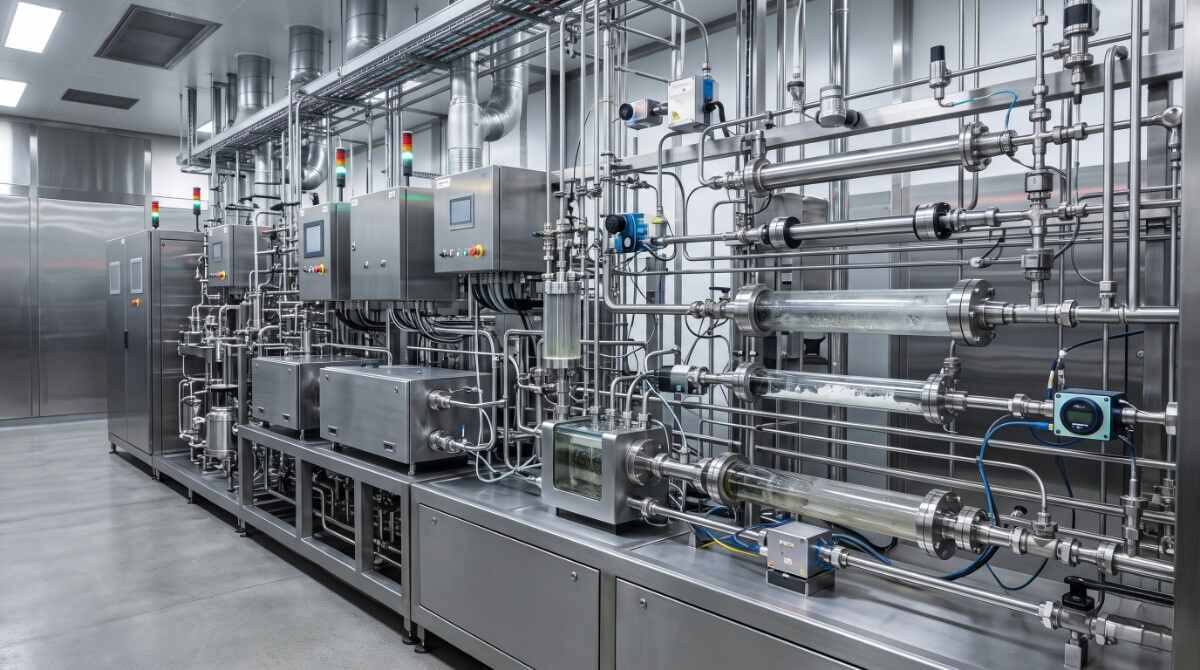
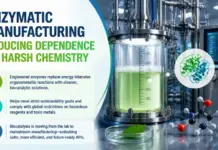
To eliminate hazardous organometallic reagents and extreme thermal quenching steps within multi-stage flow sequences, development teams increasingly integrate biocatalytic packed beds alongside chemical reactors, where enzymatic manufacturing routes reducing dependence on harsh chemistry provide precise stereo-selective conversions in mild aqueous environments. Combining chemocatalysis and biocatalytic transformations inside continuous loops allows process chemists to construct highly congested chiral centers while operating under benign solvent conditions.
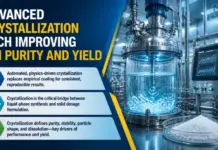
Managing solids remains the primary technical challenge in continuous chemical processing. Precipitating salts, slurries, and active pharmaceutical ingredient solids can rapidly foul narrow microchannels. Modern continuous manufacturing platforms overcome this challenge through specialized active-flow technology, including continuous oscillatory baffled reactors, acoustic levitation fields, and targeted ultrasonic transducers mounted along reactor walls to maintain slurry dispersion and prevent fouling.
In-Line Process Analytics and Quality Assurance
Regulatory compliance for continuous drug substance manufacturing depends heavily on automated, real-time quality verification rather than retrospective batch testing. Under the guidance established in ICH Q13, quality is continuously measured throughout the entire production lifecycle using integrated Process Analytical Technology.
Core analytical components deployed within commercial continuous pipelines include:
- In-line Fourier-transform near-infrared spectrometers monitoring functional group conversions and reagent consumption in real time.
- Flow-through Raman probes assessing dissolved intermediate concentrations and detecting crystal nucleation events within fluid streams.
- High-speed automated liquid chromatography sampling interfaces capable of extracting, diluting, and analyzing reaction aliquots every two minutes.
- Automated feedback control architectures that instantly adjust pump flow rates, backpressure regulators, or heating jackets upon detecting minute compositional drift.
By coupling continuous process analytical data with hydrodynamic dispersion models, manufacturers construct definitive residence time distribution curves. This data determines the exact physical location of every milliliter of material moving through the reactor train. If an operational excursion occurs, such as a temporary pressure fluctuation or a reagent pump malfunction, the control system calculates precisely when that compromised volume reaches the outlet and triggers high-speed diversion valves to isolate the rejected fraction. The rest of the production run continues unaffected, entirely eliminating the catastrophic commercial losses associated with whole-batch rejections.
Global health authorities, including the United States Food and Drug Administration and the European Medicines Agency, actively encourage the adoption of continuous small molecule manufacturing because it provides superior process certainty. Automated data collection generates comprehensive digital records that satisfy stringent data integrity mandates while supporting real-time release testing. As market pressures demand lower costs, faster delivery, and greener active pharmaceutical ingredient synthesis, Pharma Advancement observes that continuous manufacturing provides the technical foundation for the next generation of small molecule therapeutics.
