



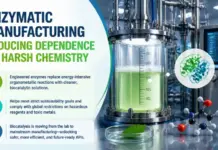




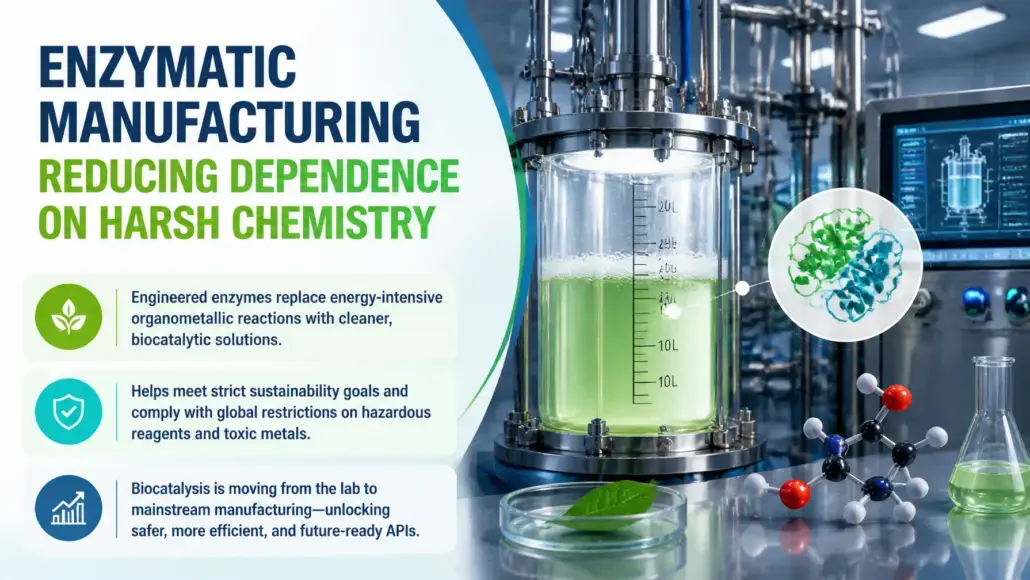
Commercial pharmaceutical active ingredient synthesis is undergoing a fundamental realignment as developers replace energy-intensive organometallic transformations with engineered biological catalysts. Accelerated by stringent corporate decarbonization commitments and tightening global restrictions on hazardous industrial reagents, including per- and polyfluoroalkyl substances and toxic transition metals, biocatalytic routes are transitioning from niche academic curiosities to mainstream industrial standards. Synthetic campaigns for complex modern drugs often demand extreme stereochemical precision, requiring multi-step protecting group manipulations and expensive chiral auxiliaries under conventional chemocatalytic conditions. Biocatalytic platforms bypass these tortuous synthetic detours by executing exquisite chemo, regio, and stereoselective conversions in mild aqueous environments, drastically reducing waste generation while strengthening supply chain resilience.
Traditional synthetic organic chemistry has long depended on heavy transition metals such as palladium, rhodium, and ruthenium to catalyze challenging carbon-carbon and carbon-heteroatom bond formations. Beyond their substantial financial cost and volatile global supply, these precious metal catalysts pose persistent regulatory risks regarding residual metal contamination in final drug substances. Strict limits enforced by international pharmacopeias necessitate intensive, yield-sapping scavenging and recrystallization steps. In contrast, Pharma Advancement notes that enzymatic manufacturing routes utilize biodegradable protein catalysts that operate without toxic metal residues, simplifying regulatory compliance and eliminating hazardous contamination vectors at their source.
Computational Design and Directed Evolution Capabilities
The industrial viability of modern biocatalysis stems from revolutionary breakthroughs in protein engineering, structural biology, and artificial intelligence-driven molecular modeling. Wild-type enzymes rarely possess the structural robustness, substrate tolerance, or turnover rates required for commercial pharmaceutical production. Through advanced directed evolution protocols and predictive machine learning models, computational biologists routinely re-engineer native enzyme scaffolds to withstand non-natural operating conditions.
Key performance characteristics engineered into modern industrial biocatalysts include:
- Elevated thermal stability allowing continuous operations at temperatures exceeding sixty degrees Celsius to improve substrate solubility and reaction kinetics.
- Exceptional organic co-solvent tolerance, maintaining structural integrity and catalytic activity in reaction media containing up to fifty percent acetonitrile, dimethyl sulfoxide, or methanol.
- Broadened active-site pocket geometries capable of accommodating bulky, highly functionalized drug intermediates that bear little resemblance to natural biological substrates.
- Remarkable turnover numbers and catalytic efficiencies that minimize required enzyme loadings, frequently operating below one percent by weight relative to substrate input.
- Inherent resistance against product inhibition, permitting reactions to proceed to high completion titers without requiring continuous liquid-liquid extraction.
Engineered enzyme families now tackle transformations previously considered the exclusive domain of synthetic organic reagents. Transaminases directly install chiral amine centers from prochiral ketones in a single step, bypassing multi-stage reductive aminations that historically generated stoichiometric metal waste. Engineered ketoreductases deliver enantiomerically pure chiral alcohols with enantiomeric excesses exceeding ninety-nine percent, while imine reductases, cytochrome P450 monooxygenases, and halogenases enable targeted late-stage functionalization on highly congested molecular cores without requiring protective groups. Furthermore, computational enzyme design tools can now model transition-state stabilization across non-canonical substrates, reducing the experimental screening cycles required to discover high-performing mutant candidates from dozens of rounds down to just two or three iterations.
Environmental Metrics and Process Mass Intensity Gains
The environmental case for adopting enzymatic routes is reflected in the dramatic compression of Process Mass Intensity metrics monitored by the American Chemical Society Green Chemistry Institute Pharmaceutical Roundtable. Traditional multi-step chemical synthesis routinely exhibits environmental E-factors between fifty and one hundred, indicating that fifty to one hundred kilograms of hazardous waste are generated for every single kilogram of therapeutic drug substance produced.
Substantial environmental and operational gains documented across commercial biocatalytic campaigns include:
- Direct reduction of overall process mass intensity by 40 to 70 percent through the elimination of stoichiometric protecting and deprotecting sequences.
- Reduction of volatile organic solvent consumption by up to 80 percent by conducting enzymatic conversions in water-dominant buffer solutions.
- Complete eradication of cryogenic operating envelopes, shifting reactions from minus seventy-eight degrees Celsius down to ambient room temperature and cutting facility energy expenditures.
- Avoidance of specialized, high-cost waste remediation treatments required for organometallic complexes, hazardous hydrides, and halogenated waste streams.
- Substantial abatement of greenhouse gas emissions associated with high-temperature thermal incineration of chlorinated chemical solvents.
These sustainability metrics represent direct operational cost savings. Managing and incinerating toxic chemical effluent constitutes a major expenditure for active ingredient producers. By substituting hazardous reagents with biodegradable enzymes and benign aqueous salts, manufacturers substantially curtail hazardous waste liabilities and align their operations with emerging corporate and regulatory environmental standards.
Downstream Isolation and Phase Management Realities
Transitioning from organic solvents to aqueous biocatalysis introduces unique chemical engineering considerations across downstream recovery phases. Enzymatic reaction mixtures typically yield dilute aqueous solutions containing spent protein, residual cofactors, and emulsifying surfactants alongside the desired active molecule.
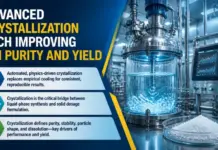
While biocatalytic transformations excel at generating high enantiomeric purity in water-rich crude mixtures, isolating the final active ingredient requires advanced crystallization technologies improving API purity and yield to harvest well-defined crystal polymorphs without compromising thermal or chemical integrity. Efficient phase separation, controlled anti-solvent addition, and precise temperature ramping ensure that sensitive organic molecules crystallize cleanly without trapping residual biological proteins or trace inorganic salts within the crystal lattice.
Biocatalytic development teams deploy various physical containment strategies to simplify downstream purification:
- Covalent enzyme immobilization onto porous polymeric beads or silica matrices, enabling rapid physical recovery and catalyst reuse across dozens of successive synthetic cycles.
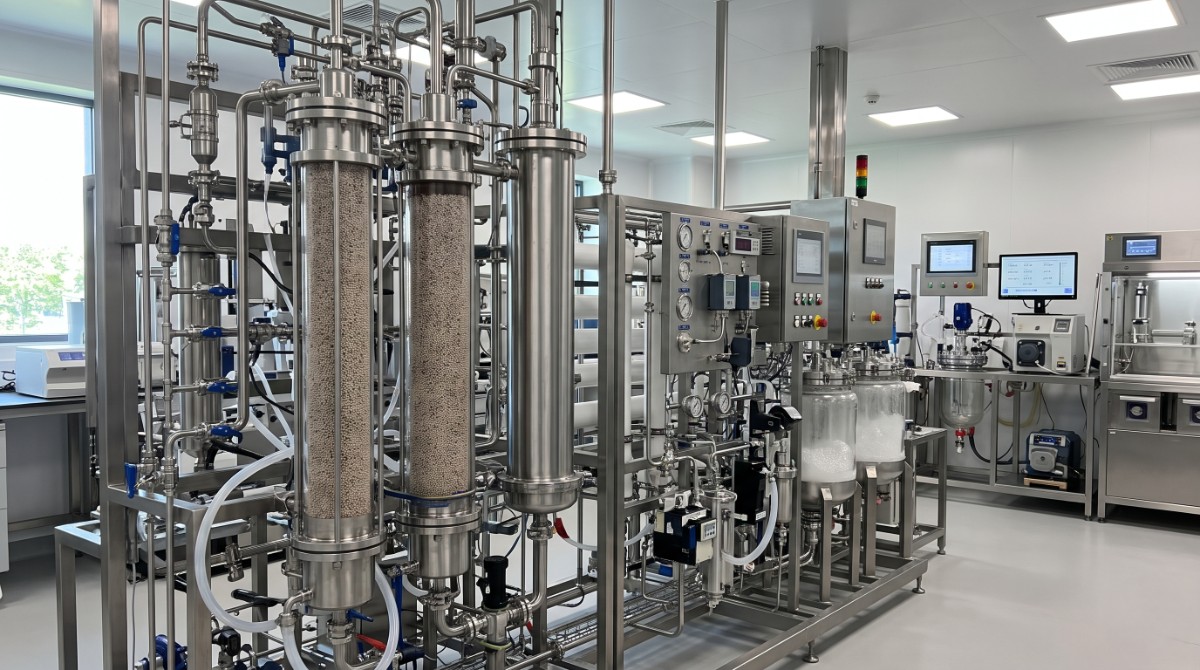
- Packed-bed continuous flow biocatalytic reactors that contact immobilized enzymes with flowing substrate streams, preventing enzyme carryover into downstream product collection tanks.
- Cross-linked enzyme aggregates that maintain structural stability without requiring inert support carriers, maximizing active volumetric productivity within compact footprint geometries.
- Ultrafiltration and nanofiltration membrane skids that separate high-molecular-weight enzymes from low-molecular-weight product streams prior to final crystallization.
- Automated inline flocculation and depth filtration assemblies that rapidly aggregate and remove precipitated residual biocatalyst fractions without fouling downstream filter plates.
Cofactor regeneration remains a vital economic consideration for industrial oxidoreductases that consume expensive nicotinamide adenine dinucleotide or related coenzymes. Modern commercial processes resolve this challenge by coupling primary synthetic enzymes with auxiliary regeneration systems, such as glucose dehydrogenase or formate dehydrogenase. These coupled catalytic loops regenerate reduced cofactors in situ using inexpensive sacrificial co-substrates like glucose or sodium formate, driving reaction equilibrium forward while maintaining exceptionally favorable process economics.
Commercial Scale Integration and Market Trajectory
Pharmaceutical manufacturers are increasingly embedding biocatalytic stages within core manufacturing pipelines for commercial oncology, antiviral, and metabolic therapies. Contract development organizations are expanding specialized enzyme screening libraries and high-throughput microtiter robotics to evaluate thousands of catalyst variants in parallel, shortening biocatalytic route selection from months to weeks.
Regulatory authorities have developed mature evaluation frameworks for biocatalytic active ingredient manufacturing. Agencies review enzyme safety, host cell protein clearance, and bioburden controls using well-established quality risk management principles. Validated enzyme-linked immunosorbent assays and total organic carbon monitoring guarantee that active drug substances meet parts-per-million purity specifications for residual biologics. Because biocatalytic routes operate under inherently safe conditions without severe pressure or thermal volatility, they present negligible industrial hygiene or process safety risks. As molecular complexity continues to rise across drug discovery pipelines, Pharma Advancement notes that enzymatic manufacturing routes provide the essential synthetic precision and environmental efficiency required for sustainable, modern pharmaceutical active ingredient production.
