








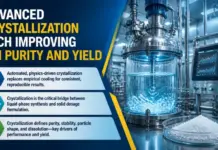








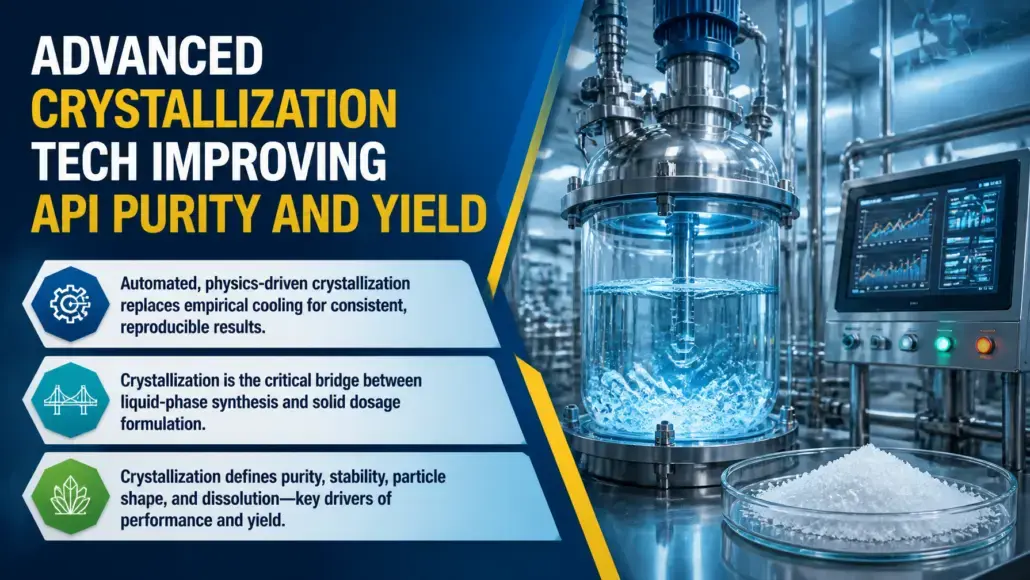
Commercial active pharmaceutical ingredient manufacturing is undergoing an engineering renaissance as drug developers replace empirical cooling protocols with automated, physics-driven crystallization platforms. Solid-state isolation represents the critical bridge between liquid-phase chemical synthesis and secondary drug product formulation. The physical characteristics established during crystallization determine crystalline purity, chemical stability, particle morphology, dissolution kinetics, and downstream tableting performance. Driven by increasing structural complexity across active pharmaceutical ingredient pipelines and the commercial necessity to eliminate costly batch failures, active drug developers are deploying advanced crystallization technologies to ensure absolute polymorphic fidelity and maximize chemical yields.
In legacy batch operations, crystallization has frequently been treated as an empirical art rather than a predictable science. Large agitated tanks subject cooling slurries to non-uniform shear profiles, creating unpredictable supersaturation gradients across the vessel. These localized variations often trigger uncontrolled secondary nucleation, leading to broad particle size distributions, solvent inclusion, and the formation of undesirable metastable polymorphs. Because polymorphic transformations can alter drug solubility and therapeutic bioavailability, an unexpected polymorphic transition during late-stage production can delay commercial drug release or result in catastrophic batch rejection. Pharma Advancement notes that modern crystallization engineering solves these challenges by combining continuous thermodynamic modeling with precision mechanical interventions.
Thermodynamic Precision and Controlled Supersaturation Trajectories
Controlling the supersaturation driving force within the metastable zone width is the cornerstone of modern crystallization engineering. Rather than relying on linear temperature reduction schedules that inevitably trigger sudden, uncontrolled crash nucleation, automated systems employ feedback-controlled concentration trajectories that keep the crystallizing solution within an optimal growth corridor.
Key operational capabilities embedded within these automated platforms include:
- Attenuated total reflectance ultraviolet-visible and infrared spectroscopy tracking dissolved solute concentrations in real time to calculate instantaneous solution supersaturation.
- Focused beam reflectance measurement probes monitoring chord length distributions in situ to track crystal count and detect early nucleation onset without manual sampling.
- High-resolution in situ video microscopy utilizing automated image analysis algorithms to continuously evaluate crystal habit, aspect ratio, and agglomeration severity.
- In-line Raman spectroscopy immersion optics verifying polymorphic form identity continuously within the slurry, alerting operators to unexpected solid-state transitions within seconds.
- Precision dry-seed and wet-milled seed conditioning systems delivering well-characterized crystalline nuclei at exact supersaturation levels to bypass spontaneous primary nucleation.
- Automated anti-solvent metering loops that adjust non-solvent addition rates dynamically based on real-time solubility curves, preventing oiling out and amorphous phase separation.
- Dynamic heating and cooling cycles deployed within the metastable zone to dissolve unwanted fine particles and selectively promote the growth of larger, uniform seed crystals.
By keeping solution supersaturation strictly within validated limits, active ingredient manufacturers suppress primary nucleation in favor of controlled secondary crystal growth. This operational control prevents the entrapment of mother liquor and chemical impurities within the growing crystal lattice, elevating final active substance purity beyond ninety-nine point five percent while dramatically reducing the volume of wash solvent required during downstream isolation. Furthermore, automated supersaturation control allows process chemists to accomplish direct chiral resolution via preferential crystallization of enantiomeric pairs, selectively growing desired enantiomers while retaining optical antipodes in solution.
Mechanical and Acoustic Innovations in Continuous Crystallizers
Achieving consistent crystal size distributions has led to the widespread adoption of continuous crystallization architectures that replace unmixed stirred tanks with uniform fluidic geometries. Continuous crystallization platforms maintain constant steady-state supersaturation profiles, ensuring that every crystal experiences an identical thermodynamic environment from nucleation to discharge.
Significant mechanical advancements modernizing commercial crystallization facilities include:
- Mixed-suspension mixed-product removal cascades that decouple nucleation and growth phases across distinct, interconnected continuous stages.
- Continuous oscillatory baffled crystallizers utilizing periodic fluidic oscillation through annular orifice plates to generate uniform radial mixing without high mechanical shear.
- High-intensity sonocrystallization modules applying targeted acoustic cavitation fields to induce reproducible primary nucleation at exceptionally low supersaturation thresholds.
- Microfluidic impinging-jet crystallizers that contact opposing reagent streams at high velocities, producing nanoscale and sub-micron drug particles with tightly uniform dimensions.
- Taylor-Couette flow crystallizers generating vortex-driven shear fields that facilitate rapid, non-destructive heat transfer for highly thermal-sensitive active ingredients.
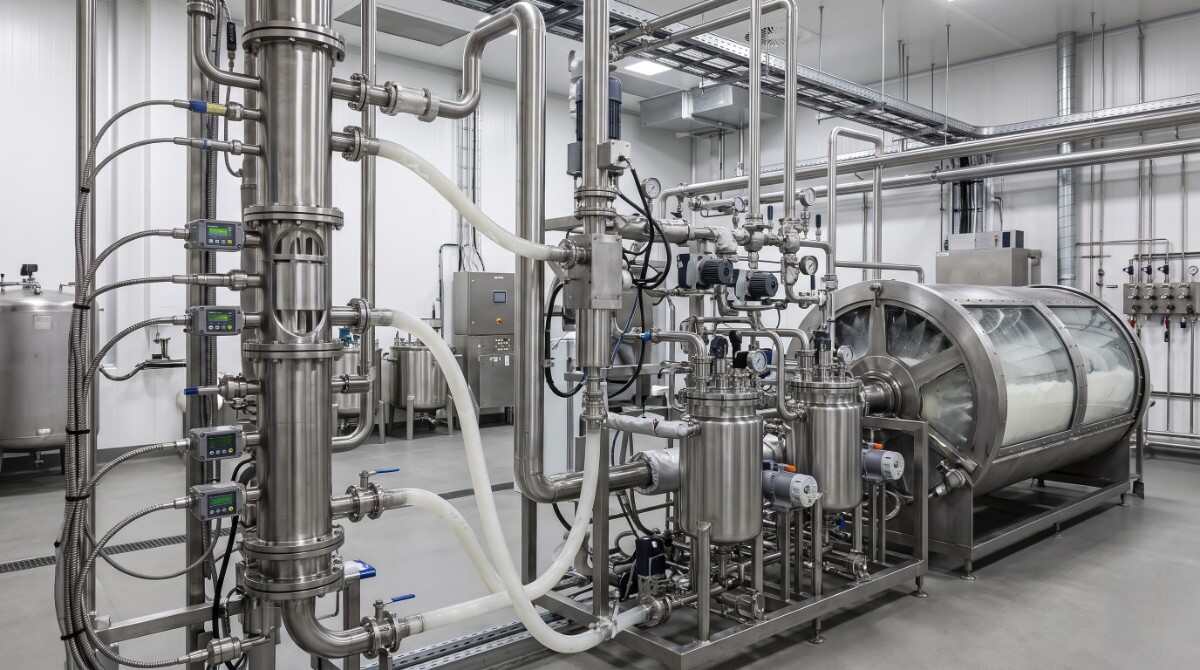
Sonocrystallization has emerged as an especially powerful tool for active pharmaceutical ingredients exhibiting broad metastable zones or erratic spontaneous nucleation behaviors. By applying ultrasound waves into the solution, the technology generates microscopic cavitation bubbles that collapse violently, creating localized pressure and thermal spikes that trigger immediate, uniform crystal nucleation. This acoustic intervention eliminates the need for physical seed addition, minimizes the risk of microbial contamination, and produces exceptionally narrow particle size distributions. The resulting crystals exhibit superior mechanical strength, resisting attrition during subsequent fluid transport.
Downstream Filtration, Washing, and Interline Synergy
The physical benefits gained from precision crystallization directly transform downstream isolation operations. Fine particles, needle-shaped crystals, and broad size distributions historically create dense, impermeable filter cakes that resist deliquoring. In severe cases, filtration cycles require days of vacuum or pressure operation, causing solvent cracking and non-uniform cake washing that leaves residual impurities trapped in the final solid.
By tailoring crystal aspect ratios and producing uniform, equant particles, advanced crystallization technologies reduce specific cake resistance by an order of magnitude. Filtration rates increase substantially, deliquoring cycle times shorten, and automated continuous filtration carousels can continuously dewater and wash active substance slurries without operator intervention. Solvent consumption during washing decreases by up to forty percent because uniform crystal packings eliminate channeling artifacts through the filter cake.
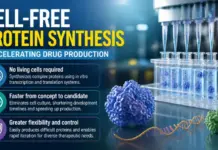
The continuous isolation and precise molecular engineering principles transforming solid drug substances are similarly advancing biomanufacturing frontiers, where cell-free protein synthesis for rapid pharmaceutical production bypasses living cell cultures to express targeted therapeutic proteins in hours rather than weeks. Just as continuous solid-state chemistry eliminates the unpredictable biological variables of bulk batch vessels, synthetic biology platforms are removing cellular membrane barriers to dramatically streamline biologic production.
Digital Twins and Real-Time Solid-State Assurance
The integration of advanced population balance modeling with computational fluid dynamics has elevated crystallization development into a predictive digital discipline. Engineers routinely simulate the coupled interactions between fluid hydrodynamics, mass transfer, heat exchange, and crystal population dynamics across multi-phase slurry mixtures.
These predictive computational models enable development teams to evaluate hundreds of solvent systems, anti-solvent ratios, and cooling profiles virtually before entering the physical pilot plant. By correlating in-line process analytical technology signals with digital twin models, commercial operators can verify polymorph purity and particle size targets in real time, fulfilling stringent regulatory requirements established under ICH Q6A specifications.
Global regulatory authorities recognize that tight physical control of drug substance particles eliminates formulation variability in downstream tablet compression and wet granulation lines. When active pharmaceutical ingredients exhibit uniform shape, high bulk density, and narrow size distributions, secondary manufacturers can often bypass dry granulation or wet granulation steps entirely, moving directly to high-speed direct compression. As pharmaceutical pipelines bring forth increasingly complex, Pharma Advancement notes that poorly soluble small molecules, advanced crystallization technologies serve as an indispensable technological lever, safeguarding product quality and establishing resilient, cost-effective manufacturing supply chains.
