


























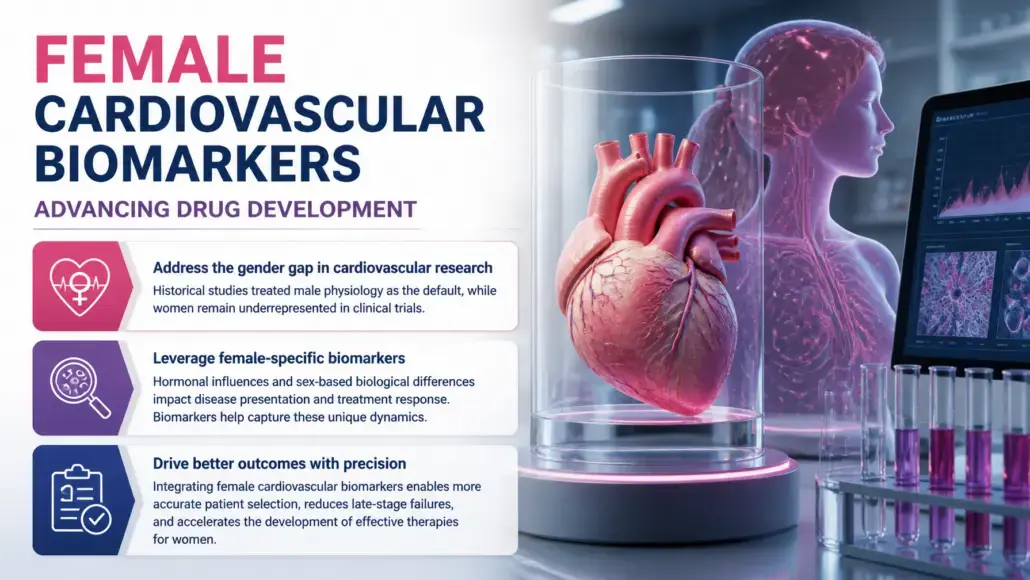
Cardiovascular drug development has long contended with high late-stage attrition rates, where promising pre-clinical compounds fail to demonstrate definitive efficacy in broad phase 2 and phase 3 clinical programs. A fundamental contributor to these clinical failures lies in historical trial designs that treated male cardiovascular physiology as the default biological standard. While cardiovascular disease remains the primary cause of mortality among women globally, women represented only an estimated 38 percent of participants across cardiovascular clinical trials published between 2018 and 2024, according to a systematic analysis published in Clinical Research in Cardiology in late 2025. This structural imbalance frequently dilutes therapeutic signals, obscures sex-specific treatment responses, and leads to costly pipeline terminations.
Pharma Advancment observes that pharmaceutical developers and clinical research organizations are actively adopting female cardiovascular biomarkers to correct these historical imbalances. By incorporating biological indicators tailored to female vascular and myocardial pathophysiology, clinical development teams can identify target populations with greater precision, validate therapeutic responses earlier, and improve the overall success rate of cardiovascular assets.
Regulatory agencies have intensified the pressure on drug sponsors to modernize clinical trial methodologies. In January 2025, the U.S. Food and Drug Administration issued updated draft guidance entitled “Evaluation of Sex Differences in Clinical Investigations” and “Study of Sex Differences in the Clinical Evaluation of Medical Products” under Docket FDA-2024-D-4245. The federal guidance explicitly advises sponsors to design clinical trials that enroll female cohorts proportional to real-world disease prevalence, while establishing prospective biomarker protocols capable of detecting sex-differentiated pharmacodynamics and therapeutic efficacy.
Overcoming Diagnostic Blind Spots in Clinical Enrollment
The primary challenge in female cardiovascular therapeutics stems from distinct pathophysiological presentations. Male cardiovascular disease predominantly involves epicardial coronary artery disease characterized by focal, flow-limiting atherosclerotic plaques. In contrast, women frequently present with diffuse coronary disease, coronary microvascular dysfunction, spontaneous coronary artery dissection, and ischemia with non-obstructive coronary arteries. When clinical trial protocols apply uniform, male-derived diagnostic criteria, female patients suffering from active myocardial ischemia are frequently excluded from enrolment.

The diagnostic distortion is particularly acute in cardiac troponin measurements. The 99th percentile upper reference limit for high-sensitivity cardiac troponin in healthy women is approximately 50 percent lower than the corresponding threshold in men. When clinical investigators apply a single pooled cutoff across both sexes, substantial clinical misclassification occurs:
- Women presenting with acute or chronic ischemic damage are systematically underdiagnosed because their biomarker elevations remain below male-weighted thresholds.
- Men with baseline subclinical myocardial stress are disproportionately enrolled into trials, introducing baseline heterogeneity that can mask treatment benefits.
- Drug candidates designed to protect ischemic myocardium show inconsistent statistical separation from placebo due to misclassified patient cohorts.
- Post-trial subgroup analyses often reveal retrospective efficacy in female subsets that prospective trial designs failed to capture adequately.
Integrating female cardiovascular biomarkers into screening protocols directly resolves these recruitment distortions. By applying sex-specific upper reference limits, trial investigators ensure that enrolled female cohorts genuinely reflect active target disease, enhancing baseline diagnostic purity and boosting statistical power.
Commercial Diagnostic Deployments Refining Trial Stratification
Global diagnostic and healthcare corporations have introduced sensitive analytical platforms that facilitate this operational shift in biopharmaceutical trials. These platforms provide the high analytical precision at low concentrations required to establish validated female decision cutoffs.
- Roche Diagnostics secured CE Mark clearance in September 2025 for its sixth-generation Elecsys Troponin T high-sensitivity assay. The system provides improved analytical accuracy at extremely low concentration ranges, allowing clinical trial sponsors to detect minor myocardial injury and evaluate drug-mediated cardioprotection in female subjects with elevated precision.
- Abbott Laboratories has embedded sex-specific 99th percentile upper reference limits into its Alinity i and Architect high-sensitivity troponin I platforms, utilizing a female threshold of 14 ng/L compared to a male threshold of 35 ng/L. This assay design allows drug developers to establish sensitive, sex-stratified trial inclusion criteria that prevent the exclusion of symptomatic female patients.
- Siemens Healthineers has validated sex-stratified thresholds across its Atellica IM High-Sensitivity Troponin I platform. In clinical evaluations, the implementation of female-specific reference ranges reclassified more than 20 percent of female patients presenting with suspected acute cardiac syndromes, providing researchers with a more reliable screening foundation.
These diagnostic advancements allow biopharmaceutical companies to integrate validated laboratory parameters into their clinical trial protocols, establishing reliable objective baselines across multinational investigation sites.
Resolving the HFpEF Enrollment Dilemma
Heart failure with preserved ejection fraction represents one of the largest unmet medical needs and fastest-growing therapeutic markets in modern cardiology. Women account for between 55 percent and 65 percent of the clinical population diagnosed with this condition. The syndrome is driven by systemic microvascular inflammation, concentric left ventricular remodeling, and elevated myocardial stiffness rather than the gross cardiomyocyte loss typical of heart failure with reduced ejection fraction.
Despite the female predominance in this patient population, earlier clinical trials in this space frequently reported neutral outcomes or failed to achieve primary composite endpoints. A contributing factor was the reliance on circulating B-type natriuretic peptide and N-terminal pro-B-type natriuretic peptide thresholds that did not account for sex-specific physiology. Circulating natriuretic peptides are cleared more rapidly in the presence of higher adiposity, while hormonal variations across the menopause transition influence baseline hemodynamic stress responses.
Pharmaceutical sponsors have achieved clearer efficacy signals by adjusting natriuretic peptide inclusion thresholds and pairing them with inflammatory and fibrotic markers.
In the landmark PARAGON-HF clinical program, sponsored by Novartis, the angiotensin receptor-neprilysin inhibitor sacubitril and valsartan missed its primary composite endpoint in the overall study population by a narrow margin. However, prespecified subgroup analyses revealed a statistically significant 27 percent reduction in cardiovascular hospitalizations and death among women compared to active control. Subsequent aptamer-based plasma proteomic profiling published across 2024 and 2025 by Novartis researchers demonstrated that female patients exhibited distinct baseline circulating biomarker profiles, including elevated markers of systemic inflammation and collagen turnover. These findings confirmed that therapeutic benefit extended across a substantially broader left ventricular ejection fraction range in women than in men.

Similarly, Bayer completed and reported findings from the Phase III FINEARTS-HF trial in late 2024 and 2025, evaluating the nonsteroidal mineralocorticoid receptor antagonist finerenone in patients with heart failure and mildly reduced or preserved ejection fraction. The trial enrolled 6,001 patients across 37 countries, with female representation reaching 45.5 percent. By tracking longitudinal variations in N-terminal pro-B-type natriuretic peptide alongside functional status, investigators demonstrated consistent risk reductions across both sexes, establishing a strong model for balanced trial execution.
Multi-Marker Panels for Microvascular and Inflammatory Pathologies
Beyond established troponins and natriuretic peptides, biopharmaceutical pipelines are increasingly deploying multi-marker panels that capture the specific biological cascades underpinning female cardiovascular disease. These panels combine indicators of vascular inflammation, endothelial shear stress, and extracellular matrix remodeling.
Key biomarker targets currently incorporated into phase 1 and phase 2 cardiac programs include:
- Soluble Suppression of Tumorigenicity 2, which quantifies myocardial strain and progressive cardiac fibrosis independent of body mass index.
- Galectin-3, a beta-galactoside-binding lectin that signals active macrophage infiltration and progressive cardiac tissue stiffening.
- Endothelin-1, a potent vasoconstrictor peptide that serves as a direct indicator of coronary microvascular spasm and endothelial dysfunction.
- High-sensitivity C-reactive protein, which tracks low-grade systemic vascular inflammation that disproportionately accelerates arterial stiffness in post-menopausal women.
- Growth Differentiation Factor-15, an integrated stress-response cytokine associated with vascular injury and heightened risk of major adverse cardiac events.
Integrating these specialized markers allows pharmaceutical teams to construct precision medicine strategies for complex conditions such as ischemia with non-obstructive coronary arteries. When testing novel vascular modulators, endothelin receptor antagonists, or targeted anti-inflammatory agents, sponsors utilize these circulating proteins as early surrogate pharmacodynamic endpoints. This quantitative feedback allows portfolio managers to make objective go or no-go pipeline decisions months before clinical outcome endpoints mature.
Accelerating Clinical Timelines and Commercial De-Risking
The strategic deployment of female cardiovascular biomarkers yields compelling economic and operational advantages for pharmaceutical sponsors. Late-stage cardiovascular trials routinely cost between 100 million and 300 million dollars, making protocol optimization a financial imperative.
Implementing sex-stratified biomarker criteria delivers distinct operational benefits across the drug lifecycle:
- Reduced sample sizes, because enrolling biochemically homogeneous patient cohorts decreases outcome variability and increases statistical efficiency.
- Faster participant recruitment, as validated female-specific cutoffs expand the eligible screening pool of symptomatic women who were previously rejected by conventional thresholds.
- Enhanced regulatory confidence, fulfilling contemporary FDA and European Medicines Agency guidelines regarding demographic diversity and subpopulation pharmacokinetics.
- Clearer label expansion opportunities, providing prospective mechanistic evidence to support targeted indications for female-predominant cardiovascular phenotypes.
Pharma Advancement notes that as precision therapeutics continue to displace broad-spectrum treatments in cardiovascular medicine, drug developers that embed sex-specific biomarker strategies into their research protocols protect their clinical pipelines from costly late-stage failures and build stronger competitive positions in global healthcare markets.
