


























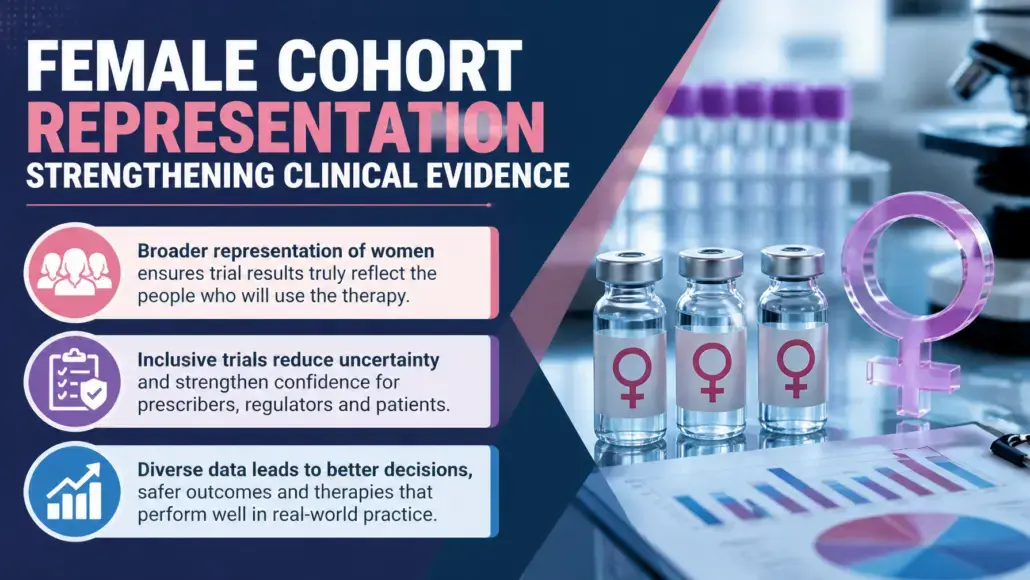
Every clinical trial makes an implicit promise: that its data will tell prescribers, regulators and patients how a therapy is likely to behave once it reaches the clinic. That promise weakens when the people enrolled in a study look very different from the people who will eventually take the drug. For much of modern pharmaceutical history, one of the most consequential mismatches has involved women.
Pharma Advancement observes that female cohort representation is often discussed as a matter of fairness, and it is one. It is also a matter of scientific rigor, regulatory readiness and commercial durability. Sponsors that treat it that way tend to produce evidence that holds up better under scrutiny.
Why Female Cohort Representation Is an Evidence-Quality Issue
A trial result is only as useful as its external validity. If a study enrolls too few women to say anything meaningful about how they respond, the resulting label effectively extrapolates from one population to another and hopes the biology cooperates. Sometimes it does. Sometimes it does not, and the gap surfaces only after approval, when far more patients are exposed and correction is far more costly.
Underrepresentation narrows what a dataset can support. Safety signals that occur more often in women may stay buried in small numbers, dose-response relationships may be characterized mainly in men, and efficacy estimates may blend two populations whose responses differ. None of this necessarily invalidates a trial, but it leaves uncertainty that regulators, payers and clinicians increasingly expect sponsors to address rather than defer.
How Women Came to Be Underrepresented in Clinical Research
The roots of the problem were partly protective. In the wake of thalidomide and other concerns about fetal exposure, FDA guidance issued in 1977 recommended excluding women of childbearing potential from early-phase drug studies. The policy aimed to prevent harm, but it had a lasting side effect: much of the early pharmacology for new drugs was characterized in men, and the assumption that results would transfer to women often went untested.
The tide began to turn in 1993. The NIH Revitalization Act required the inclusion of women in NIH-funded clinical research, and the FDA withdrew its earlier restriction through new guidance on studying gender differences in the clinical evaluation of drugs. A 2001 review by the US General Accounting Office (now the Government Accountability Office) later underlined the stakes, finding that most of the prescription drugs withdrawn from the US market between 1997 and 2000 posed greater health risks for women than for men.
Progress since then has been real but uneven. Enrollment of women has improved in many areas, yet gaps persist in certain therapeutic fields and trial phases, with early-phase research and some cardiovascular studies frequently cited as areas where women remain underrepresented relative to the disease burden they carry.
| Year | Milestone | Significance |
|---|---|---|
| 1977 | FDA guidance excludes women of childbearing potential from early-phase studies | Protective intent, but creates a long-term data gap |
| 1993 | NIH Revitalization Act and revised FDA guidance | Inclusion becomes an expectation rather than an exception |
| 2001 | US General Accounting Office review of drug withdrawals | Highlights greater risks for women among withdrawn drugs |
| 2016 | NIH policy on sex as a biological variable takes effect; SAGER guidelines published | Extends attention to preclinical work and reporting standards |
| 2022 | FDORA introduces Diversity Action Plan requirements | Enrollment planning becomes a formal regulatory deliverable |
The Scientific Case: Sex Differences in Pharmacology and Disease
The argument for strong female cohort representation rests on biology as much as on policy. Men and women can differ in how a drug is absorbed, distributed, metabolized and cleared, and those differences can produce meaningfully different exposures at the same dose.
Pharmacokinetic and Pharmacodynamic Differences
Body composition affects how drugs distribute, particularly lipophilic compounds. The activity of certain metabolizing enzymes can vary by sex, and renal clearance often differs as well. Hormonal changes across the menstrual cycle, pregnancy and menopause add further variability. The best-known regulatory illustration came in 2013, when the FDA lowered the recommended starting dose of zolpidem for women after data showed that women eliminated the drug more slowly and faced a higher risk of next-morning impairment. It was a clear case of sex-specific data changing a label years after approval.
Disease Presentation and Progression
Differences extend beyond drug handling. Many conditions present, progress or respond to treatment differently in women, and comorbidity patterns can vary. Cardiovascular disease, autoimmune disorders and pain conditions are frequently discussed examples. When trial populations do not reflect these patterns, endpoints and eligibility criteria may inadvertently favor presentations more typical of men.
Sex Versus Gender
Biological sex and gender are related but distinct. Sex refers to biological attributes; gender encompasses social roles, behaviors and circumstances. Both can influence outcomes. Gender can shape adherence, access to care, caregiving burden and willingness to report side effects, all of which affect what a trial ultimately measures.
| Factor | Potential Effect on Drug Response |
|---|---|
| Body composition | Altered volume of distribution, especially for lipophilic drugs |
| Metabolic enzyme activity | Differences in clearance and overall exposure |
| Renal function | Variation in elimination of renally cleared compounds |
| Hormonal changes | Variability across the menstrual cycle, pregnancy and menopause |
| Disease presentation | Different symptom profiles may affect diagnosis and endpoint selection |
The Regulatory and Commercial Landscape
Regulators have steadily raised expectations. In the United States, the Food and Drug Omnibus Reform Act of 2022 (FDORA) requires Diversity Action Plans for certain late-stage studies, with enrollment goals broken down by age group, sex, and racial and ethnic characteristics, plus an explanation of how sponsors intend to meet them. The FDA has also long required that marketing applications present effectiveness and safety data by demographic subgroup, including sex.

Internationally, ICH E8(R1) emphasizes that study populations should reflect the patients likely to use a product. In Europe, the Clinical Trials Regulation asks sponsors to justify the gender and age allocation of trial participants and to explain any exclusion or underrepresentation of a particular group.
The commercial consequences of thin subgroup data are less visible but no less real. They can include post-marketing commitments, cautious labeling, prescriber hesitancy and tougher questions from payers and health technology assessment bodies weighing value across patient groups.
| Framework | Region | Relevance to Female Representation |
|---|---|---|
| FDORA Diversity Action Plans | United States | Enrollment goals by sex and other demographics for certain studies |
| ICH E8(R1) | International | Study populations should reflect intended patients |
| EU Clinical Trials Regulation | European Union | Justification of gender and age allocation of participants |
Designing Protocols That Enable Meaningful Inclusion
Representation is largely decided before the first patient is screened. Protocol design either opens the door to a representative population or quietly narrows it.
Revisiting Eligibility Criteria
Sponsors benefit from asking whether each exclusion criterion is scientifically necessary. Pregnancy-related exclusions and contraception requirements are sometimes broader than the safety profile warrants, and burdensome requirements can discourage participation. Where real risk exists, proportionate safeguards are generally preferable to blanket exclusion.
Setting Goals and Planning the Analysis
Enrollment targets work best when grounded in the epidemiology of the condition rather than an arbitrary split. Where there is a plausible scientific reason to expect differences, sponsors can consider powering key subgroup analyses. Sex-disaggregated analyses belong in the statistical analysis plan from the outset, not added after unblinding.
Starting Earlier in Development
Including both sexes in nonclinical studies, consistent with the NIH’s sex-as-a-biological-variable policy, helps surface potential differences early and informs dose selection and safety monitoring well before pivotal trials.
Practical Recruitment and Retention Strategies
Even a well-designed protocol can fall short if participation does not fit women’s lives. Caregiving responsibilities, inflexible scheduling, travel demands and, in some communities, a well-founded distrust of research all play a role. Decentralized and hybrid elements such as remote visits, home health services and local laboratory testing can lower the burden considerably, while flexible visit windows and support for transport or childcare make a difference that protocol language alone cannot.
Site selection matters too. Investigators and clinics that already serve many women patients, along with partnerships with community organizations, tend to recruit more effectively than generic outreach. Patient-facing materials should speak plainly about safety, reproductive health questions and the true time commitment involved.
Analyzing and Reporting Sex-Specific Data
Collecting the data is only half the task. Results should be presented by sex consistently, even when a trial is not powered for formal subgroup conclusions, because transparency across studies builds a more complete picture over time. The SAGER guidelines offer a practical framework for reporting sex and gender information in research publications.
Interpretation requires discipline. Subgroup findings can mislead in both directions: chance variation can look like a real difference, and a genuine difference can be dismissed as noise. Pre-specification, appropriate caution and complementary sources such as pooled analyses and real-world evidence help sponsors communicate findings responsibly.
Making Female Cohort Representation an Operational Discipline
Female cohort representation is not a single decision made at protocol sign-off. It is an ongoing discipline that runs from nonclinical work through eligibility design, site selection, recruitment, analysis and reporting. Sponsors that build it into routine practice generate evidence that better reflects the patients they intend to serve, anticipate regulatory questions rather than react to them, and earn greater confidence from clinicians and patients alike. As evidence quality increasingly shapes a product’s trajectory, that is a competitive advantage as well as a scientific obligation.
