















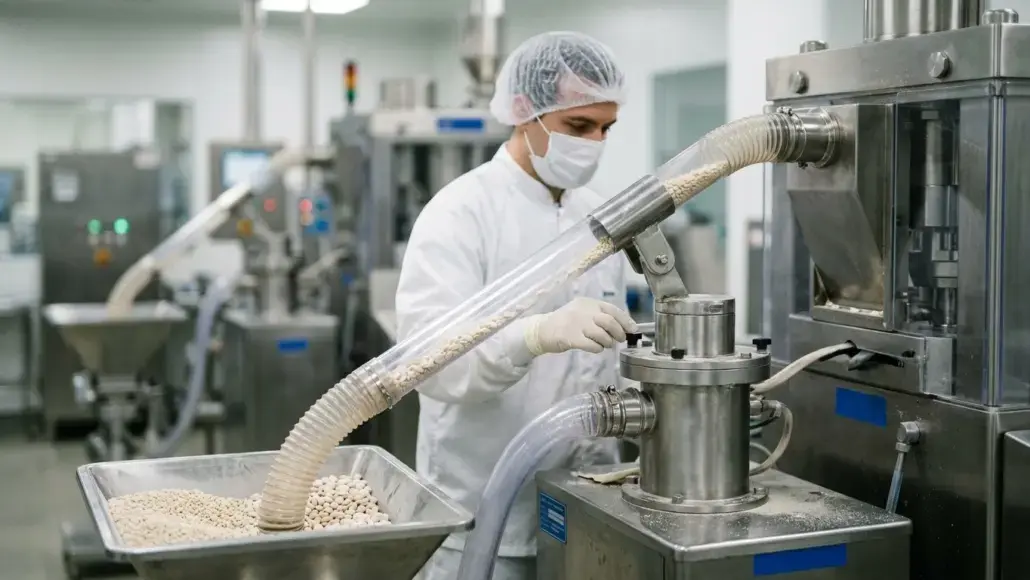
Pneumatic vacuum conveying is emerging as a critical technology for pharmaceutical manufacturers seeking to overcome the pervasive issues of product degradation and contamination in oral solid dosage (OSD) production. For years, the transfer of powders, granules, and finished tablets between processing stages has been a significant bottleneck, often leading to a ‘chipping’ crisis where delicate tablets are damaged by mechanical handling. Traditional transport methods, such as bucket elevators or screw conveyors, are often too aggressive for the fragile nature of pharmaceutical products. Pneumatic vacuum conveying, by contrast, uses a gentle stream of negative pressure to move materials through enclosed tubing, providing a clean, efficient, and damage-free solution that is transforming the efficiency of OSD manufacturing lines.
Pharma Advancement notes that the shift toward pneumatic vacuum conveying is driven by the industry’s relentless focus on yield and product quality. In the competitive world of solid dosage manufacturing, even a 1% loss due to tablet chipping or breakage can translate into millions of dollars in lost revenue over a year. Furthermore, the dust generated by mechanical conveyors poses a significant risk to operator safety and increases the complexity of cross-contamination control. Pneumatic vacuum systems address these challenges simultaneously by providing a fully contained environment where the product is carried by air rather than pushed by mechanical parts. This technology is not just an alternative to mechanical conveying. It is a superior method for maintaining the integrity of the pharmaceutical product from the initial powder blend to the final packaged tablet.
The Technical Principles of Vacuum-Based Material Transfer
The underlying principle of pneumatic vacuum conveying is deceptively simple: it uses a vacuum pump or a multi-stage ejector to create a pressure differential that draws material through a convey line. The process begins with the pickup point, where the powder or tablets are introduced into the air stream. The material is then entrained in the moving air and transported at a controlled velocity to a receiver or separator. At the receiver, the air and material are separated; the material drops into the target vessel (such as a tablet press or a coating pan), while the air is filtered and exhausted. This enclosed, negative-pressure design ensures that no dust can escape into the surrounding environment, making it an ideal choice for the high-containment requirements of modern pharmaceutical plants.
The secret to success in pneumatic vacuum conveying lies in the precise control of the air-to-product ratio and the velocity of the air stream. For fragile finished tablets, dense phase conveying is often used. In this mode, the tablets move at a much lower velocity in plugs or slugs, significantly reducing the impact force against the tube walls and at pipe bends. This gentle handling is what prevents the dreaded chipping that occurs in high-speed mechanical systems. For powders and granules, lean phase conveying may be more appropriate, providing high throughput for bulk material transfer. The ability to fine-tune these parameters allows a single pneumatic system to handle a wide range of different pharmaceutical formulations with the same high level of care.
Mitigating Tablet Chipping and Enhancing OSD Production Yield
The chipping crisis in OSD production is more than just an aesthetic issue; it is a regulatory and functional problem. A chipped tablet may have an incorrect dosage, a compromised enteric coating, or an altered dissolution profile, making it a reject that cannot be sold. Pneumatic vacuum conveying addresses this by eliminating the mechanical pinch points and aggressive agitation found in traditional conveyors. The use of large-radius bends and specialized interior coatings in the convey tubing further minimizes the friction and impact experienced by the tablets. By significantly reducing the percentage of rejects, pneumatic vacuum systems provide a direct and measurable boost to the overall production yield and profitability of the plant.
Moreover, the gentle nature of pneumatic conveying is essential for the newer generation of fast-dissolve or soft-melt tablets, which are designed to be extremely fragile. These products often cannot be handled by any traditional mechanical system without catastrophic failure. Pneumatic vacuum conveying provides the only viable way to move these sensitive items through the production line at scale. By enabling the manufacture of these advanced dosage forms, pneumatic technology is expanding the therapeutic options available to patients. The reliability of vacuum-based transfer ensures that every tablet—no matter how delicate—remains intact and functional from the moment it is compressed until it reaches the patient’s hand.
Cleanliness, Containment, and Regulatory Compliance
In the pharmaceutical industry, cleanliness is not optional. One of the greatest advantages of pneumatic vacuum conveying is its inherent hygienic design. Because the system is fully enclosed and operates under negative pressure, it naturally prevents the migration of dust and cross-contaminants. This is particularly important when handling potent active pharmaceutical ingredients (APIs) or hormone-based products that require high levels of operator protection. The absence of moving parts in the material stream also means there is no risk of mechanical wear leading to metal-on-metal contamination—a common problem with screw conveyors and rotary valves.
Furthermore, pneumatic vacuum systems are exceptionally easy to clean and validate. Many modern systems are designed for Clean-in-Place (CIP) or Wash-in-Place (WIP) operations. The smooth, internal surfaces of the convey lines can be thoroughly flushed with cleaning agents and then dried with filtered air, all without the need for manual disassembly. This dramatically reduces the downtime required for product changeovers and ensures that the facility remains in a constant state of GMP compliance. For manufacturers producing multiple different products on the same line, the speed and reliability of the cleaning process are a major competitive advantage, allowing for higher equipment utilization and more agile production planning.
Improving Powder Handling and Material Flow Reliability
While tablet transfer is a high-profile application, pneumatic vacuum conveying is equally valuable for the movement of powders and granules earlier in the OSD production process. Pharmaceutical powders are often difficult materials; they can be cohesive, abrasive, or prone to segregation. Mechanical conveyors often struggle with these materials, leading to bridging in hoppers or the separation of active ingredients from excipients during transport. Pneumatic systems, by contrast, maintain a more consistent and homogenous blend by keeping the material in a fluid state during transfer.
The reliability of material flow is essential for the continuous operation of high-speed tablet presses. Any interruption in the powder supply can lead to weight variations or soft tablets, which again increases the reject rate. Pneumatic vacuum conveying provides a demand-based supply of powder, where sensors in the tablet press hopper signal the conveyor to deliver exactly the amount of material needed. This just-in-time delivery prevents overfilling and minimizes the residence time of the powder in the hopper, which is crucial for materials that are sensitive to moisture or oxygen. By ensuring a steady and reliable flow of high-quality powder, pneumatic systems support the overall stability and efficiency of the entire OSD production line.
The Future of Pneumatic Conveying: Smart Control and Industry 4.0
The future of pneumatic vacuum conveying lies in the integration of smart sensors and AI-driven control systems. Modern ‘smart conveyors’ are equipped with load cells, flow sensors, and pressure transducers that provide a continuous stream of data on the performance of the system. This data can be used for real-time optimization; for example, if the system detects that a powder is becoming more cohesive due to an increase in ambient humidity, it can automatically adjust the vacuum level or the air-to-material ratio to maintain a consistent flow rate. This self-tuning capability is a key component of the move toward fully autonomous pharmaceutical manufacturing.
Furthermore, the integration of these systems with the plant’s Industrial Internet of Things (IIoT) infrastructure allows for predictive maintenance. By monitoring the performance of the vacuum pump and the condition of the filters, the system can predict when a component is nearing failure and alert the maintenance team before a breakdown occurs. This data-driven approach ensures maximum uptime and reduces the total cost of ownership. As the pharmaceutical industry continues to evolve toward ‘continuous manufacturing’ models, the role of precise, reliable, and intelligent pneumatic vacuum conveying will only become more central to success.
Conclusion: A Foundation for High-Quality OSD Production
In conclusion, pneumatic vacuum conveying is a transformative technology that solves many of the most persistent challenges in oral solid dosage production. By providing a gentle, enclosed, and highly controllable method for material transfer, it addresses the chipping crisis, reduces dust and contamination, and enhances overall production yield. Its inherent cleanliness and ease of validation make it the ideal choice for meeting the rigorous regulatory standards of the pharmaceutical industry, while its flexibility supports the manufacture of a wide range of sensitive and complex dosage forms.
As pharmaceutical manufacturers face increasing pressure to improve efficiency and maintain the highest quality standards, the adoption of pneumatic vacuum conveying will become a standard requirement for any modern facility. It is a technology that aligns perfectly with the goals of Industry 4.0 and the pursuit of operational excellence. Pharma Advancement believes that by investing in the airborne transport of their most valuable products, manufacturers are ensuring that they can deliver safe, effective, and high-quality medications to patients with maximum reliability and minimal waste. Pneumatic vacuum conveying is, quite literally, the breath of fresh air that the OSD production industry has been waiting for.
