

















The arduous journey of bringing a new drug from concept to patient has historically been fraught with staggering costs, extensive timelines, and a dishearteningly high rate of failure. For decades, pharmaceutical research has grappled with these inherent inefficiencies, often relying on serendipity and painstaking trial-and-error methodologies. However, a profound paradigm shift is now underway, driven by the ascendancy of artificial intelligence, particularly the transformative capabilities of generative AI in drug research. This advanced technology is not merely optimizing existing processes. Pharma Advancement notes that it is fundamentally reimagining the very fabric of novel therapeutics discovery, promising to accelerate the pace at which life-saving medicines reach those in need.
The integration of generative AI in drug research marks a pivotal moment in the history of medicine. It offers a powerful antidote to the traditional bottlenecks, providing a pathway to more efficient AI drug discovery and streamlined AI in drug development. By leveraging sophisticated algorithms, this innovative approach can unlock unprecedented insights from vast datasets, enabling researchers to explore chemical spaces that were previously inaccessible and to design molecules with tailored properties at an speed and precision unimaginable just a few years ago.
The Intricacies of Traditional Drug Discovery and Its Bottlenecks
Traditional drug discovery is an incredibly complex, multi-stage endeavor. It typically begins with identifying a biological target—a protein or gene implicated in a disease—followed by screening millions of compounds to find those that interact with the target. Promising candidates, known as “hits,” are then refined through a process called lead optimization to improve their efficacy, safety, and pharmacokinetic properties. This entire journey is often protracted, stretching over a decade, and astonishingly expensive, frequently exceeding billions of dollars per successful drug. The attrition rate is equally daunting, with less than 10% of compounds entering clinical trials ever making it to market. This empirical, labor-intensive approach often leaves much to chance, demanding substantial resources for often incremental gains. The sheer volume of biological and chemical data, combined with the intricate interplay of molecular forces, overwhelms human capacity for analysis, highlighting a critical need for more intelligent pharmaceutical research tools.
Generative AI: Reshaping the Landscape of Molecular Innovation
At its core, generative AI in drug research refers to AI models capable of creating new data instances that resemble the training data. In the context of drug discovery, this translates to generating novel molecular structures, protein sequences, or even entire biological pathways that could serve as potential novel therapeutics. Unlike discriminative AI, which categorizes or predicts outcomes based on existing data, generative models are truly creative, offering an unparalleled capability for de novo design.
Leading the charge in computational drug discovery are architectures such as Generative Adversarial Networks (GANs), Variational Autoencoders (VAEs), and more recently, transformer models. GANs, for instance, consist of two neural networks—a generator that creates new molecular candidates and a discriminator that evaluates their plausibility against a dataset of known drugs or desirable compounds. Through this adversarial training, the generator learns to produce increasingly realistic and effective molecular designs. VAEs, on the other hand, learn a compressed representation (latent space) of molecular structures, allowing researchers to navigate and sample this space to generate molecules with desired characteristics. These models are adept at understanding the complex rules of chemical synthesis and biological activity, enabling them to suggest compounds that are not only novel but also synthetically viable and therapeutically promising. This fundamentally alters the starting point of therapeutic discovery, shifting from exhaustive screening to intelligent design.
Precision in Target Identification
One of the earliest and most critical steps in AI drug discovery is target identification. Accurately pinpointing the specific biological molecules involved in disease progression is paramount. Generative AI, alongside other machine learning techniques, excels here by sifting through vast omics data—genomics, proteomics, transcriptomics—to identify disease-causing proteins or pathways with unprecedented speed and accuracy. By recognizing patterns and correlations invisible to the human eye, these systems can prioritize targets that are most likely to be therapeutically actionable, thereby significantly narrowing the focus for subsequent drug development efforts. This initial analytical power vastly improves the foundation for creating novel therapeutics.
Revolutionizing Molecular Design and Synthesis
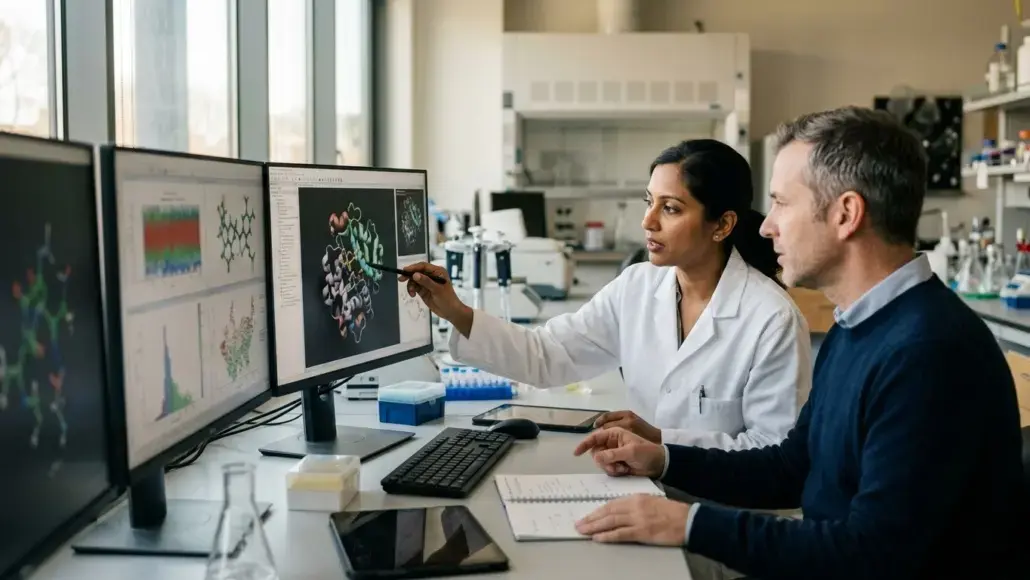
Perhaps the most compelling application of generative AI in drug research lies in molecular design. Rather than relying on iterative modifications of existing compounds, AI can generate entirely new chemical entities from scratch. Researchers can specify desired properties—such as binding affinity to a target, solubility, or permeability—and the generative model will propose novel molecules that possess these characteristics. This de novo design capability is a game-changer, allowing scientists to explore chemical space far more broadly and efficiently than ever before. It allows for the rapid iteration and refinement of ideas, pushing the boundaries of what is chemically possible and leading to truly innovative drug candidates. This drug research technology essentially acts as a highly intelligent chemist, able to synthesize countless potential solutions without physical experimentation.
Optimizing Leads with Unparalleled Efficiency
Once initial molecular candidates are identified, lead optimization becomes crucial. This process involves modifying the chemical structure of a compound to enhance its potency, selectivity, and pharmacokinetic profile while minimizing potential toxicity. Generative AI for pharma greatly accelerates this stage by predicting a compound’s ADMET (Absorption, Distribution, Metabolism, Excretion, Toxicity) properties before it is even synthesized in the lab. AI models can simulate how a molecule will interact with biological systems, suggesting modifications that could improve its drug-like qualities. This predictive capability dramatically reduces the number of compounds that need to be physically synthesized and tested, saving immense amounts of time and resources in AI in drug development. The ability to rapidly iterate on molecular structures based on predicted outcomes is a stark contrast to the slow, manual processes of the past.
The Path to Truly Novel Therapeutics and Personalized Medicine
The promise of generative AI in drug research extends beyond merely accelerating existing processes; it paves the way for the creation of genuinely novel therapeutics that might never have been discovered through traditional means. By exploring vast, uncharted regions of chemical space, AI can uncover compounds with unique mechanisms of action, addressing unmet medical needs and offering new hope for diseases that currently lack effective treatments. This biotech innovation can lead to first-in-class drugs rather than just incremental improvements.
Furthermore, machine learning in healthcare is increasingly driving the vision of personalized medicine. Generative AI can be used to design drugs tailored to an individual patient’s genetic makeup or disease profile. By analyzing a patient’s unique biomarkers, AI could generate optimized therapies that are more effective and safer, minimizing adverse reactions. This level of precision moves us closer to a future where medicine is truly personalized, optimizing outcomes on an individual basis. The concept of novel therapeutics discovery now includes an element of individual customization, a truly transformative step.
Navigating the Challenges and Envisioning the Future
Despite its immense potential, the widespread adoption of generative AI in drug research is not without its hurdles. Data quality and availability remain significant challenges; AI models are only as good as the data they are trained on. High-quality, diverse, and well-annotated datasets are crucial for building robust and reliable models. The interpretability of AI models, often referred to as the “black box” problem, also presents an obstacle. Understanding why an AI model proposes a particular molecule is important for gaining scientific trust and guiding further experimental validation.
Moreover, integrating AI-generated insights with traditional pharmaceutical research workflows requires significant infrastructural changes and a new interdisciplinary skillset among scientists. The transition from computational prediction to experimental validation in wet labs is still a critical and often time-consuming step. Regulatory frameworks also need to evolve to accommodate the unique challenges and opportunities presented by AI-driven drug discovery.
Looking ahead, the future of generative AI in drug research is incredibly bright. Continued advancements in AI algorithms, coupled with increasing computational power and the accumulation of more comprehensive biological data, will unlock even greater capabilities. We can anticipate more sophisticated models that can predict not only molecular properties but also complex biological interactions and entire pathway modulations. The synergy between generative AI, robotic automation, and advanced experimental platforms will create fully integrated AI-driven drug discovery factories, drastically compressing the timeline from target to clinic. Pharma Advancement highlights that generative AI for pharma matures, it will undoubtedly become an indispensable tool, driving the next wave of biotech innovation and delivering a continuous stream of novel therapeutics that address some of humanity’s most pressing health challenges. The revolution has just begun, and its impact on human health will be profound and lasting.
