



















The landscape of modern oncology and regenerative medicine has been fundamentally altered by the advent of personalized therapeutics, yet the industrial frameworks required to produce these treatments are only now catching up to the biological possibilities. At the center of this industrial shift is the transition away from retrospective quality control toward a more dynamic and integrated approach. For decades, the pharmaceutical industry relied on a linear make-then-test model, where products were manufactured in batches and then quarantined for days or weeks while laboratories conducted exhaustive safety and potency trials. However, in the high-stakes world of individualized medicine, where a patient’s own cells are the raw material, these delays are increasingly untenable. Pharma Advancement notes that the industry is rapidly pivoting toward real-time cell therapy manufacturing, a model that builds quality directly into the production process itself, ensuring that every dose is verified as safe the moment the bioreactor cycle concludes.
Reducing Vein-to-Vein Time Through Continuous Manufacturing
This paradigm shift is driven by a simple but profound reality: for a patient battling an aggressive late-stage malignancy, time is the most precious resource. Traditional manufacturing timelines for chimeric antigen receptor (CAR) T-cell therapies often span several weeks, a duration that can exceed the clinical stability of a critically ill individual. By implementing real-time cell therapy manufacturing, organizations are seeking to slash the vein-to-vein time, which encompasses the entire journey from the initial collection of patient cells to the final infusion of the modified product. This acceleration is not achieved by cutting corners or reducing safety standards; rather, it is accomplished by replacing slow, manual testing protocols with high-frequency digital monitoring and automated analytical tools that provide a continuous stream of data regarding the product’s biological state.
Process Analytical Technology Driving Real-Time Monitoring
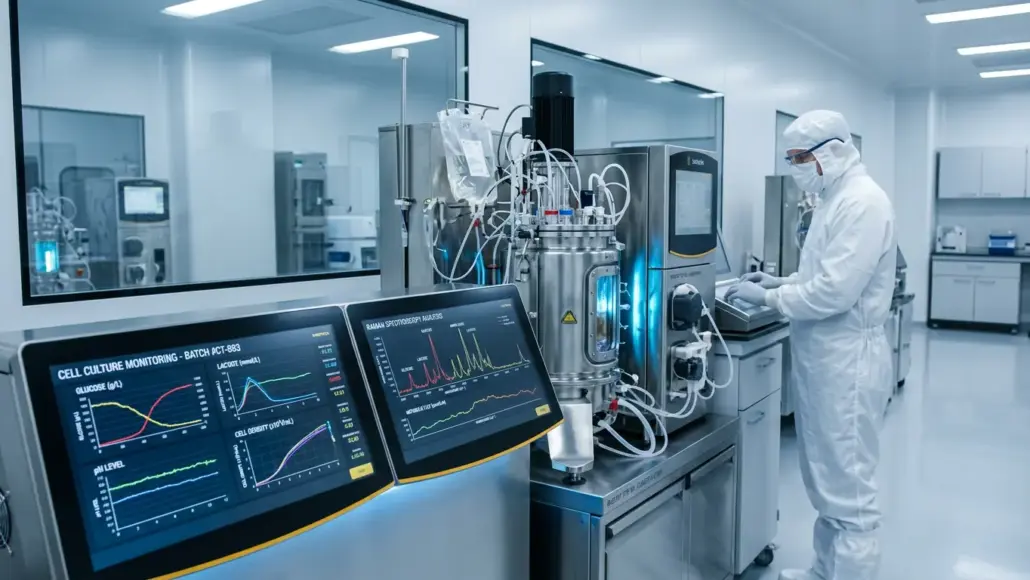
At the heart of this technical revolution is the application of Process Analytical Technology, or PAT. This framework allows bioprocess engineers to monitor critical quality attributes (CQAs) without ever breaking the sterile seal of the bioreactor. In a conventional setup, a technician might remove a small volume of the cell culture to check for glucose levels or cell viability in an external lab, a process that introduces the risk of contamination and provides only a snapshot of the culture’s health at a single point in time. In a real-time cell therapy manufacturing environment, sophisticated sensors such as Raman spectroscopy and holographic imaging are used to observe the cells in situ. These tools provide a wealth of data on metabolic activity, phenotypic markers, and proliferative capacity in real-time, allowing for a level of granular oversight that was once purely the domain of academic research.
Building a Digital Infrastructure for Manufacturing Excellence
The transition to real-time cell therapy manufacturing also necessitates a complete reimagining of the digital infrastructure within the production facility. When the decision to release a therapy is based on data generated during the manufacturing process, the integrity and security of that data become the primary pillars of regulatory compliance. Modern facilities are moving away from paper-based records in favor of integrated cloud platforms and electronic batch records (EBRs). These systems create a digital thread that follows the therapy from the bedside to the manufacturing floor and back. Every fluctuation in temperature, every nutrient adjustment, and every sensor reading is captured and timestamped, creating a transparent and audit-ready history. This digital maturity is essential for satisfying the rigorous expectations of agencies like the FDA and EMA, which are increasingly supportive of continuous manufacturing models that can demonstrate superior process control.
Artificial Intelligence and Predictive Process Optimization
Furthermore, the integration of artificial intelligence and machine learning is turning this raw data into a proactive tool for process optimization. In a eal-time cell therapy manufacturing setup, algorithms can analyze incoming sensor data to identify subtle shifts in cell behavior that might indicate an impending batch failure. If the system detects that lactate levels are rising too quickly or that oxygen consumption is dipping below an optimal threshold, it can automatically adjust the nutrient feed or gas flow to steer the culture back toward the desired specifications. This predictive capability significantly reduces the rate of discarded batches, which is a major financial and clinical risk in autologous therapy production. By stabilizing the manufacturing environment through automated feedback loops, pharmaceutical firms can ensure a higher degree of consistency and reliability, which is the cornerstone of operational excellence in bioprocessing.
Enhancing Patient Safety and Therapy Effectiveness
The impact of real-time cell therapy manufacturing on patient safety cannot be overstated. When a therapy can be released immediately upon completion, the need for long-term cryopreservation or extended storage is minimized. This is particularly vital for cell-based products, which are notoriously sensitive to environmental changes. Delivering a fresh product that has not been subjected to multiple freeze-thaw cycles or prolonged transit times ensures that the cells remain highly viable and potent when they reach the patient. This physiological integrity is a key determinant of clinical success, as the therapeutic cells must be robust enough to survive the host environment and perform their targeted function. By aligning the manufacturing cycle with the clinical needs of the patient, the industry is moving toward a truly patient-centered model of care.
Scaling Cell Therapy Manufacturing Through Automation
Scalability remains one of the greatest hurdles for the cell therapy sector, and it is here that real-time cell therapy manufacturing provides a much-needed solution. Current manufacturing methods are often labor-intensive, requiring a high degree of manual intervention by highly skilled scientists. This artisanal approach is difficult to scale to thousands of patients across global markets. However, by automating the quality control and release processes, manufacturers can handle a much higher volume of personalized treatments without a linear increase in headcount or laboratory space. This efficiency is what will allow cell therapies to move beyond niche applications for rare diseases and into the mainstream treatment of common cancers and chronic conditions. The transition to a more automated and data-driven workflow is the only way to make these life-saving medicines accessible to the broader population.
The Rise of Decentralized Cell Therapy Production
Looking toward the future, the concepts underpinning real-time cell therapy manufacturing are paving the way for decentralized production. We are already seeing the development of modular, factory-in-a-box systems that can be deployed directly within hospitals or regional treatment centers. These closed-loop, automated systems would perform the entire manufacturing process locally, removing the logistical nightmare of shipping live biological materials across borders. The role of real-time monitoring in this scenario is indispensable; it provides the centralized oversight needed to ensure that a therapy produced in a hospital in Singapore meets the exact same quality standards as one produced in a facility in New York. This distributed manufacturing model, supported by real-time data verification, could be the key to democratizing access to the most advanced medical treatments on earth.
Evolving Regulatory Frameworks for Continuous Manufacturing
The regulatory landscape is also evolving in tandem with these technological advancements. Regulatory bodies are recognizing that continuous monitoring provides a much more comprehensive view of product quality than the traditional end-product testing. As a result, new guidelines are being developed to accommodate real-time cell therapy manufacturing, allowing for ‘on-the-fly’ release decisions based on validated process parameters. This collaborative relationship between industry and regulators is essential for accelerating the path to market approval for new therapies. When manufacturers can prove that their processes are inherently stable and that their monitoring systems are fail-safe, the traditional regulatory bottlenecks begin to dissolve, allowing innovation to reach the bedside at the speed of science.
Future Innovations in Real-Time Cell Therapy Manufacturing
The focus in the coming years will shift toward the refinement of the analytical sensors and the maturation of the data ecosystems that support these factories. We can expect to see even more sophisticated tools, such as real-time genomic stability testing and automated functional assays, integrated into the bioreactor environment. These advancements will provide an even deeper level of assurance regarding the long-term safety and efficacy of cell-based medicines. The ongoing collaboration between bioprocess engineers, software developers, and clinicians is the engine driving this progress, ensuring that the pharmaceutical industry remains at the cutting edge of what is technically and biologically possible.
Conclusion
In conclusion, the transition toward real-time cell therapy manufacturing represents a fundamental reorganization of how we think about pharmaceutical production. It is a move away from the static, the retrospective, and the manual toward the dynamic, the continuous, and the automated. By prioritizing the integration of advanced analytics and digital infrastructure, the industry is setting the stage for a future where personalized medicine is both reliable and scalable. This commitment to speed, quality, and patient-centeredness is what will define the next decade of medical progress. For every patient waiting for a breakthrough, the arrival of real-time manufacturing is a promise of hope, ensuring that the most advanced therapies in the world are delivered with the precision and urgency they deserve. Pharma Advancement believes that the future of healthcare is not just about the discovery of new medicines, but about the mastery of the processes that bring them to life, and real-time cell therapy manufacturing is the blueprint for that mastery.
