















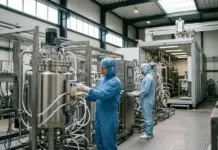



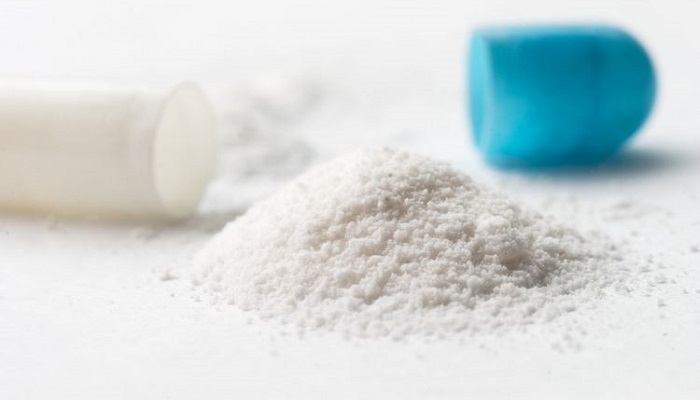
Scientists have shown that a recently developed two-chamber setup (TCS) for containment investigations that consists of an emission chamber as well as a detection chamber can predict highly potent API-HPAPI dustiness in the system that is sealed at varied flow conditions.
These different flow conditions have the plain diffusive transport as well as diffusive transport with a convective flow of airborne particles that are oppositely directed of the similar safe surrogate substance acetaminophen.
Dustiness can be defined as the propensity of a material to bring out airborne particles during handling. The various processes in pharma manufacturing like processing, grinding, milling, and mixing happen to be associated with dust generation. Hence, the formulation of the dust that contains HPAPIs is a big problem that concerns potential exposure.
The researchers put forth the fact that risks pertaining to hazard exposure comprise danger to the operators and also cross-contamination during the manufacturing process. In order to guarantee the safe manufacturing of dosage containing HPAPIs, production setups which are special are applied that happen to be operated at a pressure which is negative. This further reduces the potential airborne transfer risk to the immediate environment, as per the research. The risk of hazards can be reduced through governance methods such as barrier isolators, valve systems, and high-performance filters.
The prediction by the researchers that deviation from the linearity in case of atomised amount more than 400mg was majorly caused by saturation effect within the system. The study showed a linear correlation was witnessed between amounts up to 400 mg of ACAM and the dust emissions resulting from it. Notably, the emissions were significantly reduced by an oppositely directed convective flow.
CFD, which are computational fluid dynamics simulations that were performed to gauge the evacuation time, showed that nine minutes were apt for an evacuation that was reproducible and for a detection that was reliable of most of the airborne ACAM particles that were there within the detection chamber. Significantly, the extension of the evacuation time did not result in an increase in the detected particles.
