

















Efficiency in pharmaceutical operations is often the result of harmonizing countless small variables to produce a predictable outcome. Among these variables, the performance of water purification units is paramount. Achieving pharma lab water system consistency is not just about hardware it is about creating a reliable environment where every scientist can expect the same high-quality reagent every time they turn on a tap. In a multi-billion dollar industry where a single contamination event can halt production for weeks, the stability of the water supply serves as a critical safeguard against operational volatility.
The Link Between System Reliability and Data Accuracy
Every analytical test conducted in a pharmaceutical lab relies on water as the primary solvent. If the water quality fluctuates even slightly, the blank baseline of an experiment changes, which can lead to misinterpretation of results. Pharma lab water system consistency ensures that these fluctuations are minimized, providing a stable platform for high-precision tasks like High-Performance Liquid Chromatography (HPLC). When systems are inconsistent, researchers spend more time troubleshooting their equipment and less time advancing their research. By standardizing the technology and maintenance of these systems, organizations can reclaim thousands of man-hours lost to environmental interference.
In the world of spectroscopy, even the smallest variation in water purity can lead to baseline drift. For example, in UV-Vis spectrophotometry, dissolved organic compounds in the water can absorb light at specific wavelengths, interfering with the measurement of the drug sample. If the water system is inconsistent, one day’s zeroing of the instrument may not be valid the next. By maintaining pharma lab water system consistency, labs can ensure that their instruments are always operating under optimal conditions, leading to data that is not only accurate but also highly reproducible across different days and different operators.
Reducing Variation in Multi-Facility Networks
Large pharmaceutical companies often manage dozens of laboratories across different geographic regions. Each location faces unique challenges based on the local tap water’s mineral content and seasonal variations. Maintaining pharma lab water system consistency across these diverse sites requires a centralized strategy for water purification. By using identical equipment and standardized filtration modules, a company can ensure that a quality control test performed in Germany is identical in every way to one performed in Brazil. This global consistency is essential for the rapid scale-up of new drugs, as it allows for the seamless transfer of analytical methods between facilities.
Consider the challenge of Method Validation across multiple sites. If the water quality at Site A is slightly different from Site B, a method that worked perfectly in development may fail when transferred to the production site. This transfer failure can trigger long investigations and delay product launches. However, if pharma lab water system consistency is baked into the organizational strategy, the water quality becomes a controlled constant rather than a variable. This allows the validation team to focus on the nuances of the drug’s chemistry, knowing that the environment is uniform across the entire global network.
Impact on Quality Control Processes
Quality Control (QC) is the final gatekeeper of pharmaceutical safety. In this environment, the tolerance for error is zero. Any inconsistency in the water used for dissolution testing or impurity analysis can lead to a batch being erroneously flagged or, worse, a contaminated product reaching the market. Pharma lab water system consistency provides the QC department with a known constant. When the water quality is guaranteed through continuous monitoring and validated purification stages, the lab can focus its full attention on the product itself, knowing that the testing medium is beyond reproach.
Dissolution testing, a critical QC test for solid oral dosage forms, is highly sensitive to the pH and ionic strength of the dissolution medium. If the water used to prepare these media is not consistent, the rate at which the drug dissolves could appear to vary, even if the drug itself is perfect. Achieving pharma lab water system consistency means that every dissolution test is conducted in an identical environment, ensuring that the results are a true reflection of the drug’s performance. This level of control is what allows pharmaceutical companies to confidently stand behind their products.
Streamlining Regulatory Compliance
The pharmaceutical industry is among the most heavily regulated sectors in the world. Inspectors from the FDA, EMA, and other global agencies look for evidence of process control and stability. An inconsistent water system is a red flag for auditors, suggesting that the facility may not have full control over its environment. By implementing a strategy of pharma lab water system consistency, companies can provide clear, documented evidence of their water quality over time. Modern systems that offer digital monitoring and automated alerts for deviations make it much easier to maintain a state of control.
During an inspection, the ability to show a trend analysis of water quality is invaluable. If a company can produce a report showing that their TOC and resistivity have remained within a narrow, specified range for the past year, it builds immense confidence in the auditor’s mind. Pharma lab water system consistency is the key to this trend analysis. It demonstrates that the company is not just reacting to problems as they arise but has built a system that prevents them from occurring in the first place. This proactive approach is the hallmark of a mature, compliant organization.
Operational Efficiency and Maintenance Optimization
Beyond the science, there is a clear business case for pharma lab water system consistency. When a facility uses a variety of different water purification brands and models, the burden on the maintenance team is immense. They must stock dozens of different filters, lamps, and sensors, and be trained on multiple different interfaces. By standardizing on a consistent system architecture, companies can optimize their spare parts inventory and streamline their service contracts. This operational leaness reduces overhead costs and ensures that if a system does go down, it can be repaired quickly using standardized parts already on hand.
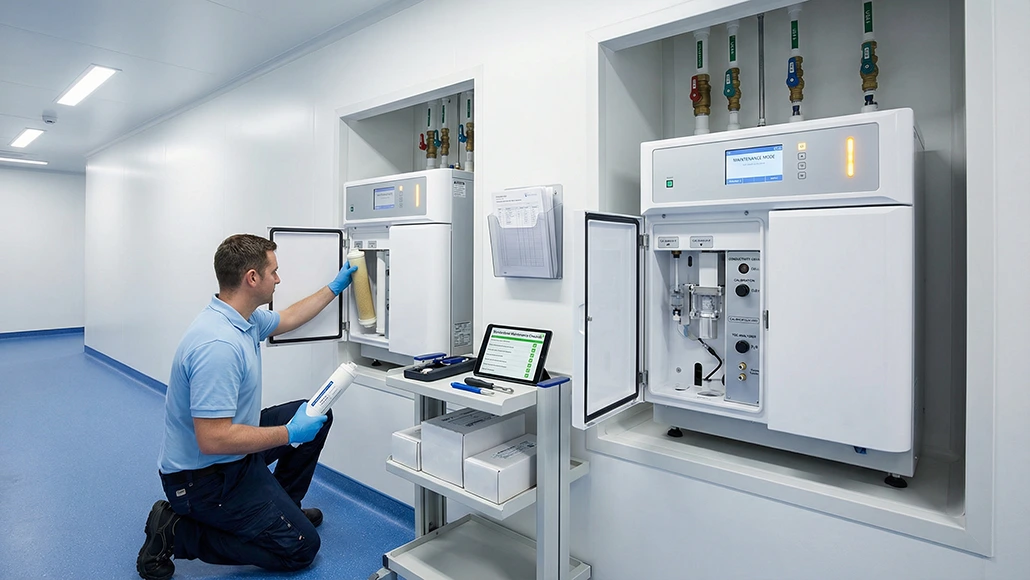
Furthermore, a consistent approach to maintenance such as a global contract with a single service provider ensures that every water system receives the same level of care. This prevents the forgotten system syndrome, where a remote or low-use lab is neglected until it fails. Pharma lab water system consistency means that every system, regardless of its location or usage level, is maintained to the same high standard. This prolongs the life of the equipment and ensures that the water quality remains high across the entire enterprise, protecting the company’s investment in its infrastructure.
Advanced Monitoring for Real-Time Consistency
The next frontier in achieving pharma lab water system consistency lies in the integration of Internet of Things (IoT) technology. Modern purification units can now transmit real-time data on resistivity, Total Organic Carbon (TOC), and temperature to a centralized dashboard. This allows facility managers to monitor the health of their water systems across an entire campus from a single screen. If a filter in a remote lab begins to saturate, the system can automatically trigger a service request before the water quality ever drops below the required threshold.
This move toward Predictive Maintenance is a game-changer for pharma lab water system consistency. It moves the organization away from a break-fix mentality and toward a model of continuous uptime. In a high-throughput lab, the cost of a single day of downtime can be staggering. By using IoT to ensure consistency, labs can operate with the confidence that their most critical reagent will always be available when they need it. This digital oversight is the ultimate safeguard for pharmaceutical operations in the 21st century.
The Human Element: Standardizing SOPs
While hardware is important, pharma lab water system consistency also depends on the people who use the systems. Even the best water system in the world can be undermined by poor handling practices. For example, if one technician rinses their glassware three times with ultra-pure water and another rinses it only once, the level of background contamination will vary. Standardizing the Standard Operating Procedures (SOPs) for water use is a critical part of the overall consistency strategy.
Training programs should emphasize the why behind the water standards. When scientists understand the impact of CO2 absorption or the leaching of ions from plastic containers, they are much more likely to follow the SOPs correctly. Pharma lab water system consistency is thus a combination of high-quality technology and high-quality human behavior. By fostering a culture where water is respected as a critical reagent, companies can ensure that their operational consistency starts at the lab bench and extends all the way to the finished product.
Conclusion: Operational Excellence through Consistency
In the final analysis, pharma lab water system consistency is about more than just water it is about the integrity of the entire pharmaceutical enterprise. It is a commitment to removing unnecessary variables and ensuring that every decision made in the lab is based on solid, reproducible data. By investing in consistent systems, standardized maintenance, and rigorous training, pharmaceutical companies can strengthen their operations, improve their regulatory standing, and ultimately deliver safer, more effective drugs to patients.
As the industry continues to evolve, the importance of this consistency will only grow. In an era of increasing complexity and shrinking margins, those companies that can master their operational variables starting with the most fundamental one: water will be the ones that thrive. Consistent water quality is the silent engine of pharmaceutical excellence, powering the discoveries and the quality standards that will define the future of healthcare.
