













The foundation of every pharmaceutical breakthrough rests upon the reliability of its smallest components. In the complex ecosystem of a research laboratory, water is frequently the most utilized reagent, yet it is often the most overlooked. Achieving lab water quality standardization pharma R&D is not merely a technical preference but a strategic necessity for modern drug discovery. When researchers across different geographical locations utilize varying grades of water, the risk of experimental drift increases exponentially. Standardizing this vital resource ensures that a discovery made in a Boston laboratory can be replicated with identical precision in Singapore or Zurich, effectively removing one of the most pervasive variables in scientific inquiry.
The Critical Role of Purity in Analytical Reproducibility
Modern pharmaceutical research relies on ultra-sensitive instrumentation such as High-Performance Liquid Chromatography (HPLC) and Liquid Chromatography-Mass Spectrometry (LC-MS). These tools can detect impurities at the parts-per-trillion level. Without lab water quality standardization pharma R&D, trace contaminants whether organic compounds, ions, or dissolved gases can create ghost peaks or suppress signals, leading to erroneous interpretations. High-purity water acts as a blank canvas, allowing the true chemical signatures of potential drug candidates to emerge without interference. This level of purity is essential when mapping the metabolic pathways of new chemical entities, where even a slight deviation in solvent quality can mask a critical reaction or catalyze an unwanted side effect.
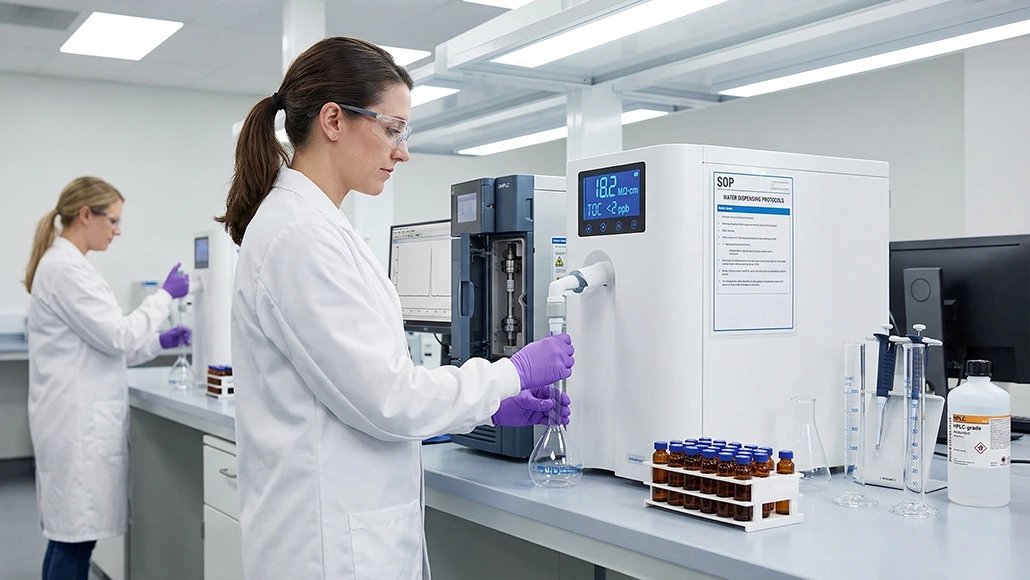
Furthermore, the impact of inorganic ions like sodium, magnesium, or calcium cannot be understated. In many enzymatic assays, these ions act as co-factors. If the water quality varies, the concentration of these background ions varies, which can lead to artificial spikes or dips in enzyme activity. By standardizing to a resistivity of 18.2 MΩ·cm, researchers ensure that the background ionic strength is a known constant, rather than a hidden variable. This level of precision is what separates a world-class research organization from one that struggles with inconsistent data sets and failed technology transfers.
Addressing the Variable Nature of Source Water
Laboratory water systems must account for the immense variability in municipal water supplies. A facility in a region with hard water faces different challenges than one in a soft water area. Lab water quality standardization pharma R&D involves implementing multi-stage purification processes including reverse osmosis, deionization, and ultrafiltration to bring diverse source waters to a singular, high-performance standard. This technological leveling ensures that the research outcomes are a product of the chemistry under investigation rather than the local geography of the testing site.
Moreover, seasonal variations in tap water can introduce organic matter spikes during the spring thaw or increased chlorine levels during the summer. A standardized system with robust pre-treatment and continuous Total Organic Carbon (TOC) monitoring acts as a buffer against these environmental swings. It ensures that regardless of what is happening in the municipal pipes, the water at the lab bench remains pristine. This stability is particularly important for long-term stability studies where the consistency of the solvent environment must be maintained over months or even years.
Mitigating Biological and Organic Interference
Beyond inorganic minerals, biological contaminants such as endotoxins and nucleases pose significant threats to biotechnological research. In the development of protein-based therapeutics or genomic therapies, the presence of even minute amounts of these contaminants can degrade samples or trigger false positives in cellular assays. Adopting lab water quality standardization pharma R&D allows organizations to establish stringent microbial limits that are consistent across all platforms. This consistency is vital for maintaining the health of sensitive cell lines and ensuring that the biological activity observed in vitro is a true reflection of the drug’s potential.
In the realm of proteomics, the presence of proteases in lab water can lead to the unintended degradation of target proteins during extraction or purification. This can result in lower yields or fragmented products that do not represent the native state of the molecule. By utilizing ultrafiltration systems that specifically target large biological molecules, standardized lab water provides a safe haven for fragile biological constructs. This allows researchers to study proteins in their most natural form, leading to more accurate predictions of how they will behave in the human body.
Regulatory Alignment and Data Integrity
Regulatory bodies like the FDA and EMA place a premium on data integrity. A significant portion of this integrity depends on the controlled nature of the laboratory environment. Lab water quality standardization pharma R&D provides a clear audit trail and a verifiable baseline for all solvent-based activities. When every lab in a global network adheres to the same water quality specifications, the transition from early-stage research to clinical trials becomes significantly smoother. Standardized protocols simplify the validation of analytical methods, as the solvent performance remains a known constant throughout the drug development lifecycle.
The concept of ALCOA+ (Attributable, Legible, Contemporaneous, Original, Accurate, and more) is the gold standard for data integrity. Standardized water systems contribute to the Accurate and Attributable portions of this framework. By having integrated data logging within the water purification units, every drop of water used can be traced back to a specific resistivity and TOC reading at the time of use. This level of documentation is invaluable during regulatory inspections, as it demonstrates that the lab is not just aiming for quality, but is actively measuring and recording it.
Enhancing Global Collaborative Efficiency
The pharmaceutical industry is increasingly decentralized, with different phases of R&D often occurring in different countries. Lab water quality standardization pharma R&D removes one of the most common variables that complicate technology transfers. If a secondary lab cannot reproduce the results of the primary site, the investigation into why can cost months of time and millions in capital. Often, the culprit is a subtle difference in water quality. By standardizing at the outset, companies can drastically reduce these delays, accelerating the timeline from bench to bedside.
Consider a scenario where a lead compound is being moved from a discovery lab in the UK to a process development lab in India. If the water quality standards differ, the solubility of the compound might appear different, leading to changes in formulation strategy that were entirely unnecessary. Standardizing the water quality across the entire R&D chain creates a common denominator that allows scientists to speak the same technical language, regardless of their location. This unity of purpose and process is what drives innovation in a globalized economy.
Sustainable Practices through Standardized Systems
Standardization also opens the door to more sustainable laboratory operations. When systems are uniform, maintenance schedules and consumable replacements can be optimized at scale. Modern lab water quality standardization pharma R&D systems often include real-time monitoring of Total Organic Carbon and resistivity, allowing for on-demand purification rather than constant, wasteful cycling. This efficiency reduces both the water footprint and the energy consumption of the facility, aligning research goals with corporate sustainability initiatives.
Furthermore, standardized systems allow for better waste management. Many modern purification units are designed with water-saving features that recycle reject water for non-critical applications or utilize more efficient reverse osmosis membranes. When a company standardizes on these high-efficiency models, the cumulative environmental impact across a global network of labs is substantial. This not only fulfills ethical obligations to the planet but also improves the bottom line by reducing utility costs and waste disposal fees.
The Evolution of Type I, II, and III Classifications
To truly understand standardization, one must look at the hierarchy of water types used in the lab. Type III water, or primary grade water, is typically used for rinsing glassware and heating baths. While it is clean, it is not suitable for analytical work. Type II water is used for general lab applications like buffer preparation and microbiological media. However, it is Type I water the ultra-pure grade that is the star of the show in pharma R&D. Achieving lab water quality standardization pharma R&D means ensuring that the jump from Type II to Type I is handled by a validated, consistent process.
The distinction between these types is becoming increasingly blurred as technology advances. Many labs are now moving toward Type I+ standards, where the water is not just 18.2 MΩ·cm, but also has TOC levels below 2 parts per billion (ppb) and is virtually free of dissolved oxygen. This shift toward even higher standards is driven by the needs of single-molecule imaging and next-generation sequencing. By standardizing on the highest possible tier, a lab future-proofs itself against the next wave of analytical sensitivity, ensuring that its infrastructure doesn’t become the bottleneck for future discoveries.
Addressing the Human Variable in Maintenance
A water system is only as good as its last filter change. A key part of lab water quality standardization pharma R&D is the standardization of maintenance protocols. If one lab changes its cartridges based on a calendar and another waits for an alarm, the water quality between the two will diverge. Standardizing the maintenance schedule preferably through automated, usage-based alerts removes the human element of forgetfulness or stretching the life of a consumable to save money. This proactive approach ensures that the system is always operating within its validated parameters.
Training is another critical component. Personnel must understand that the way they dispense water can affect its quality. For example, leaving a carboy open to the air allows CO2 to dissolve into the water, lowering the pH and increasing the conductivity. Standardizing the SOPs (Standard Operating Procedures) for water handling using specialized dispensers, avoiding long storage times, and utilizing point-of-use filters ensures that the ultra-pure water produced by the machine actually stays ultra-pure when it reaches the beaker.
Future-Proofing Pharma Research Environments
As we move toward a future defined by personalized medicine and highly potent active ingredients, the tolerance for error continues to shrink. The next generation of lab water quality standardization pharma R&D will likely incorporate advanced digital twins and IoT-enabled monitoring to provide a constant stream of purity data. This proactive approach ensures that any deviation is caught before it affects a single assay. Investing in these standardized infrastructures today is an investment in the long-term viability of the drug pipeline, ensuring that the research conducted today remains valid and actionable for years to come.
The integration of AI-driven analytics will soon allow water systems to predict their own failures or suggest optimizations based on the specific assays being performed in the lab. Imagine a system that knows you are about to perform a sensitive mass spec run and automatically increases its internal recirculation to ensure the lowest possible TOC levels. This level of intelligent standardization is the future of pharma R&D, where the environment itself becomes an active partner in the scientific process, guiding the researcher toward the most reliable and impactful outcomes possible.
