










Quality assurance in the pharmaceutical industry is a high-stakes endeavor where the margin for error is nonexistent. At the heart of this process lies a resource so fundamental that its quality dictates the success of every assay: water. Implementing lab water standards pharma testing is the only way to ensure that results are accurate, reproducible, and compliant with international regulations. Whether it is for dissolving reagents, cleaning glassware, or serving as a mobile phase in chromatography, the water used must meet specific, standardized criteria to prevent the introduction of variables that could compromise the final product’s safety profile.
The Scientific Necessity of Standardized Purity
In analytical chemistry, the sensitivity of modern equipment has reached unprecedented levels. Techniques like ultra-high-performance liquid chromatography (UHPLC) and inductively coupled plasma mass spectrometry (ICP-MS) require water that is virtually free of any interfering substances. Without strict lab water standards pharma testing, trace levels of silica, ions, or organic molecules can cause baseline noise, peak tailing, or even the total failure of a validation study. These standards categorize water into typestypically Type I, II, and IIIeach with defined limits on resistivity, total organic carbon, and bacterial count, ensuring that the right level of purity is used for the specific sensitivity of the test.
For instance, in the testing of heavy metals within a drug formulation, using water that contains even a few parts per billion of lead or arsenic would completely invalidate the results. Standardized Type I water ensures that the background levels of these elements are below the detection limit of the ICP-MS. This allows the analyst to confidently state that any detected metal is coming from the sample itself, not the solvent. This clarity is the bedrock of pharmaceutical quality control, providing the empirical evidence needed to release a batch of life-saving medicine to the market.
Impact on Microbiological Control
For pharmaceutical products that must be sterile, the water used in testing must be strictly monitored for microbial content and endotoxins. Lab water standards pharma testing provide the benchmarks for these limits. If water used in a sterility test contains even a single colony-forming unit of a contaminant, it can lead to a false positive result, triggering an expensive and time-consuming investigation. By adhering to global standards such as those found in the United States Pharmacopeia (USP) or the European Pharmacopoeia (EP), labs can mitigate these risks and maintain a high level of confidence in their microbiological assessments.
Furthermore, endotoxins the lipopolysaccharides found in the cell walls of gram-negative bacteria are potent pyrogens that can cause severe inflammatory reactions in patients. In the testing of injectable drugs, water must meet endotoxin-free standards, typically defined as less than 0.001 EU/ml. Achieving this requires specialized ultrafiltration at the point of use. Without standardized protocols for maintaining and testing these filters, the risk of endotoxin breakthrough becomes a significant liability. Standardized testing ensures that every batch of water is as safe as the product it is testing.
Ensuring Consistency in Global Operations
Many pharmaceutical companies operate testing facilities across multiple continents. The challenge of maintaining identical testing conditions in different environments is significant. Source water in one region might be rich in minerals, while another might have high levels of organic matter. Lab water standards pharma testing act as a universal language, ensuring that the water produced by a purification system in one part of the world is chemically identical to that produced elsewhere. This consistency is vital for multi-site clinical trials and global quality control programs, where data must be pooled and compared without the fear of environmental bias.
Consider a global pharmaceutical giant releasing a vaccine simultaneously in fifty different countries. Each regional lab must perform identical release tests. If one lab uses water that is slightly more acidic due to dissolved CO2, it could affect the stability profile of the vaccine in that specific region. Standardizing the water systems and the handling protocols such as using vacuum-degassed water or airtight dispensing systems ensures that the vaccine’s performance is consistent worldwide. This global harmonization is not just a logistical convenience; it is a fundamental requirement for global health equity.
Regulatory Compliance and Audit Readiness
Regulatory agencies expect pharmaceutical manufacturers to demonstrate total control over their manufacturing and testing processes. Water systems are a focal point of any inspection. Following established lab water standards pharma testing allows a facility to provide documented proof of its commitment to quality. Modern purification systems that incorporate automated data logging of resistivity and TOC levels make it much easier to demonstrate compliance during an audit. This transparency not only protects the company from regulatory action but also builds trust with healthcare providers and patients who rely on the integrity of the testing data.
During a typical FDA audit, the inspector will often ask to see the validation reports for the water system, including the Installation Qualification (IQ), Operational Qualification (OQ), and Performance Qualification (PQ). These documents prove that the system was installed correctly, operates within its design parameters, and consistently produces water that meets lab water standards pharma testing. Without a standardized approach to these qualifications, a lab may find itself unable to prove the reliability of its data, leading to Form 483 observations or even warning letters that can halt production.
Cost Efficiency through Reduced Re-Testing
The financial implications of poor water quality are substantial. A single failed batch or an invalidated test result due to water contamination can cost a laboratory tens of thousands of dollars in reagents, labor, and time. By investing in systems that meet lab water standards pharma testing, organizations significantly reduce the incidence of out of specification (OOS) results. While the initial investment in high-quality purification technology and regular validation may seem high, it is dwarfed by the long-term savings realized through operational efficiency and the avoidance of costly investigative procedures.
Moreover, the time spent investigating an OOS result is time that could be spent on productive testing. In a busy QC lab, the backlog caused by a single water-related failure can ripple through the entire production schedule, delaying the release of products to patients. Standardized water quality act as a preventative measure, ensuring that the lab’s throughput remains high and its results remain beyond reproach. This reliability is a competitive advantage in an industry where speed-to-market is a key performance indicator.
Advanced Technologies Supporting Modern Standards
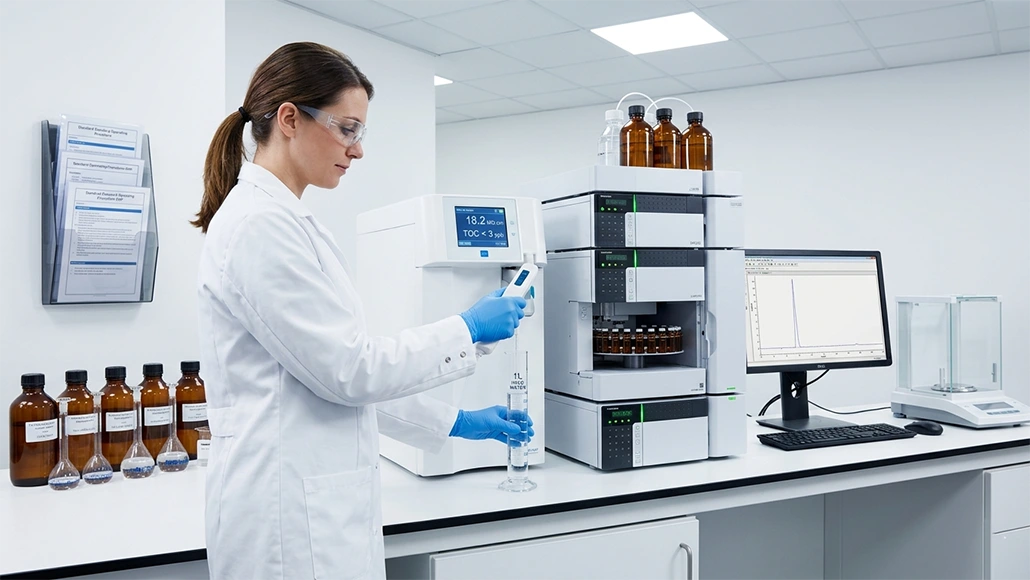
The evolution of water purification technology has played a critical role in making lab water standards pharma testing achievable and sustainable. Technologies like electrodeionization (EDI) provide a consistent flow of high-purity water without the need for hazardous chemical regeneration. Furthermore, the integration of UV photo-oxidation at 185nm for organic removal and ultra-filtration for pyrogen control ensures that the water exceeds the minimum requirements of most pharmacopeias. These advancements allow labs to focus on their core scientific work, knowing that their most basic reagent is consistently performing at its peak.
The latest systems also feature smart dispensing technologies that allow for precise volume control and flow rates, reducing splashing and the introduction of air bubbles. This is particularly important when preparing delicate protein solutions or high-concentration standards. By standardizing the dispensing process as much as the purification process, labs can further reduce the variation in their experimental setups. This holistic view of water quality from the incoming pipe to the final beaker is the hallmark of a modern, standardized pharmaceutical testing facility.
The Human Element in Quality Control
While technology provides the tools, the human element remains essential in maintaining lab water standards pharma testing. Training laboratory personnel on the importance of water quality, proper sampling techniques, and the nuances of system maintenance is critical. A culture of quality ensures that deviations are reported and investigated promptly. When scientists understand that the blank in their chromatography run is only as good as the water they use, they become the first line of defense against contamination.
This training should extend to the very basics of lab hygiene. For example, using a plastic squeeze bottle to dispense ultra-pure water can leach phthalates into the solvent, which will then appear as contaminants in a GC-MS run. Standardizing on glass containers or specialized fluoropolymer bottles for ultra-pure water storage is a simple but vital part of the overall quality strategy. When every team member is aligned with these best practices, the lab becomes a bastion of precision, capable of producing the reliable data that the pharmaceutical industry demands.
Future Trends in Pharmaceutical Water Standards
As we look to the future, the standards for lab water are likely to become even more granular. We are seeing a move toward application-specific water standards, where the purification process is tailored to the specific needs of genomics, proteomics, or cell therapy. For example, water for mRNA vaccine testing may need to be certified RNase-free beyond the standard Type I requirements. Standardizing these ultra-high tiers of purity will require even more sophisticated monitoring and validation protocols.
The integration of blockchain technology for data integrity is another potential trend. By recording water quality data on an immutable ledger, companies could provide an unbreakable chain of custody for every drop of water used in a drug’s development. While this may seem futuristic, it is a logical extension of the current drive toward total transparency and control in pharmaceutical testing. By staying ahead of these trends and embracing lab water standards pharma testing today, organizations are positioning themselves for success in the increasingly complex world of tomorrow’s medicine.
