


























The biopharmaceutical manufacturing environment is characterized by a high degree of variability, where different therapeutic modalities such as monoclonal antibodies, viral vectors, and mRNA vaccines each place unique demands on the equipment used to produce them. While standardized components offer convenience, they often fail to address the specific nuances of a complex bioprocess. This has led to the widespread adoption of customization strategies in single-use bag manifold design, a practice that empowers engineers to create bespoke fluid management solutions that are optimized for maximum yield, safety, and operational simplicity. By tailoring the architecture of the manifold to the specific requirements of a process, manufacturers can eliminate unnecessary complexity and focus on the most critical aspects of their production workflow.
The Logic of Process-Specific Fluid Path Design
At its core, the drive for customization is about achieving a “perfect fit” between the process and the equipment. Every extra inch of tubing, every unnecessary connector, and every “dead leg” in a manifold represents a potential point of failure or a source of product loss. Effective customization strategies in single-use bag manifold design involve a deep analysis of the process flow to identify opportunities for simplification and optimization. For example, in high-value cell therapy manufacturing, minimizing the internal volume of the manifold is essential for maximizing the recovery of precious cells. By carefully selecting tubing diameters and lengths, designers can ensure that every milliliter of product is accounted for, which is a critical factor in both the economic and clinical success of the therapy.
Selecting the Right Components for Functional Performance
A key element of any customization strategy is the selection of individual components that perform specific functions within the assembly. This includes choosing the appropriate type of aseptic connector, filter, and sampling port based on the process conditions. Customization strategies in single-use bag manifold design allow engineers to mix and match components from different suppliers to create a hybrid system that offers the best possible performance. For instance, a manifold might use a specific brand of reinforced tubing for high-pressure pump sections and a more flexible, low-permeability film for the storage bags. This level of granularity ensures that each part of the assembly is engineered to withstand the specific mechanical and chemical stresses it will encounter during the run.
Enhancing Ergonomics and Reducing Human Error
One of the most significant benefits of a custom-designed system is the improvement in operator usability. Complex bioprocesses often involve dozens of fluid transfers, and the risk of a manual error during setup can be high. Customization strategies in single-use bag manifold design address this by incorporating ergonomic features like color-coded tubing, physical lockouts on connectors, and integrated labels that guide the operator through the assembly process. Furthermore, custom manifolds can be designed to fit perfectly within the specific physical footprint of the manufacturing suite, reducing the physical strain on operators and minimizing the risk of tripping or accidental damage to the equipment. By making the system more intuitive to use, manufacturers can significantly enhance the overall reliability of their operations.
Balancing Customization with Supply Chain Lead Times
While the benefits of bespoke design are clear, customization often comes at the cost of longer lead times and higher complexity in the supply chain. A successful implementation of customization strategies in single-use bag manifold design requires a balanced approach that considers both performance and availability. Many manufacturers are now adopting a “configurable” approach, where they use a library of pre-validated sub-assemblies to build a custom system. This allows for a high degree of tailoring while still leveraging the benefits of standardization, such as faster delivery and simplified quality documentation. This hybrid strategy ensures that the manufacturer can respond quickly to process changes without sacrificing the benefits of a process-optimized design.
Material Selection and Chemical Compatibility Optimization
Not all biological products are created equal, and some may be particularly sensitive to the materials used in the fluid path. Customization strategies in single-use bag manifold design provide the opportunity to select materials that are specifically optimized for the product’s chemical and biological profile. For example, some proteins may be prone to adsorption on certain types of plastic, leading to loss of potency. By choosing a bag film with a specialized low-protein-binding inner layer, designers can mitigate this risk. Similarly, for processes involving aggressive buffers or organic solvents, customization allows for the use of chemically resistant tubing and seals that prevent degradation and ensure the long-term integrity of the sterile barrier.
The Role of 3D Modeling and Virtual Design Reviews
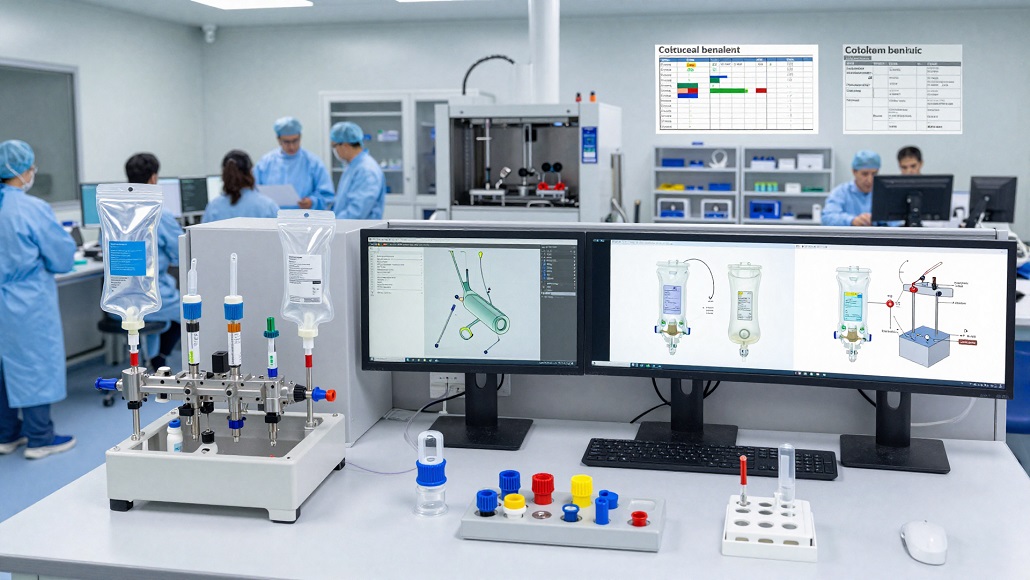
The design process for a custom manifold has been revolutionized by the use of advanced digital tools. Customization strategies in single-use bag manifold design now frequently involve 3D CAD modeling and virtual reality walkthroughs. These tools allow engineers to visualize the entire assembly in the context of the cleanroom, ensuring that the manifold is easy to install and that all ports and sensors are accessible. Virtual design reviews enable stakeholders from quality, manufacturing, and engineering to provide feedback early in the process, reducing the need for costly physical prototypes and ensuring that the final design meets all operational and regulatory requirements. This “digital first” approach significantly accelerates the time from concept to delivery for custom single-use solutions.
Scaling Custom Designs from Pilot to Commercial Production
One of the challenges of customization is ensuring that the design remains scalable as the process moves from the laboratory to full-scale manufacturing. Customization strategies in single-use bag manifold design must account for the mechanical stresses that occur at larger volumes. This may involve reinforcing bag support structures, increasing tubing diameters to maintain flow rates, or adding additional filtration capacity. By thinking about scalability from the very beginning, engineers can create a design that can be easily expanded without requiring a complete overhaul of the fluid path. This consistency is vital for maintaining the validated state of the process and ensuring that the product quality remains constant across all phases of the drug development lifecycle.
Cost-Benefit Analysis of Bespoke vs. Standardized Systems
While a custom manifold might have a higher unit price than a standard one, the total cost of ownership is often lower when considering the operational savings. Customization strategies in single-use bag manifold design can lead to significant reductions in labor costs, waste generation, and batch failure rates. For instance, a manifold that is easier to set up can save hours of operator time per batch, while a design that minimizes product loss can increase the value of each run by tens of thousands of dollars. A thorough cost-benefit analysis should look beyond the purchase price and consider how the design impacts the overall efficiency and risk profile of the manufacturing facility.
The Future of Customization: Additive Manufacturing and Modular Racks
As technology continues to advance, the possibilities for customization are expanding. We are beginning to see the emergence of additive manufacturing (3D printing) for specialized manifold components, allowing for even more complex and optimized geometries. Additionally, the development of modular rack systems that can be reconfigured to support different custom manifold designs is providing a new level of facility-level flexibility. These trends suggest that customization strategies in single-use bag manifold design will become even more integrated into the broader bioprocess engineering workflow, providing the foundation for the next generation of highly efficient and adaptable “factories of the future.”
Conclusion
The shift toward personalized medicine and more complex biological therapies is driving a fundamental change in how we think about bioprocess infrastructure. Customization strategies in single-use bag manifold design are at the forefront of this change, providing the flexibility and precision needed to meet the challenges of modern drug manufacturing. By prioritizing the specific needs of the process and the operator, these bespoke solutions empower manufacturers to optimize their workflows, reduce risk, and deliver life-saving therapies with greater speed and reliability. As the industry continues to innovate, the ability to create tailored fluid management solutions will remain a critical differentiator for companies striving for operational excellence in the highly competitive world of biotechnology.
