



























Key Takeaways
- Digital twins create synchronized virtual replicas of pharmaceutical processes that enable real-time monitoring and optimization
- Scenario analysis through digital simulation allows manufacturers to predict outcomes of process changes before implementing them
- Predictive maintenance capabilities prevent unexpected equipment failures by forecasting failure risks based on equipment condition
- Golden batch prediction helps manufacturers optimize formulations and processing parameters to achieve superior product quality
- Real-time decision support guides operators toward optimal parameter selections during complex multi-variable manufacturing processes
- Virtual commissioning of new equipment and processes reduces startup delays and accelerates technology transfer between facilities
- Integration with IoT sensors and data analytics creates continuous feedback loops that automatically improve process performance
The pharmaceutical manufacturing environment presents extraordinary operational complexity. Production facilities managing multiple drug products must maintain precise control over hundreds of variables simultaneously temperature, pressure, humidity, flow rates, mixing speeds, and countless others. Managing this complexity while ensuring batch-to-batch consistency, maintaining regulatory compliance, and optimizing efficiency challenges even the most experienced manufacturing teams. Digital twin technology offers a transformative approach to this challenge by creating virtual representations of physical manufacturing systems that evolve in lockstep with actual operations.
Understanding Digital Twin Technology in Pharmaceutical Context
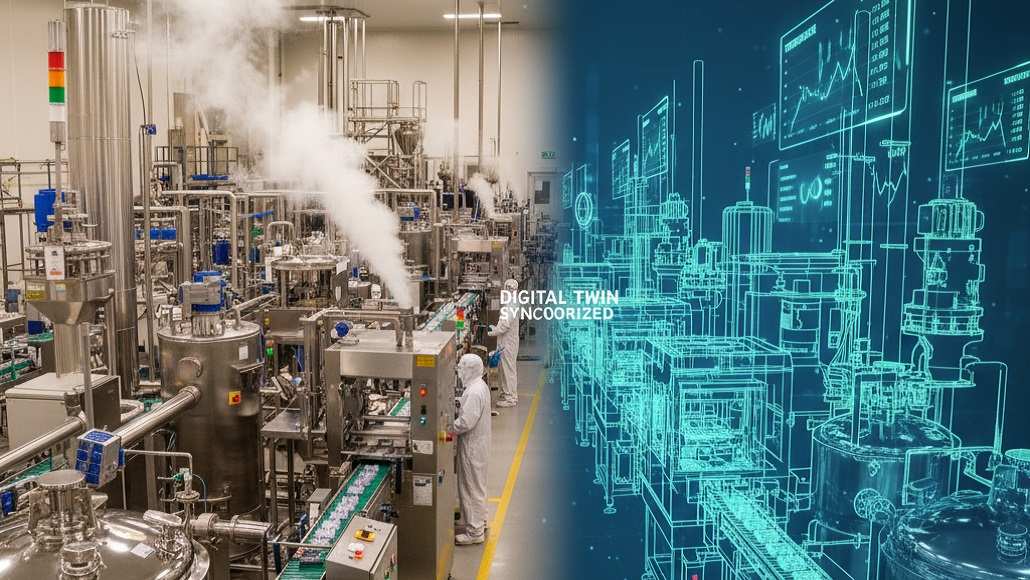
A digital twin pharma manufacturing system represents far more than a static computer model or simulation. Traditional simulations capture a single snapshot of how systems might behave under specific conditions. Digital twins operate continuously, receiving real-time data from physical equipment through IoT sensors, updating their internal state to mirror actual operations, and generating insights that guide manufacturing decisions. The relationship between physical and digital systems is bidirectional sensors continuously feed physical performance data into the digital model, while the digital model generates insights and recommendations that inform real-world operational decisions.
The architecture of pharmaceutical digital twins typically comprises several integrated components. Sensor networks deployed throughout manufacturing facilities capture real-time process parameters equipment temperatures, pressures, material flow rates, and environmental conditions. This sensor data transmits continuously to edge computing systems that pre-process and validate information before transmission to cloud platforms where the primary digital twin operates. The digital model itself integrates process physics, equipment characteristics, and historical performance patterns learned from prior batches. Advanced analytics layers analyze real-time performance, comparing actual operations against predicted behavior and identifying deviations that warrant attention.
The sophistication of digital twins varies substantially depending on their purpose. A maintenance-focused twin might emphasize equipment condition monitoring and failure prediction, tracking bearing wear, pump cavitation, and motor efficiency degradation. A quality-focused twin prioritizes product attribute monitoring, tracking formulation consistency, impurity generation, and critical quality attribute evolution throughout manufacturing. A comprehensive facility twin integrates multiple specialized models, providing holistic visibility across entire production systems.
Real-Time Process Monitoring and Predictive Control
One of the most immediate benefits of implementing virtual manufacturing systems in pharmaceutical facilities is the unprecedented process visibility they enable. Traditional manufacturing operations provide periodic information batches are processed through unit operations, results are analyzed in laboratories, and batches are approved or rejected based on final testing. By the time results are available, the batch has already been manufactured, processed further, and potentially released. If quality issues are discovered late, remediation options become limited.
Digital twins enable what might be called manufacturing transparency continuous visibility into exactly how processes actually perform throughout production. Rather than waiting for final test results, manufacturers observe process signatures in real-time. Temperature profiles during a drying step can be continuously verified against specifications. Mixing quality can be assessed by monitoring torque patterns and power consumption. Particle size evolution during grinding can be tracked through real-time particle size analysis rather than waiting for laboratory results.
This real-time visibility enables predictive control pharmaceutical systems that guide operators toward optimal performance. Consider a tablet compression step where operators control compression force, turret speed, and feeder settings. Traditional operations involve manually adjusting these parameters based on operator experience and periodic tablet weight measurements. Digital twin systems model how tablets respond to parameter changes, predicting tablet hardness, friability, and dimensions for any parameter combination. Operators receive real-time guidance indicating whether current settings will produce acceptable tablets or require adjustment. If a slight parameter modification will improve consistency without compromising other quality attributes, the system recommends the adjustment before any out-of-specification tablets are produced.
This predictive guidance proves particularly valuable for complex unit operations with numerous interactive parameters. Fluid bed drying requires simultaneous control of inlet temperature, air flow rate, product bed temperature, and moisture content target. These parameters interact in complex, nonlinear ways adjusting inlet temperature affects bed temperature, which influences drying rate, which determines the moisture level achieved at process endpoint. Inexperienced operators can easily adjust one parameter in ways that compromise others. Digital twin systems model these interactions, predicting batch outcomes for any parameter combination and guiding operators toward optimal settings that maximize efficiency while maintaining quality specifications.
Scenario Analysis and Batch Optimization
Pharmaceutical process development and manufacturing optimization inherently involve uncertainty. When considering process parameter changes, manufacturers face critical questions: if we adjust the mixing time by ten percent, how will this affect product homogeneity? If we reduce the crystallization temperature, will impurity levels increase? If we modify the filtration pressure, will we achieve faster processing without compromising product purity? Traditionally, answering these questions requires conducting experiments time-consuming and expensive undertakings that consume materials and equipment time.
Process simulation pharma powered by digital twins enables scenario analysis without requiring physical experimentation. Manufacturers can pose hypothetical questions to their digital twin: “What would happen if I changed this parameter to this value?” The digital model, trained on historical batch data and process physics, predicts the likely outcome. Should the prediction suggest an improvement, the manufacturer can implement the change with confidence. Should the prediction suggest degradation in some quality attribute, the manufacturer can explore alternative parameter combinations without committing to physical experiments.
The practical benefit extends to process robustness assessment, a regulatory requirement in pharmaceutical manufacturing. Manufacturers must demonstrate that processes remain functional when parameters vary from nominal values. Traditionally, this involves conducting carefully designed experiments, varying parameters systematically while monitoring product quality. Digital twins enable what might be called virtual robustness assessment modeling process performance across the full parameter range without requiring each condition to be tested physically.
Consider designing a dosage form where the target composition is thirty percent drug, fifty percent excipient A, and twenty percent excipient B. Regulatory expectations require manufacturers to demonstrate that the process produces acceptable products even when component amounts vary by plus or minus five percent. The traditional approach involves conducting factorial experiments testing all combinations of component variations. A digital twin approach simulates product quality across the entire parameter space, identifying which combinations produce acceptable products and which create problems. This insight might reveal that the process is robust to ten percent variation in excipient A but sensitive to variation in excipient B, guiding manufacturers to tighter controls on the critical material.
Golden Batch Prediction and Quality Optimization
In pharmaceutical manufacturing, the concept of a “golden batch” represents the ideal the single best batch ever manufactured, with perfect consistency, optimal quality attributes, and flawless purity. Identifying what made that particular batch superior and replicating the conditions consistently remains a persistent manufacturing challenge. Manufacturing teams might suspect that slightly different operating conditions, raw material characteristics, or environmental factors contributed to superior performance, but isolating the specific factors among hundreds of potential variables proves extremely difficult.
Golden batch prediction powered by digital twins transforms this challenge fundamentally. By analyzing all historical batch data recording not just final product quality but complete process signatures including every parameter variation digital twins identify the specific conditions correlating with superior batches. The analysis might reveal that superior batches consistently incorporated raw material from a particular supplier exhibiting slightly different particle size distribution. Or that batches manufactured during seasons with stable humidity demonstrated better consistency. Or that minor modifications to mixing sequence that appeared inconsequential actually produced meaningful improvements in product homogeneity.
Once identified, these optimization opportunities can be investigated further or immediately implemented depending on feasibility. Some improvements might be instantly reproducible implementing identified parameter adjustments or selecting preferred raw material suppliers. Others might require additional study but provide clear direction for process optimization efforts. The critical benefit is that digital twins enable systematic identification of meaningful optimization opportunities from vast amounts of historical data a discovery process that would be essentially impossible through human analysis alone.
The quality improvement implications prove substantial. Golden batch prediction doesn’t require discovering revolutionary new approaches to manufacturing. It simply ensures that the best practices demonstrated in historical operations are systematically understood and consistently replicated going forward. For facilities manufacturing thousands of batches annually, enabling even a one percent improvement in consistency translates to improved quality across the entire product portfolio.
Predictive Maintenance and Equipment Reliability
Manufacturing downtime represents one of the largest hidden costs in pharmaceutical production. Equipment failures force production line shutdowns, delaying batches, disrupting manufacturing schedules, and potentially compromising supply chain reliability. The traditional approach to managing this risk involves scheduled maintenance replacing components at predetermined intervals regardless of actual condition. This approach generates unnecessary expenses by replacing components that remain functional while occasionally missing actual failures in components not on the maintenance schedule.
Predictive maintenance technology enabled by digital twins offers superior approach. Rather than calendar-based maintenance, digital twins monitor equipment health continuously, predicting failure risk and remaining useful life. A bearing showing normal vibration characteristics continues operating while another bearing showing accelerating wear receives attention before failure. A pump delivering normal discharge pressure continues operating while another pump showing subtle pressure rise receives preventive maintenance before performance degrades further.
The prediction capability comes from integrating historical equipment failure patterns with real-time condition monitoring. Digital twins learn from past equipment failures recognizing which condition changes preceded failures and how much time typically remained between initial condition degradation and actual failure. When current equipment shows similar condition changes, the system forecasts failure probability and remaining useful life. Maintenance teams receive alerts enabling proactive repair scheduling before failures occur.
The practical benefit extends beyond simply avoiding unexpected failures. Predictive maintenance enables condition-based replacement rather than time-based replacement, reducing maintenance costs substantially. Equipment components are replaced only when condition monitoring indicates degradation, potentially extending equipment life beyond traditional replacement intervals. The resulting maintenance cost reduction, combined with improved uptime, typically justifies digital twin implementation on equipment reliability grounds alone.
Quality by Design and Continuous Improvement
Pharmaceutical regulatory guidance increasingly emphasizes Quality by Design (QbD), an approach where product quality is engineered into manufacturing processes through comprehensive process understanding rather than achieved through extensive testing and inspection. Quality by Design requires deep knowledge of how raw materials, equipment parameters, and environmental factors influence product quality precisely the knowledge that digital twins generate systematically.
By analyzing historical batch data and current operations, digital twins document relationships between input variables and product outcomes. Raw material particle size correlates with product homogeneity. Mixing intensity affects impurity formation. Drying temperature influences crystal form development. This process understanding, documented systematically through digital twin analysis, forms the foundation for robust Quality by Design implementation. Manufacturers demonstrate comprehensive process understanding not through conceptual arguments but through actual data showing how specific parameter changes influence measurable product attributes.
This data-driven process understanding enables continuous improvement in ways that traditional quality systems cannot achieve. Rather than relying on annual process reviews to identify improvement opportunities, digital twins continuously analyze performance against expectations. When actual batch outcomes deviate from predicted patterns, the system flags these anomalies for investigation. When subtle trends appear in process performance, digital twins identify patterns humans might miss. When newly implemented improvements prove beneficial, digital twins quantify the benefit and assess whether similar improvements apply to other unit operations or products.
Implementation Pathways and Validation Considerations
Implementing digital twins in pharmaceutical facilities represents a significant undertaking requiring careful planning and validation. Unlike pilot projects in other industries where occasional errors have minimal consequences, pharmaceutical manufacturing demands comprehensive validation that digital models accurately predict real-world behavior across the full range of operating conditions.
Implementation typically begins with comprehensive process characterization documenting how each unit operation actually performs under various conditions. This characterization might involve controlled experiments varying parameters systematically while measuring outcomes. Or it might involve analyzing historical batch data from hundreds of production batches, identifying relationships between parameters and outcomes. The resulting process model forms the foundation for the digital twin the more accurate and comprehensive this characterization, the more reliable the digital twin predictions.
Data infrastructure development follows, ensuring that sensor networks provide reliable real-time data, that this data transmits reliably to digital twin systems, and that data quality meets pharmaceutical standards. Pharmaceutical facilities cannot tolerate data gaps or unreliable measurements digital twins trained on poor quality data will generate poor quality predictions. Substantial effort goes into validating that sensors operate within acceptable accuracy ranges, that data transmission systems maintain reliability, and that anomalous readings are identified and corrected rather than corrupting the digital model.
Validation protocols must demonstrate that digital twin predictions align with actual manufacturing results. Manufacturers conduct side-by-side comparisons making physical batches while simultaneously running digital predictions, comparing results, and confirming alignment. This validation effort might consume dozens of batches and several months of manufacturing time. Yet this validation proves essential before deploying digital twins to guide manufacturing decisions.
Competitive and Strategic Advantages
Pharmaceutical companies deploying pharmaceutical process monitoring through advanced digital twins gain substantial competitive advantages. Manufacturers operating digital twin systems can modify processes more confidently because they can simulate changes before implementing them reducing the risk of process failures. They can optimize operations more aggressively because virtual scenario analysis identifies improvement opportunities safely. They can respond more quickly to market changes because digital twins guide parameter adjustments enabling rapid product format changes or capacity adjustments.
These operational advantages translate to competitive benefits. Facilities with advanced digital twins maintain superior equipment reliability, reducing unplanned downtime that competitors might experience. They achieve superior batch consistency because digital twins guide parameter optimization. They respond more quickly to quality issues because digital twins immediately alert operators to process deviations. They achieve lower manufacturing costs because optimization reduces waste and material consumption.
Conclusion
Digital twin technology represents a fundamental advancement in pharmaceutical manufacturing capability. By creating synchronized virtual replicas of physical manufacturing systems, digital twins enable predictive control that guides manufacturers toward optimal operations. The capability to simulate process changes before implementing them, predict equipment failures before they occur, and identify optimization opportunities from vast amounts of historical data creates unprecedented manufacturing intelligence.
The competitive landscape increasingly favors manufacturers with advanced digital twin capabilities. As more facilities implement this technology, those without digital twins face growing disadvantages in responsiveness, flexibility, and cost competitiveness. For pharmaceutical manufacturers committed to operational excellence and long-term competitiveness, digital twin implementation has progressed from optional innovation to essential capability for surviving in an increasingly sophisticated manufacturing environment.
