





















Key Takeaways
- Automation-assisted workflows improve pharmaceutical manufacturing efficiency while augmenting human decision-making rather than replacing workers
- Human-machine collaboration creates manufacturing environments where humans manage strategic decisions and optimization while automation handles repetitive or hazardous tasks
- Flexible production line designs enable rapid product changeovers and capacity adjustments, improving facility responsiveness and asset utilization
- Continuous manufacturing approaches reduce production cycle times, minimize batch-to-batch variability, and improve overall facility throughput
- Modern paradigm shifts maintain regulatory compliance through integrated quality systems and real-time monitoring replacing traditional batch-based quality verification
- Manufacturers combining multiple efficiency paradigms achieve compounded benefits exceeding what any single approach delivers independently
- Strategic facility modernization requires systematic approach evaluating equipment capabilities, workforce readiness, and regulatory alignment
The pharmaceutical manufacturing landscape is experiencing a fundamental transformation in how facilities approach production efficiency. Traditional batch manufacturing loading material into equipment, processing through defined cycles, discharging and moving to next operation has served the industry adequately for decades. Yet this traditional model inherently generates inefficiencies that modern manufacturing approaches address systematically. Batch manufacturing creates inevitable transition losses, requires substantial intermediate material storage, generates batch-to-batch variability despite rigorous controls, and limits facility responsiveness to changing market demands. Pharma manufacturing efficiency optimization increasingly emphasizes approaches fundamentally reimagining how pharmaceutical production occurs shifting from batch paradigms toward continuous and flexible manufacturing approaches promising superior efficiency, consistency, and agility.
The Limitations of Traditional Batch Manufacturing
Understanding emerging efficiency paradigms requires recognizing limitations within traditional batch manufacturing that these newer approaches address. Batch manufacturing begins with batch preparation gathering materials, setting equipment parameters, loading materials into the first unit operation. This first operation processes material through defined cycle time perhaps several hours for complex synthesis or formulation operations. Upon completion, material moves to next operation, repeating the cycle. Each transition between operations creates inevitable losses material residual in equipment, time waiting for next equipment availability, potential contamination risks during transfer.
Consider a typical pharmaceutical synthesis comprising five sequential operations, each requiring four hours of processing. In traditional batch manufacturing, completing a single batch requires minimum twenty hours. If the facility has only one production line, achieving continuous output requires starting a new batch immediately upon completing the previous one. Yet real manufacturing involves equipment maintenance, parameter verification, changeover for different products, and inevitable transition delays. Actual throughput rarely achieves theoretical maximum perhaps achieving only sixty to seventy percent utilization despite maintaining production schedules continuously.
Beyond throughput limitations, batch manufacturing generates inevitable variability. Despite rigorous parameter control during each batch, subtle differences between batches slightly different raw material characteristics, minute environmental variations, normal equipment wear create batch-to-batch differences. Quality assurance systems accommodate this variability by setting specification ranges wide enough to encompass normal variability. Yet from first-principles perspective, this batch-to-batch variability represents quality loss inconsistent products rather than perfectly uniform batches.
Material inventory requirements represent another traditional manufacturing inefficiency. Since batches process sequentially rather than continuously, facilities maintain intermediate material buffers between operations. If synthesis produces material faster than the next operation can process, storage tanks or warehouses accumulate intermediate material. These inventories tie up capital, require space, and create contamination or degradation risks if material sits stored for extended periods. From lean manufacturing perspectives, inventory represents waste material in process but not advancing toward finished product.
Automation-Assisted Workflow Transformation
Addressing traditional manufacturing limitations, modern pharmaceutical facilities increasingly implement automation-assisted workflows fundamentally transforming how operations execute. Automation-assisted approaches differ fundamentally from traditional “lights out” factory concepts where humans are eliminated from manufacturing. Rather, these approaches strategically automate tasks unsuited to human capability while augmenting human decision-making through automation support.
Automation-assisted workflows might involve automated material handling systems that transfer material between operations, dramatically reducing transition time and contamination risk. Rather than operators manually moving intermediate material a process consuming time, risking spills, and exposing workers to potent compounds automated transfer systems move material through enclosed piping at controlled rates. This automation improves efficiency while eliminating worker exposure and contamination risk.
Another automation-assisted approach involves automated parameter control for repetitive operations. Many pharmaceutical unit operations involve well-defined procedures dissolving materials at specific temperature, mixing at prescribed intensity for defined duration, crystallizing under controlled cooling. Rather than requiring operator attention to maintain parameters throughout extended operations, automated control systems manage these parameters precisely while operators monitor systems and intervene if anomalies appear. This automation frees human attention for problem-solving and optimization rather than routine monitoring.
Automated data collection represents another significant workflow enhancement. Traditional batch manufacturing requires substantial manual documentation operators recording temperatures, pressures, and measurements at intervals. This manual recording introduces errors, consumes time, and fails to capture data granularity that digital systems can provide. Automated data collection through sensors and digital systems creates comprehensive, accurate records while eliminating transcription errors and human oversight. Operators focus on interpreting data patterns and making decisions rather than routine data entry.
The practical benefit of automation-assisted workflows extends beyond simple efficiency improvements. By automating hazardous or uncomfortable tasks, these systems improve worker safety and satisfaction. Operators avoid exposure to toxic solvents or extreme temperatures. Physically demanding tasks like material handling are automated. Repetitive, monotonous monitoring is automated. The resulting work becomes more cognitively engaging and safer.
Human-Machine Collaboration Models
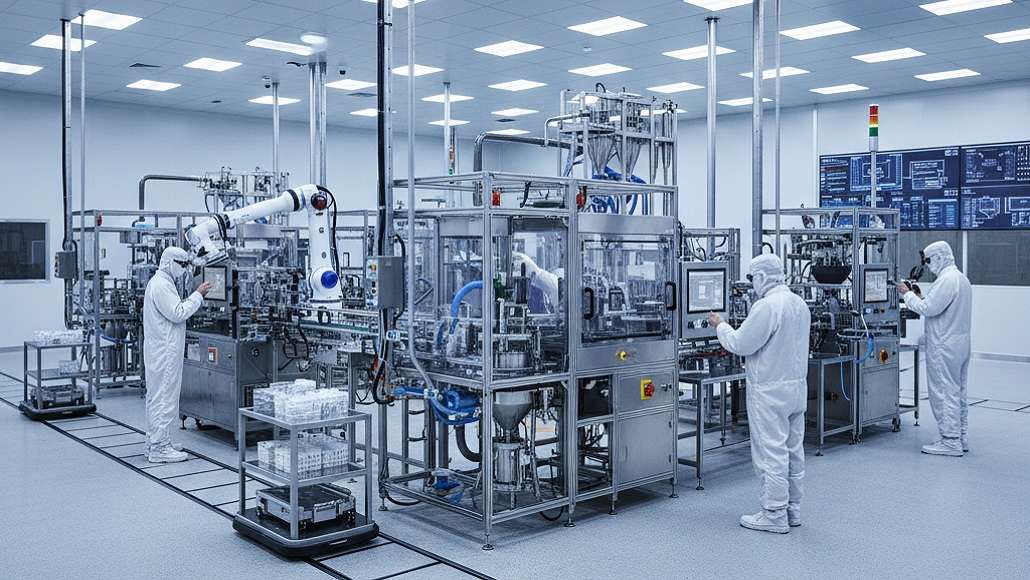
Modern pharmaceutical manufacturing increasingly emphasizes human-machine collaboration pharma environments where humans and automation work interdependently, each contributing distinctive capabilities. This collaboration model differs fundamentally from either purely manual manufacturing or fully automated approaches it deliberately combines human judgment, adaptability, and strategic thinking with automation precision, consistency, and tireless execution.
In human-machine collaboration environments, automation handles tasks where consistency and precision matter most. Automated mixing maintains precise mixing intensity throughout operation. Automated filtration controls filtration pressure maintaining specified parameters. Automated temperature control maintains narrow process windows throughout reactions. Humans, conversely, manage strategic decisions where judgment and adaptability prove essential. If equipment signals an anomaly, humans diagnose whether the anomaly is significant and determine appropriate response. If process data suggests optimization opportunity, humans evaluate whether proposed changes merit implementation. If production needs shift due to supply disruption or market demand, humans adjust production schedules and priorities.
This collaboration model requires designing manufacturing environments explicitly for human-machine interaction. Equipment must provide clear signals communicating its status and any detected problems. Automation systems must explain their reasoning not simply making decisions but providing human-interpretable explanation for why decisions were made. Control interfaces must be intuitive, enabling operators to understand systems quickly and intervene appropriately when needed.
The operational benefits prove substantial. Collaborative approaches achieve consistency superior to manual operation while maintaining flexibility superior to fully automated systems. An operator experiencing unusual equipment behavior can investigate and make adjustments. A fully automated system encountering unexpected conditions might default to safe shutdown. A collaborative approach enables the operator to understand the situation and decide whether automated default response is appropriate or whether situation merits continued operation with modified parameters.
Flexible Production Line Architecture
Traditional pharmaceutical manufacturing builds facilities around specific products or product families. Once constructed, production lines adapt with difficulty to different products requiring equipment reconfiguration, parameter reprogramming, even physical equipment rearrangement. This inflexibility creates substantial challenges when market demands shift or when facilities need producing new products. Flexible production lines address this limitation through modular architecture enabling rapid adaptation to different products.
Flexible manufacturing systems employ standardized interfaces enabling quick equipment interconnection. Rather than permanently connecting specific equipment sequences, flexible systems allow configuring different sequences for different products. A facility might configure equipment sequence A for product one and sequence B for product two, then reconfigure back to A when demand shifts. This flexibility typically requires minutes to hours rather than weeks or months required in traditional fixed manufacturing.
Equipment modularity represents another flexibility enabler. Rather than single large equipment serving specific function, flexible facilities employ multiple smaller units that can be configured in different sequences. A flexible facility might have three reaction vessels that can be connected in different configurations two vessels in sequence for certain products, three in parallel for others, single large vessel for third product. This modularity enables facility to adapt to changing product requirements without capital equipment replacement.
Automated process parameter management enables flexible equipment to adapt rapidly between products. Rather than manual configuration of each equipment parameter for each product, integrated control systems store all parameter configurations and apply appropriate configuration upon receiving production instruction. An operator specifies that production should commence for product X, and all equipment automatically configures appropriate parameters. This automation eliminates configuration errors and dramatically reduces setup time.
The business benefits of flexible production lines prove substantial. Facilities can respond more quickly to market demand shifts, ramp up production of unexpected winners or reduce production of underperformers rapidly. Capital equipment remains productive across multiple product lines, improving asset utilization. Facilities can manufacture multiple products simultaneously if configured appropriately, improving overall throughput.
Continuous Manufacturing Transformation
Perhaps the most significant emerging manufacturing paradigm involves shifting from continuous manufacturing pharmaceutical approaches replacing traditional batch processing. Continuous manufacturing represents fundamentally different operational philosophy rather than discrete batches processed sequentially, material flows through manufacturing continuously without batch boundaries.
Continuous manufacturing offers remarkable advantages over batch approaches. Transition losses that consume time and material in batch manufacturing essentially disappear no discharge from one equipment and loading into next, no intermediate material buffering, no startup and shutdown phases for each batch. Equipment operates continuously at optimal efficiency. Production runs become limited only by customer demand rather than natural batch cycle completion points.
Variability reduction in continuous manufacturing proves particularly significant. Batch manufacturing inevitably displays startup variability initial product quality differs from steady-state quality as equipment parameters stabilize and processes achieve equilibrium. Continuous manufacturing eliminates this startup phase once manufacturing parameters stabilize, all subsequent product maintains consistent quality. This consistency improvement has profound regulatory implications rather than batch-to-batch testing to verify acceptability, continuous manufacturing with proven process control ensures all product meets specifications.
Implementing continuous manufacturing requires substantial equipment and facility transformation. Equipment must function reliably during extended continuous operation without maintenance or shutdown. Process control systems must manage numerous parameters automatically, maintaining consistency without operator intervention. Quality assurance must shift from batch testing to real-time process monitoring verifying consistency throughout continuous operation. These requirements explain why continuous manufacturing, despite theoretical advantages, remains relatively uncommon in pharmaceutical manufacturing the implementation complexity and capital requirements prove substantial.
Yet emerging regulatory guidance increasingly encourages continuous manufacturing approaches, recognizing superior consistency and efficiency benefits. FDA guidance explicitly discusses continuous manufacturing as advanced manufacturing approach worthy of regulatory encouragement. This regulatory support accelerates continuous manufacturing adoption, particularly for newly developed products where continuous approaches can be built into manufacturing design from inception rather than retrofitted to existing batch facilities.
Facility Modernization and Infrastructure Evolution
Implementing efficiency paradigm shifts requires systematic facility modernization addressing multiple dimensions. Equipment upgrade proves most visible replacing older batch equipment with flexible or continuous manufacturing systems. Yet equally important are less visible infrastructure changes upgrading facility utilities to support continuous operation at higher throughput, installing comprehensive sensor networks enabling real-time process monitoring, developing software systems managing complex manufacturing workflows.
Facility modernization typically progresses through phases. Initial phase might focus on specific product lines where efficiency improvements offer highest returns and implementation challenges appear most manageable. Success in pilot projects generates organizational capability and confidence supporting broader facility evolution. Subsequent phases extend successful approaches to additional product lines, incorporating learning from pilot implementations.
The financial case for facility modernization combines capital efficiency improvements with operational cost reduction. While modernization requires substantial capital investment, improved efficiency typically justifies investment through combination of increased throughput, reduced material waste, lower labor requirements, and improved product quality reducing scrap losses. Most pharmaceutical organizations achieve return on investment within three to five years, making modernization financially attractive alongside operational benefits.
Regulatory Pathway and Compliance Alignment
Implementing emerging efficiency paradigms requires careful regulatory management. FDA and international regulatory agencies have long emphasized that manufacturing processes should remain stable and consistent. Changes to manufacturing processes including conversion from batch to continuous manufacturing require comprehensive validation and often regulatory approval before implementation.
Modern regulatory guidance increasingly supports efficiency innovations, particularly those demonstrating superior consistency and control. FDA’s guidance on continuous manufacturing explicitly encourages companies to pursue continuous approaches and offers regulatory pathways enabling implementation. Regulatory agencies recognize that emerging paradigms, when properly implemented and validated, often provide superior assurance of consistent product quality compared to traditional batch manufacturing.
Successful regulatory strategy involves early engagement discussing intended manufacturing changes with regulatory agencies before implementation, presenting validation approaches for agency feedback, building regulatory confidence that changes represent improvement rather than corner-cutting. This proactive approach typically leads to smoother approvals and faster implementation than attempting to implement changes after full development.
Competitive Imperatives and Strategic Urgency
Manufacturing agility pharma has become competitive imperative. Manufacturers operating flexible, efficient facilities respond more quickly to market opportunities and competitive threats. They achieve lower per-unit manufacturing costs through improved efficiency. They achieve superior product quality through reduced variability. These advantages compound over time, creating escalating competitive differentiation.
Organizations lagging in manufacturing modernization face escalating disadvantages. Their per-unit costs exceed competitors with efficient modern facilities. Their ability to respond to market changes lags competitors with flexible manufacturing. Their product quality, while acceptable, cannot match competitors achieving superior consistency through advanced paradigms.
Conclusion
Pharmaceutical manufacturing paradigms are shifting fundamentally toward efficiency-driven approaches emphasizing automation-assisted workflows, human-machine collaboration, flexible production lines, and continuous manufacturing. These emerging paradigms promise superior efficiency, reduced variability, improved worker safety, and enhanced facility agility. Implementing them requires capital investment, workforce capability development, and regulatory strategy, yet the competitive imperative is compelling organizations that successfully implement efficiency paradigm shifts position themselves for long-term competitive advantage.
For pharmaceutical manufacturers committed to operational excellence and long-term viability, paradigm modernization represents not optional capital project but essential strategic imperative. The trajectory of pharmaceutical manufacturing increasingly favors organizations with modern, flexible, efficient facilities. Those lagging modernization efforts face escalating competitive disadvantages.
