















Key Takeaways
- Advanced mixing equipment technologies provide superior homogeneity and reproducible mixing performance across batch scales
- Modern filtration systems offer enhanced separation efficiency with reduced product loss and contamination risk
- Continuous separation technologies enable faster processing with superior selectivity compared to traditional batch approaches
- Integrated control systems allow real-time parameter adjustment ensuring optimal performance throughout production cycles
- Equipment innovations reduce batch-to-batch variability through precision design and elimination of dead zones or mixing inefficiencies
- Scalable equipment architectures enable technology transfer between pilot and commercial scales while maintaining process consistency
- Advanced material handling systems minimize product degradation and contamination through automated, contained processing approaches
The consistency of pharmaceutical product quality depends fundamentally on manufacturing equipment performance. A single equipment limitation affecting process variability can degrade final product quality regardless of how carefully manufacturing procedures are designed or how rigorously processes are controlled. Conversely, advanced equipment offering superior precision and consistency enables pharmaceutical manufacturers to achieve product quality and process efficiency impossible with older technologies. The evolution of advanced pharmaceutical equipment manufacturing represents one of the most significant drivers of improved pharmaceutical quality and efficiency in recent decades.
The Role of Equipment in Process Consistency
Pharmaceutical manufacturing consistency requires controlling hundreds of variables simultaneously across multiple unit operations. Equipment represents the platform enabling this control. Process parameters reaction temperature, mixing intensity, filtration pressure, separation efficiency are managed through equipment capability. When equipment provides limited control range, manufacturers operate near equipment constraints, leaving little margin for process adjustments. When modern equipment offers superior control precision, manufacturers can optimize parameters to narrow operational windows, improving consistency substantially.
Consider tablet compression, one of the simplest pharmaceutical unit operations conceptually. Operators feed powder mixture into a hopper, the equipment compresses the powder under controlled force, and tablets exit at specified intervals. Simple in principle, yet achieving consistent tablet weight and hardness across a production run depends entirely on equipment sophistication. Older compression equipment might maintain compression force within ten percent variation, producing tablets with significant weight variation. Modern equipment maintains compression force within one percent or better, producing tablets with remarkably tight weight distribution.
This equipment-enabled consistency improvement translates directly to product quality. Tablets with uniform weight and hardness dissolve more consistently, delivering more uniform drug absorption and bioavailability. Pharmaceutical companies achieve better product uniformity not through heroic manufacturing effort but simply through equipment evolution enabling tighter process control.
Mixing Technologies and Homogeneity Assurance
Mixing represents a foundational operation in pharmaceutical manufacturing. Drug substance must be uniformly distributed throughout formulations. Excipients must be evenly distributed. Color additives must be thoroughly incorporated. In many cases, mixing inadequacy represents the most common reason for batch failure portions of batches contain insufficient drug substance while others contain excess, resulting in units failing potency specifications.
Pharmaceutical mixing equipment innovations have transformed mixing from simple particle blending into sophisticated science. Blade designs now optimize flow patterns ensuring comprehensive coverage of vessel contents. Variable speed control enables different mixing strategies during different blend phases high-speed mixing initially for blending particles, then lower-speed mixing to prevent demixing as blend densifies. Inline monitoring systems confirm mixing adequacy through particle size reduction verification or density measurement before material exits the mixer.
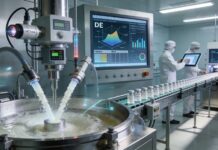
Continuous mixing represents one of the most significant innovations in mixing technology. Traditional batch mixing loads powder into a vessel, mixes for defined time, then discharges material. Continuous mixing systems create uniform mixing of incoming material streams, eliminating the variability inherent in batch-to-batch equipment transitions or initial-versus-end-of-batch consistency differences. Material flowing through continuous mixers achieves consistent composition throughout the entire production run a consistency advantage over batch mixing that translates directly to superior finished product uniformity.
Scalability represents another critical mixing consideration often overlooked in discussions of mixing technology. A mixer suitable for pilot-scale development might not function adequately when scaled to commercial production. Increasing vessel volume by a hundred-fold doesn’t simply require larger equipment it creates different mixing dynamics, different power draw requirements per unit volume, and potential dead zones where material mixes inadequately. Modern mixing equipment design addresses these scalability challenges, enabling commercial-scale mixers that maintain the mixing quality achieved in development batches.
Filtration and Separation Advances
Filtration and separation operations represent critical quality assurance points in pharmaceutical manufacturing. Sterile manufacturing requires removing all microbial contamination through sterilizing filtration. API synthesis requires removing byproducts and impurities through separatory processes. Formulation development often requires removing undissolved particles or achieving particle size specifications.
Advanced filtration technology provides increasingly sophisticated approaches to these separation challenges. Traditional filtration employed relatively simple filter media removing particles based on size. Modern membranes enable separation based on molecular properties, enabling separations impossible through size-based approaches. Ultrafiltration removes large molecules while passing small molecules. Nanofiltration provides intermediate separation ranges. Reverse osmosis achieves remarkable purity levels. Organic solvent nanofiltration, a relatively recent innovation, enables separation and purification in organic solvents, expanding the range of processes where membrane technology applies.
The efficiency improvements prove substantial. Traditional separations often generated significant product loss impurities were removed by discarding substantial product quantities. Modern separation technology enables separations removing unwanted components while recovering nearly all desired product. This product recovery improvement translates both to economic benefit through reduced material loss and environmental benefit through reduced waste generation.
Membrane technology offers additional advantages beyond improved separation efficiency. Unlike traditional separation approaches that might generate harsh conditions damaging sensitive pharmaceutical molecules, membrane separation operates at mild conditions room temperature, atmospheric pressure, gentle flow conditions enabling separation of temperature-sensitive or pressure-sensitive materials.
Crystallization Equipment and Particle Engineering
Many pharmaceutical operations involve crystallization bringing dissolved drug substance out of solution as crystals. Crystallization determines particle size, crystal form, and purity of the final isolated product. Crystal properties directly influence downstream processing crystal size affects filtration rate, washing efficiency, and drying characteristics. Crystal form influences product stability, bioavailability, and processability.
Advanced separation technology pharma in crystallization context involves sophisticated equipment providing precise control over crystal growth conditions. Traditional crystallization simply cooled solutions, allowing crystals to grow randomly. Modern crystallization equipment controls temperature precisely, controls cooling rate dynamically, maintains consistent agitation, and monitors crystal growth in real-time. This precise control enables direct crystal form targeting manufacturers can reliably produce desired crystal forms rather than settling for whatever forms happen to grow randomly.
The consistency improvement benefits extend beyond crystal form control. Particle size distribution becomes more uniform, filtration becomes more efficient, and product purity improves. Crystallization equipment innovation has proven particularly valuable for drug substances with challenging crystal forms. Some active pharmaceutical ingredients have multiple crystal polymorphs different crystal structures with different properties. Proper polymorph control becomes essential for consistent product performance. Advanced crystallization equipment enables reliable polymorph control that would be essentially impossible with traditional approaches.
Material Handling and Equipment Integration
Material handling between unit operations often receives less attention than the primary manufacturing equipment, yet represents a critical variable affecting manufacturing consistency. Product degradation during material transfer, mixing with residual previous batch material, or contamination during manual handling can degrade batch quality despite excellent performance in primary manufacturing equipment.
Modern pharmaceutical equipment innovation increasingly emphasizes integrated material handling. Rather than manually transferring material between separate equipment, integrated systems automate transfer through contained piping. Closed transfer systems prevent contamination while preventing worker exposure to potent compounds. Automated material routing directs batches precisely where needed, eliminating manual selection errors. Sensors confirm appropriate material placement before processing continues.
These integrated material handling systems provide substantial benefits beyond simple contamination prevention. Automated routing enables flexibility the same equipment platform can process different products by simply changing routing configurations. This flexibility enables faster product changeovers and more efficient facility utilization. Material tracking becomes automatic systems confirm that correct raw materials are used for each batch without relying on operator vigilance.
Equipment Validation and Regulatory Compliance
Pharmaceutical equipment operates in extraordinarily regulated environment. Before equipment can be used in manufacturing, manufacturers must validate that equipment performs as intended, that equipment design prevents contamination, that equipment materials are compatible with products, and that equipment cleaning procedures reliably remove all residual product. This validation burden is substantial a single piece of equipment might require hundreds of tests and months of validation effort.
This regulatory complexity creates advantages for equipment manufacturers investing in design robustness. Equipment designed explicitly for pharmaceutical compliance with smooth surfaces preventing bacterial harborage, with contained operating chambers preventing product release, with predictable operating characteristics enabling straightforward validation enables faster facility implementation and more efficient validation. In contrast, equipment originally designed for non-pharmaceutical purposes often requires extensive modification and validation effort to achieve pharmaceutical compliance.
The Evolution Toward Continuous Manufacturing
Pharmaceutical manufacturing is gradually evolving from predominantly batch-based operations toward increasing continuous manufacturing. While batch manufacturing requires distinct operations performed sequentially each batch through each equipment in sequence continuous manufacturing strings equipment together in lines where material flows continuously without batch boundaries.
Continuous manufacturing offers remarkable advantages in consistency. Batch-to-batch variability disappears when there are no longer distinct batches. Parameter drift that might accumulate across sequential batches is immediately corrected in continuous operations with real-time control. Product uniformity improves because continuous operation eliminates the initial conditions and final conditions variations typical of batch operations.
This continuous evolution depends fundamentally on equipment innovation. Continuous manufacturing requires equipment designed to operate continuously under controlled conditions for extended periods. Mixing equipment must provide consistent mixing of continuous flows. Reaction equipment must maintain precise control over residence time distribution and temperature. Separation equipment must operate efficiently and reliably over extended operations. These demands push equipment innovation in directions enabling both improved consistency and operational efficiency.
Quality by Design Integration with Equipment
Pharmaceutical industry increasingly emphasizes Quality by Design (QbD) engineering product quality through comprehensive process understanding rather than testing. Equipment sophistication directly enables QbD implementation by providing the control precision and monitoring capability that QbD requires.
Advanced equipment offering real-time monitoring of critical process parameters enables direct confirmation that unit operations remain within design specifications. Digital control systems generate detailed records of equipment operation, creating permanent evidence of process execution exactly as designed. Integration with process analytical technology enables real-time quality assurance rather than relying solely on end-product testing.
This equipment-enabled QbD capability strengthens regulatory relationships. FDA reviewers recognize that manufacturers employing advanced equipment and comprehensive monitoring demonstrate manufacturing excellence. Facilities with sophisticated equipment providing superior consistency and control often receive more favorable regulatory treatment than facilities operating older equipment offering less capability.
Comparative Advantages and Competitive Implications
Manufacturing variability reduction through advanced equipment investment generates substantial competitive advantages. Manufacturers operating modern equipment achieve superior product consistency, enabling better commercial performance as customers recognize and value improved consistency. They achieve lower per-unit manufacturing costs because reduced variability decreases scrap losses and rework requirements. They maintain superior regulatory compliance because sophisticated equipment enables tighter process control and better compliance documentation.
These operational advantages translate to commercial advantage. Contract manufacturers competing on quality and reliability gain competitive edge through advanced equipment. Branded manufacturers competing on product quality gain marketing advantage. Manufacturers facing capacity constraints can increase output per unit equipment through more efficient operations enabled by advanced equipment.
Conclusion
Advanced pharmaceutical equipment represents one of the most significant drivers of improved pharmaceutical manufacturing quality and efficiency. By enabling superior process control, providing comprehensive monitoring capability, and facilitating continuous manufacturing approaches, modern equipment enables consistency achievement impossible with older technologies. The evolution toward increasingly sophisticated equipment will continue, driven by regulatory pressure for consistency, competitive demand for efficiency, and technological advancement enabling new manufacturing approaches.
Pharmaceutical manufacturers committed to operational excellence and long-term competitiveness must view equipment investment not as discretionary capital expenditure but as essential capability investment. Facilities operating advanced equipment achieve competitive advantages that compound over time. Those lagging in equipment modernization face escalating disadvantages in consistency, efficiency, and regulatory standing. The clear trajectory of pharmaceutical manufacturing points toward continued equipment evolution, making equipment modernization an ongoing strategic imperative rather than occasional initiative.
