



























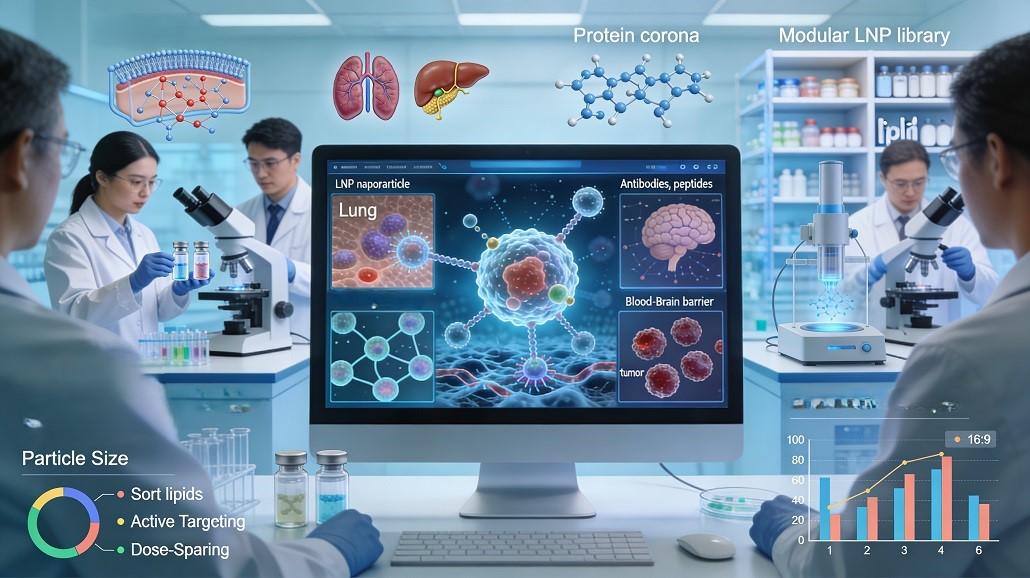
The initial success of lipid nanoparticle technology was largely driven by its ability to deliver messenger RNA to the liver, a feat that laid the groundwork for the first generation of RNA-based vaccines and therapies. However, to truly realize the potential of genetic medicine, the industry must move beyond the liver and develop systems capable of reaching any organ, tissue, or cell type in the human body. This challenge has sparked a wave of innovation focused on targeted delivery advances in LNP platforms. By modifying the chemical and physical properties of the nanoparticles, researchers are now able to direct these sophisticated carriers to specific biological destinations, such as the lungs, the central nervous system, or even individual tumor cells. This transformation is turning LNPs from general delivery vehicles into precision instruments of molecular therapy.
The drive toward targeted delivery is motivated by a simple goal: to maximize the concentration of the therapeutic at the site of disease while minimizing its exposure to healthy tissues. This not only improves the efficacy of the treatment but also significantly reduces the risk of systemic side effects. Achieving this level of precision requires a deep understanding of the biological barriers that stand in the way of nanoparticle delivery. From the filtering action of the kidneys to the highly selective nature of the blood-brain barrier, each destination in the body presents a unique set of obstacles. Targeted delivery advances in LNP platforms are providing the tools to navigate these barriers, using a combination of “passive” and “active” targeting strategies to ensure the cargo reaches its intended target.
Passive Targeting and the Influence of Particle Physics
Passive targeting relies on the inherent physical properties of the nanoparticle such as its size, charge, and surface chemistry to influence its distribution in the body. One of the most significant targeted delivery advances in LNP platforms has been the discovery of “SORT” (Selective Organ Targeting) lipids. By adjusting the molar ratios of the internal lipid components, researchers have found that they can change the primary destination of the LNP from the liver to the lungs or the spleen. This does not involve adding a specific targeting ligand; instead, it leverages the way the nanoparticle interacts with endogenous proteins in the bloodstream. These proteins form a “corona” around the particle, which in turn dictates which cell surface receptors it will recognize.
Surface charge also plays a vital role in passive targeting. Positively charged LNPs, for instance, tend to accumulate more readily in the lungs, while neutral or slightly negative particles are more likely to remain in circulation for longer periods. By fine-tuning the zeta potential of the formulation, developers can steer the nanoparticles toward specific vascular beds or away from the reticuloendothelial system. These targeted delivery advances in LNP platforms demonstrate that even subtle changes in the molecular architecture of the lipid shell can have a profound impact on where the therapeutic payload is delivered. This “internal” targeting approach is both efficient and scalable, making it an attractive option for a wide range of clinical applications.
Active Targeting via Ligand Conjugation and Surface Engineering
While passive targeting is powerful, it is often not precise enough to distinguish between different cell types within the same organ. To achieve this level of specificity, researchers are turning to “active” targeting, which involves the conjugation of specific ligands to the surface of the nanoparticle. These ligands which can be antibodies, peptides, aptamers, or small molecules are designed to bind exclusively to receptors that are overexpressed on the target cells. Targeted delivery advances in LNP platforms are making it possible to decorate the surface of LNPs with these molecular beacons without compromising the stability or encapsulation efficiency of the system.
For example, LNPs targeted to the brain often utilize ligands that recognize the transferrin receptor or the LDL receptor, which facilitate transport across the blood-brain barrier via transcytosis. In oncology, targeting ligands directed at the folate receptor or the HER2 protein allow for the selective delivery of RNA-encoded toxins or tumor suppressors directly to malignant cells. These targeted delivery advances in LNP platforms are transforming the landscape of cancer therapy, offering the promise of “chemotherapy-like” efficacy without the devastating side effects of traditional systemic treatments. The precision of active targeting is a cornerstone of the next generation of precision medicine platforms.
Navigating Biological Barriers and Endosomal Escape
The journey of a targeted LNP does not end when it reaches the target tissue; it must also successfully enter the cell and release its cargo into the cytoplasm. This requires overcoming the final biological barrier: the endosomal membrane. Targeted delivery advances in LNP platforms are incorporating “smart” lipids that are designed to respond to the acidic environment of the endosome. These lipids undergo a conformational change that triggers the fusion of the nanoparticle and endosomal membranes, effectively dumping the RNA payload into the cell’s interior. This endosomal escape is the most critical step in the delivery process, and its optimization is a major focus of current research.
Furthermore, researchers are investigating the role of the “protein corona” in both active and passive targeting. Once an LNP enters the bloodstream, it is immediately coated by a complex layer of plasma proteins. This corona can either mask the targeting ligands or, in some cases, provide its own targeting functionality. Targeted delivery advances in LNP platforms are focused on “pre-coating” nanoparticles with specific proteins to control this interaction or designing “stealth” surfaces that minimize protein adsorption altogether. By mastering the interface between the nanoparticle and the biological environment, scientists are improving the reliability and predictability of targeted delivery.
Impact on Dose Sparing and Therapeutic Index
One of the most significant benefits of improved targeting is the potential for “dose sparing.” When a therapeutic is directed precisely to its target, a much smaller total dose is required to achieve the desired effect. This is particularly important for RNA therapies, which can be expensive to manufacture and may induce an immune response if administered at high systemic doses. Targeted delivery advances in LNP platforms are allowing clinicians to achieve therapeutic outcomes with a fraction of the material previously required. This not only lowers the cost of treatment but also dramatically improves the “therapeutic index” the ratio of the dose that produces toxicity to the dose that produces a beneficial effect.
Improved targeting also opens the door to therapies that were previously considered too toxic for clinical use. By sequestering a potent drug within an LNP and directing it only to the site of disease, researchers can safely administer compounds that would be lethal if given systemically. This expanded “therapeutic window” is a direct result of targeted delivery advances in LNP platforms, and it is driving the development of new treatments for a wide range of previously untreatable conditions. As targeting technology continues to improve, the list of targetable diseases will only grow, bringing the benefits of genetic medicine to an even broader population of patients.
Future Perspectives: Personalized Targeting and Modular Platforms
The future of targeting lies in the development of modular LNP platforms that can be easily customized for individual patients or specific disease states. Imagine a system where the RNA cargo and the targeting ligands are chosen from a “library” and combined to create a bespoke therapy in real-time. Targeted delivery advances in LNP platforms are moving toward this modular reality, utilizing high-throughput screening and automated manufacturing to accelerate the design-build-test cycle. Furthermore, the use of “in vivo” screening methods where thousands of different LNP formulations are tested simultaneously in a single animal model is providing a wealth of data on how different targeting strategies perform in a complex biological environment.
As we look ahead, the integration of targeting technology with other advancements such as next-generation lipids and scalable manufacturing will create a truly transformative suite of tools for the medical community. Targeted delivery advances in LNP platforms are not just a technical improvement; they represent a fundamental shift in our ability to interact with the human body at the molecular level. By delivering the right message to the right cell at the right time, we are moving toward a future where disease can be managed with unprecedented precision and minimal impact on the patient’s quality of life. The age of targeted genetic medicine is just beginning, and its impact on human health will be profound.
