




















Key Takeaways
- Pharmaceutical net-zero strategies combine energy optimization, waste minimization, renewable energy adoption, and sustainable process design
- Solvent recovery and recycling systems reduce material waste while generating cost savings through recovered solvent reuse
- Waste-to-energy technologies convert pharmaceutical manufacturing waste streams into useful energy, improving both environmental performance and energy economics
- Water treatment and recycling systems enable manufacturing with substantially reduced freshwater consumption, critical in water-stressed regions
- Sustainable facility design including LEED certification, renewable energy systems, and efficient HVAC reduces operational carbon footprint
- Energy optimization through LED lighting, high-efficiency motors, and process improvements achieves cost savings while reducing emissions
- Balancing sustainability with regulatory compliance and product quality requires systematic approach ensuring green initiatives don’t compromise pharmaceutical standards
The pharmaceutical industry faces unprecedented pressure to address environmental impact from manufacturing operations while simultaneously managing regulatory requirements protecting patient safety and maintaining product quality. This dual imperative achieving environmental sustainability without compromising pharmaceutical standards defines the central challenge of modern pharma sustainability strategy. Sustainable pharmaceutical manufacturing strategy represents response to this challenge, incorporating multiple complementary approaches reducing environmental impact while acknowledging that pharmaceutical manufacturing cannot ethically sacrifice safety or efficacy for environmental benefit. Rather, sustainability strategy seeks optimization achieving environmental excellence through approaches that simultaneously advance operational efficiency and product quality.
The Environmental Challenge of Pharmaceutical Manufacturing
Pharmaceutical manufacturing carries substantial environmental footprint. Production facilities consume enormous quantities of energy heating, cooling, and powering sophisticated equipment throughout multi-stage production processes. Manufacturing generates hazardous and nonhazardous waste streams requiring management, treatment, or disposal. Solvent-intensive synthesis processes consume thousands of liters of organic solvents annually. Water consumption for cooling, washing, and aqueous processes draws on limited freshwater resources. Chemical waste, if improperly managed, contaminates soil and water systems threatening ecological health.
The scale of this environmental impact receives insufficient public attention compared to other industries. Yet a single pharmaceutical manufacturing facility processing thousands of kilograms of active ingredients annually generates environmental footprint comparable to small city. When multiplied across the global pharmaceutical industry manufacturing thousands of distinct products at facilities worldwide, the cumulative environmental impact becomes substantial.
Yet pharmaceutical manufacturing cannot ethically adopt environmental strategies compromising patient safety or product quality. A manufacturing process reducing waste by twenty percent but simultaneously increasing product impurities or batch variability creates more harm than environmental benefit patients harmed by inferior product quality represent human cost far exceeding environmental benefit achieved. This constraint distinguishes pharmaceutical sustainability from environmental strategies in other industries where safety-environment tradeoffs prove less acute.
Recognizing this reality, leading pharmaceutical manufacturers increasingly pursue sustainability approaches simultaneously advancing environmental objectives, operational efficiency, and product quality. Rather than viewing sustainability as constraint limiting manufacturing, these organizations recognize that environmental optimization frequently identifies efficiency improvements benefiting manufacturing economics. Solvent recovery reduces waste while simultaneously reducing material costs. Energy optimization reduces emissions while reducing operational expenses. Process improvements eliminating waste simultaneously improve product consistency.
Energy Optimization and Facility Efficiency
Energy consumption represents the largest single environmental impact from pharmaceutical manufacturing facilities. Compressors providing compressed air for equipment operation run continuously, consuming enormous electrical energy. Heating systems maintain required facility temperatures. Cooling systems reject process waste heat. Ventilation systems maintain required air changes within controlled manufacturing areas. Lighting illuminates facility spaces. Combined, these energy demands often exceed annual electrical costs exceeding millions of dollars for large facilities.
Energy optimization pharma strategies systematically address each energy consumption component. Compressor efficiency improvements replacing aging compressors with high-efficiency modern units reduce energy consumption by fifteen to twenty-five percent. Converting incandescent and fluorescent lighting to LED reduces lighting energy consumption by fifty to seventy percent while improving illumination quality. Installing high-efficiency motors on production equipment reduces energy consumption during operation. Upgrading facility insulation and HVAC systems improves temperature control efficiency.
The financial returns from energy optimization prove compelling. A facility implementing comprehensive energy optimization might reduce annual energy consumption by twenty-five to thirty-five percent. For facilities with annual energy costs in millions of dollars range, this reduction translates to cost savings offsetting equipment investment within three to five years. The return on investment is sufficient that many facilities view energy optimization as financially attractive independent of environmental considerations.
Beyond individual equipment optimization, integrated facility-wide energy management systems optimize energy consumption across the entire operation. Building automation systems monitor energy consumption continuously, identifying consumption patterns and anomalies. When energy consumption exceeds expected levels, facilities investigate causes and implement corrections. Load management systems distribute production operations to optimize facility-wide energy consumption rather than allowing consumption to spike unpredictably. Energy storage systems, including battery systems or thermal storage, enable facilities to smooth consumption peaks and potentially utilize renewable energy more effectively.
Renewable energy adoption represents another critical energy optimization approach. Facilities installing rooftop solar panels generate portion of facility electricity from renewable sources. This solar generation typically covers thirty to fifty percent of facility energy consumption depending on facility location and configuration. Larger facilities increasingly pursue power purchase agreements enabling renewable energy procurement from third-party providers, allowing facilities to achieve renewable energy objectives without requiring on-site renewable generation infrastructure.
Waste Reduction and Circular Economy Approaches
Manufacturing waste represents both environmental problem and economic loss. Waste requiring disposal generates disposal costs. Waste containing valuable materials represents recovered value lost if material is discarded rather than recovered. Waste reduction technology approaches minimize waste generation while recovering valuable materials from waste streams that remain unavoidable.
The hierarchy for waste management prioritizes approaches in order of preference. Most preferred is waste prevention modifying processes to eliminate waste generation entirely. If waste generation is unavoidable, next preference is waste reduction minimizing waste quantity while accepting that some waste remains. If waste reduction is insufficient, waste recovery becomes focus extracting valuable material from waste streams. Only when all other approaches prove inadequate does waste disposal become acceptable final destination.
Pharmaceutical manufacturing increasingly emphasizes waste prevention and reduction. Green chemistry approaches discussed earlier directly address this hierarchy designing synthesis processes generating minimal waste. Process redesign eliminating unnecessary steps reduces waste proportional to steps eliminated. Equipment improvements reducing product losses during transfer or processing decrease waste quantities.
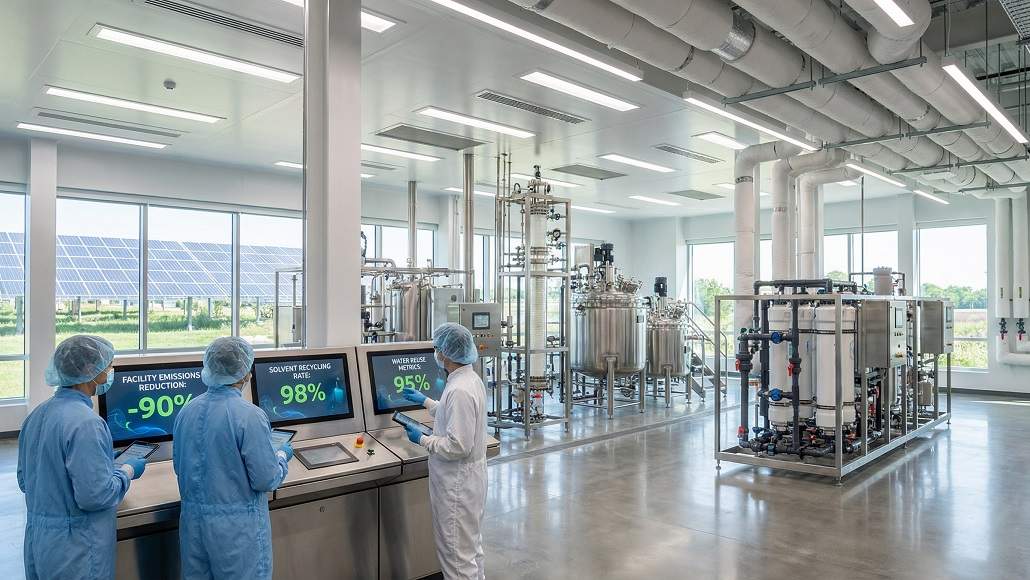
Solvent recovery and recycling represents perhaps the most significant pharmaceutical waste reduction approach. Traditional pharmaceutical manufacturing uses solvents once then discards them as hazardous waste. Solvent recovery systems distill used solvent, separating solvent from dissolved impurities, recovering pure solvent suitable for reuse. A facility using thousand liters of organic solvent annually might recover seventy to eighty percent through efficient recovery systems. This recovery reduces solvent waste requiring disposal while simultaneously reducing material costs recovered solvent costs substantially less than virgin solvent purchase.
Waste-to-energy technologies convert pharmaceutical waste streams into useful energy. Incinerators with heat recovery systems combust solid pharmaceutical waste, capturing heat energy for facility heating or electrical generation. This approach eliminates disposal requirement while recovering energy value. For facilities generating substantial solid waste quantities, waste-to-energy systems often provide financial return through energy value recovery offsetting operational costs.
Water recycling and conservation approaches address pharmaceutical manufacturing water consumption. Traditional facilities discharge water after single use, consuming enormous quantities of freshwater. Recycled water systems capture wastewater, treat it removing contaminants, and reuse for non-critical applications like cooling or washing. Some advanced facilities achieve water recycling percentages exceeding fifty percent, substantially reducing freshwater consumption.
Sustainable Facility Design and Infrastructure
Sustainable facility design represents another critical sustainability pillar. Facilities designed explicitly for sustainability from inception achieve superior environmental performance compared to traditional facilities retrofitted with sustainability measures. Sustainable facilities integrate features including high-efficiency HVAC systems, thermal storage systems reducing peak energy demands, optimized insulation and window placement reducing heating and cooling requirements, advanced lighting systems providing required illumination with minimal energy consumption, water-efficient fixtures and systems, renewable energy systems, and waste management infrastructure.
LEED certification Leadership in Energy and Environmental Design provides framework for sustainable facility design. LEED facilities demonstrate measurable environmental benefits across multiple dimensions energy consumption, water usage, waste generation, indoor air quality, and material selection. Pharmaceutical facilities pursuing LEED certification typically achieve measurable environmental benefits while simultaneously improving worker conditions through superior indoor air quality, daylighting, and ergonomic design.
Renewable energy integration represents critical sustainable facility component. New facilities increasingly design with integrated solar capability roofing and wall orientations optimized for solar panels, electrical infrastructure configured for efficient solar integration. Some facilities pursue zero-energy objectives achieving annual renewable energy generation matching annual consumption through combination of on-site renewable generation and power purchase agreements.
Water management in sustainable facilities encompasses rainwater harvesting, greywater recycling, advanced wastewater treatment, and efficient fixture specification. Facilities harvesting rainwater for non-critical uses reduce municipal water consumption. Greywater recycling treating wastewater from certain operations for reuse in others reduces freshwater requirements substantially. Advanced wastewater treatment systems enable discharge of treated water to municipal systems with confidence of meeting environmental standards.
Balancing Sustainability with Quality and Compliance
The central challenge of pharmaceutical sustainability involves advancing environmental objectives while maintaining absolute commitment to product quality and regulatory compliance. This balance requires systematic approach ensuring sustainability initiatives receive equal scrutiny to quality measures sustainability cannot be pursued at expense of pharmaceutical standards.
Implementing green chemistry approaches exemplifies this balance. When pharmaceutical companies consider substituting traditional hazardous solvent with greener alternative, the decision requires validation that alternative solvent produces identical product quality, that stability profiles remain acceptable, that analytical procedures remain suitable. While the regulatory effort may be substantial, the fundamental principle is clear sustainability improvements must maintain product quality equivalent to current manufacturing.
Energy optimization similarly requires careful management. When facilities upgrade to more efficient HVAC systems, resulting temperature and humidity control must maintain performance within required specifications. LED lighting replacement must maintain required illumination levels in clean rooms and quality-critical areas. Equipment efficiency improvements must maintain operational control and precision. These constraints sometimes limit efficiency improvements achievable a facility might eliminate optimization opportunity if implementation would compromise critical quality parameter control.
Water conservation similarly requires careful qualification. Manufacturing processes using purified water cannot simply substitute recycled water without demonstrating that recycled water quality meets process requirements. Cooling water might use less pure recycled water, but cooling water used in sterilization systems or product contact equipment requires qualification that water quality provides required purity.
This rigorous approach to sustainability requiring that environmental improvements maintain quality and compliance explains why pharmaceutical industry sustainability progress sometimes appears slower than manufacturing sectors where quality constraints prove less stringent. Yet this rigor is essential pharmaceutical patients depend on product quality, and no environmental benefit justifies product quality degradation.
Supply Chain Sustainability and Scope 3 Emissions
Environmental compliance pharma increasingly extends beyond direct manufacturing operations toward supply chain sustainability addressing upstream and downstream emissions. Scope 3 emissions indirect emissions in supply chain including raw material production, transportation, and end-of-life disposal often exceed direct manufacturing emissions (Scope 1 and 2).
Pharmaceutical companies increasingly evaluate suppliers on sustainability performance. Preferred suppliers demonstrate environmental responsibility through certifications, audited environmental management systems, and documented emissions reduction programs. Some pharmaceutical companies include environmental criteria in supplier selection, preferring suppliers with superior environmental performance even if costs are marginally higher.
End-of-life considerations increasingly influence pharmaceutical sustainability. Some companies investigate how patients dispose of unused medications, implementing take-back programs enabling proper disposal avoiding environmental contamination. Packaging material selection increasingly emphasizes recyclability and use of recycled content, reducing packaging waste.
These supply chain sustainability initiatives recognize that comprehensive sustainability requires addressing all environmental impact sources—not merely direct manufacturing but also upstream suppliers and downstream distribution and disposal.
Regulatory and Market Recognition of Sustainability
Regulatory agencies increasingly support pharmaceutical sustainability initiatives. FDA guidance emphasizes that environmental sustainability represents business opportunity and strategic advantage rather than cost burden. European Union regulations impose stricter environmental requirements than United States, driving sustainability innovation that eventually influences global pharmaceutical manufacturing.
Market recognition of pharmaceutical sustainability strengthens as consumers and healthcare institutions increasingly consider environmental responsibility in purchasing decisions. Healthcare systems increasingly prefer suppliers demonstrating sustainability commitment. Pharmaceutical companies with strong sustainability credentials find themselves more attractive to customers, investors, and talented employees motivated by environmental purpose.
Competitive and Strategic Advantage
Pharmaceutical companies leading sustainability transformation position themselves for long-term advantage. First-mover advantages include ability to build efficiency improvements into manufacturing during facility modernization, potentially achieving superior economics compared to retrofitting existing facilities. Sustainability leaders develop supplier relationships and supply chains supporting ambitious environmental objectives. They attract talented employees motivated by environmental purpose and ethical business practices.
These advantages compound over time. Facilities with superior sustainability performance achieve lower operating costs through energy and material efficiency. Their supply chains become more resilient through supplier diversity and sustainability focus. Their brand reputation strengthens, supporting market growth and premium pricing. Their employee satisfaction improves through association with environmental purpose.
Conclusion
Achieving pharmaceutical net-zero manufacturing objectives requires multifaceted approach combining energy optimization, waste reduction, renewable energy adoption, sustainable facility design, and supply chain sustainability. These approaches simultaneously advance environmental objectives, operational efficiency, and often product quality distinguishing pharmaceutical sustainability from environmental imperatives in less-constrained industries.
The pharmaceutical industry’s path toward net-zero manufacturing is accelerating. Early leaders are demonstrating that ambitious environmental objectives remain compatible with pharmaceutical quality standards and regulatory compliance. Organizations lagging sustainability transformation will face escalating competitive disadvantage as sustainability increasingly influences purchasing decisions, employee recruitment, and investor confidence.
For pharmaceutical manufacturers committed to long-term viability and competitive advantage, sustainability strategy has evolved from optional corporate responsibility initiative to essential business imperative. The trajectory of the industry increasingly favors sustainable manufacturing, making transformation not optional but necessary for surviving in an environmentally conscious marketplace.
