
























The rapid ascent of messenger RNA as a transformative tool in modern medicine has brought the challenge of molecular stability to the forefront of pharmaceutical science. RNA is inherently fragile, prone to enzymatic degradation and chemical instability that can render a therapy useless if not properly protected. Lipid nanoparticles have emerged as the premier solution for this problem, but the stability of the LNP-RNA complex itself is a multifaceted puzzle that requires constant vigilance. Through comprehensive LNP stability studies for RNA therapeutics, scientists are uncovering the delicate balance of forces that keep these nanoparticles intact during processing, storage, and transport. This research is essential for moving beyond the ultra-cold storage requirements that have historically limited the accessibility of RNA-based medicines.
Stability in the context of LNPs is not a singular metric but a combination of physical and chemical attributes that must be maintained over time. Physical stability involves the maintenance of particle size, homogeneity, and the retention of the RNA cargo within the lipid shell. Chemical stability, on the other hand, focuses on preventing the oxidation or hydrolysis of the lipid components and the degradation of the RNA sequence itself. By performing exhaustive LNP stability studies for RNA therapeutics, manufacturers can establish a clear baseline for product performance and identify the “tipping points” where environmental factors like temperature, light, or pH begin to compromise the formulation. This data is the foundation of a robust pharmaceutical product profile.
Identifying Pathways of Physical and Chemical Degradation
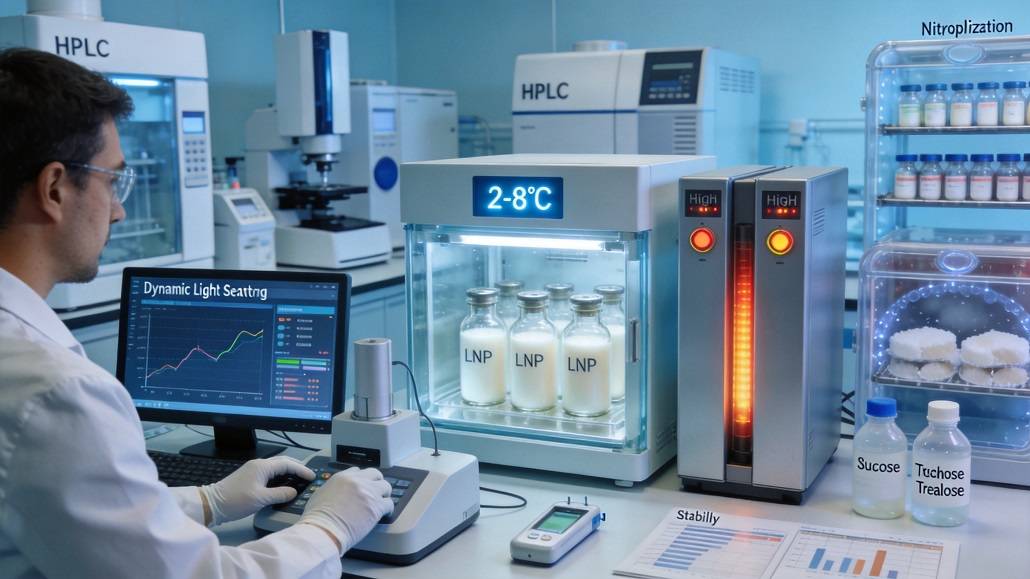
One of the primary goals of stability research is to map the specific mechanisms by which LNPs fail. Physical degradation often manifests as particle aggregation or fusion, which can significantly alter the biodistribution and safety of the drug. These events are typically driven by changes in the surface energy of the particles or the loss of the protective PEGylated lipid layer. Through LNP stability studies for RNA therapeutics, researchers use techniques like dynamic light scattering and nanoparticle tracking analysis to monitor these changes in real-time. Understanding the kinetics of aggregation allows for the selection of better stabilizers and the optimization of the lipid-to-RNA ratio to minimize surface tension.
Chemical degradation presents a different set of challenges, particularly the susceptibility of ionizable lipids to oxidation. When lipids degrade, they can form reactive species that potentially damage the mRNA cargo or create toxic byproducts. LNP stability studies for RNA therapeutics utilize high-performance liquid chromatography and mass spectrometry to detect these minute chemical shifts. Furthermore, the hydrolysis of the phosphodiester bonds in the RNA backbone is a constant threat, especially in aqueous environments. Stability studies evaluate the protective environment provided by the LNP core, ensuring that the internal pH and moisture content are maintained at levels that inhibit these degradative reactions.
Strategies for Enhancing Shelf Life and Cold Chain Robustness
The logistical burden of ultra-low temperature storage often as low as -80°C has been a major hurdle for the global distribution of mRNA vaccines. To address this, LNP stability studies for RNA therapeutics are increasingly focused on developing formulations that are stable at refrigerated (2-8°C) or even ambient temperatures. One of the most promising avenues is lyophilization, or freeze-drying, which removes water from the formulation and creates a stable, solid cake. However, the process of freezing and drying can itself be damaging to LNPs. Stability research is critical for identifying the right cryoprotectants and lyoprotectants, such as sucrose or trehalose, that can shield the particles from mechanical stress during the lyophilization cycle.
Beyond lyophilization, researchers are exploring the use of novel buffer systems and antioxidants to improve the liquid stability of LNPs. By incorporating free-radical scavengers and metal chelators, it is possible to significantly slow the rate of lipid oxidation. These advancements are directly informed by the results of long-term LNP stability studies for RNA therapeutics, which provide the empirical evidence needed to validate these protective strategies. As formulations become more robust, the reliance on the specialized “cold chain” will diminish, making it easier to provide advanced genetic therapies to regions with limited infrastructure, thereby improving global health equity.
Accelerated Stability Testing and Predictive Modeling
In the fast-paced world of drug development, waiting years for real-time stability data is often not an option. Instead, manufacturers utilize accelerated stability testing, where the product is exposed to exaggerated conditions of heat and humidity to predict its long-term behavior. LNP stability studies for RNA therapeutics use the Arrhenius equation and other kinetic models to extrapolate this data, providing an early estimate of the product’s shelf life. This predictive modeling is a powerful tool for screening different formulation candidates and selecting the ones with the highest probability of success in long-term storage trials.
However, accelerated testing must be used with caution, as the degradation pathways at high temperatures may not always reflect those at recommended storage conditions. Therefore, LNP stability studies for RNA therapeutics always include a “real-time” component that runs in parallel with accelerated studies. This dual approach ensures that any unexpected degradation mechanisms are captured and that the final shelf-life claims are supported by a rigorous and defensible dataset. As the field matures, the use of machine learning to analyze these complex stability datasets will further improve our ability to predict and prevent formulation failure.
Impact of Container Closure Systems on Stability
The stability of a drug product is also influenced by its immediate environment, specifically the vial and stopper that house it. LNP stability studies for RNA therapeutics must account for potential interactions between the nanoparticle formulation and the container closure system. For example, some lipids may adhere to the surface of glass vials, leading to a loss of potency. Similarly, components of the rubber stopper could leach into the formulation, triggering degradation or introducing impurities. By performing “leachable and extractable” studies as part of the stability program, manufacturers can ensure that the packaging remains inert and protective throughout the product’s life.
Additionally, the choice of vial size and headspace the amount of air left in the vial after filling can impact stability. Oxygen in the headspace can accelerate the oxidation of lipids, while moisture ingress can trigger hydrolysis. Modern LNP stability studies for RNA therapeutics evaluate the use of nitrogen overlaying and specialized moisture-barrier coatings to mitigate these risks. These subtle engineering details are often the difference between a product that remains stable for six months and one that lasts for two years. By optimizing the entire package, from the lipid molecules to the glass vial, the industry is setting a new standard for the reliability of complex biologics.
Future Outlook: Toward Thermostable “Off-the-Shelf” RNA
The ultimate goal of the industry is to create “off-the-shelf” RNA therapies that do not require specialized storage or handling. This vision depends entirely on the continued evolution of LNP stability studies for RNA therapeutics. We are moving toward a future where the molecular design of the lipids themselves incorporates stability-enhancing features, such as increased resistance to hydrolysis or better shielding of the RNA cargo. Furthermore, the development of sophisticated analytical tools, such as in-line stability sensors, will allow for continuous monitoring of product integrity during manufacturing and distribution.
As we look ahead, the insights gained from stability research will continue to drive innovation in the RNA space. By strengthening the robustness of these delivery systems, we are not only improving the patient experience but also expanding the therapeutic potential of RNA technology. From personalized cancer vaccines to treatments for rare genetic disorders, the success of these therapies relies on our ability to keep them stable and potent. LNP stability studies for RNA therapeutics are the unsung heroes of this medical revolution, providing the scientific foundation upon which the future of genetic medicine is being built.
