



























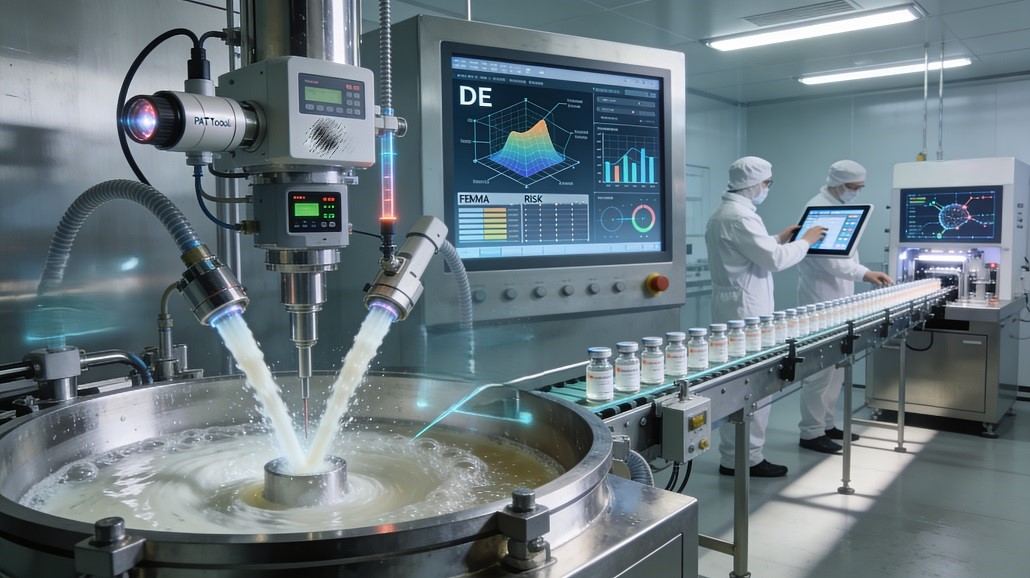
The shift from empirical drug development to a more systematic, data-driven approach has been one of the most significant trends in the pharmaceutical industry over the last two decades. At the heart of this movement is the principle of Quality by Design, a framework that emphasizes the importance of understanding the relationship between process parameters and product quality. For the production of lipid nanoparticles, which are incredibly sensitive to minor changes in manufacturing conditions, this approach is not just beneficial it is essential. Quality by Design in LNP manufacturing ensures that every batch of medicine is produced within a predefined “design space” that guarantees its safety and efficacy. By focusing on quality at the design phase rather than relying solely on end-product testing, manufacturers can build a high level of confidence in their production systems.
Implementing Quality by Design in LNP manufacturing begins with a clear definition of the Quality Target Product Profile (QTPP). This profile outlines the essential characteristics of the drug product, such as its intended use, route of administration, and critical quality attributes like particle size and encapsulation efficiency. Once the target is defined, researchers perform a “risk assessment” to identify which process parameters such as flow rates, mixing temperature, or lipid concentrations have the greatest impact on these attributes. This structured approach allows for the development of a manufacturing process that is inherently robust, meaning it is capable of handling the natural variability of raw materials and environmental conditions without compromising the final product.
Identifying Critical Quality Attributes and Process Parameters
In the context of LNP production, the identification of Critical Quality Attributes (CQAs) is a foundational step. For a typical mRNA-LNP product, the CQAs include the average particle size (Z-average), the polydispersity index (PDI), the percentage of encapsulated RNA, and the purity of the lipid components. Any significant deviation in these attributes can alter the drug’s biodistribution, toxicity, or biological activity. Quality by Design in LNP manufacturing links these CQAs to Critical Process Parameters (CPPs) using a combination of scientific knowledge and experimental data. For example, it is well-established that the flow rate ratio between the aqueous and organic phases is a CPP that directly influences particle size.
By systematically varying these CPPs through a “Design of Experiments” (DoE) approach, manufacturers can map out the multi-dimensional design space where all CQAs are within their required limits. This is a far more powerful method than the traditional “one factor at a time” testing, as it reveals the complex interactions between different variables. For instance, the optimal temperature for mixing may depend on the specific concentration of the ionizable lipid being used. Quality by Design in LNP manufacturing provides the mathematical models needed to navigate these interactions, allowing for a more precise and reliable control strategy that can be adapted as the process scales from the lab to the commercial facility.
Strengthening Risk Management through Systematic Analysis
A core component of the QbD framework is the use of formal risk management tools, such as Failure Mode and Effects Analysis (FMEA). This process involves breaking down the manufacturing workflow into individual steps and identifying all the ways in which something could go wrong. Each “failure mode” is then scored based on its severity, its likelihood of occurring, and the difficulty of detecting it. Quality by Design in LNP manufacturing uses this risk score to prioritize which parts of the process require the most stringent controls. For example, if the sterilization step is identified as a high-risk area, the manufacturer might implement additional sensors and more frequent validation cycles to ensure sterility is maintained.
This proactive approach to risk is a major advantage during regulatory reviews. Health authorities, such as the FDA and EMA, highly value the transparency and scientific rigor that QbD brings to a filing. When a manufacturer can demonstrate that they have a deep understanding of their process and have implemented a data-driven risk management strategy, it builds a foundation of trust that can lead to faster approvals. Furthermore, Quality by Design in LNP manufacturing provides a clear rationale for any changes made to the process after approval. If a change stays within the validated design space, it may not require a new clinical trial or extensive stability testing, thereby saving time and resources over the product’s lifecycle.
Implementing the Control Strategy and Real-Time Monitoring
Once the design space is established, the next step is to implement a robust “control strategy.” This strategy defines the set of controls needed to ensure that the process remains within its operating window. This includes everything from the qualification of raw material suppliers to the use of Process Analytical Technology (PAT) for real-time monitoring. Quality by Design in LNP manufacturing emphasizes the use of in-line or at-line sensors that can provide instant feedback on the state of the production run. For example, an in-line UV-Vis detector can monitor the concentration of mRNA as it is being encapsulated, allowing the system to automatically adjust flow rates if the concentration drifts.
This shift toward “real-time release testing” is the ultimate goal of the QbD movement. By monitoring quality continuously throughout the process, manufacturers can reduce the need for extensive laboratory testing after the batch is finished. This not only speeds up the release of the product but also reduces the risk of having to discard an entire batch due to a late-stage failure. Quality by Design in LNP manufacturing makes this possible by providing the scientific evidence that the process itself is the primary guarantor of quality. As manufacturing facilities become more automated and data-rich, the integration of QbD with advanced analytics will become the standard for the entire pharmaceutical industry.
Enhancing Scalability and Global Production Consistency
One of the greatest challenges in the RNA therapeutic space is the “scale-up” problem the difficulty of maintaining product quality as production volumes increase from milliliters to hundreds of liters. Quality by Design in LNP manufacturing addresses this challenge by providing a scalable framework for process development. Because the design space is based on fundamental engineering principles and molecular interactions, it can often be translated across different scales of equipment. For example, if a microfluidic device is used for initial discovery, the QbD data can inform the design of a larger impingement jet mixer used for commercial manufacturing.
Furthermore, QbD is essential for ensuring production consistency across multiple manufacturing sites. As companies expand their global footprint, they must be able to produce the exact same drug product in different countries with different environmental conditions. Quality by Design in LNP manufacturing provides the “recipe” and the “operating manual” that ensure consistency. By establishing a centralized quality system based on QbD principles, a company can guarantee that a patient in New York receives the same high-quality medicine as a patient in London or Singapore. This global reliability is the key to building a sustainable and equitable distribution network for the next generation of genetic therapies.
The Future of QbD: Digital Twins and Predictive Manufacturing
The future of Quality by Design in LNP manufacturing will be defined by the integration of digital technologies and predictive modeling. We are moving toward an era of “digital twins” virtual representations of the manufacturing process that can be used to simulate thousands of production runs in a matter of seconds. By feeding real-world data from the manufacturing floor back into the digital twin, manufacturers can continuously refine their design space and predict potential issues before they even happen. This “predictive manufacturing” represents the pinnacle of the QbD philosophy, offering a level of control and efficiency that was previously unimaginable.
In conclusion, Quality by Design in LNP manufacturing is a transformative approach that is elevating the standards of pharmaceutical production. By focusing on scientific understanding, systematic risk management, and data-driven control strategies, the industry is overcoming the complexities of producing delicate nanomedicines. As the demand for RNA therapies continues to grow, the robustness and reliability provided by QbD will be the cornerstone of a safe and successful manufacturing infrastructure. This commitment to quality is not just a regulatory requirement; it is a promise to the patients that every dose of medicine they receive has been designed and produced with the highest level of care and precision. Through the power of QbD, the promise of the RNA revolution is becoming a clinical reality.
