






















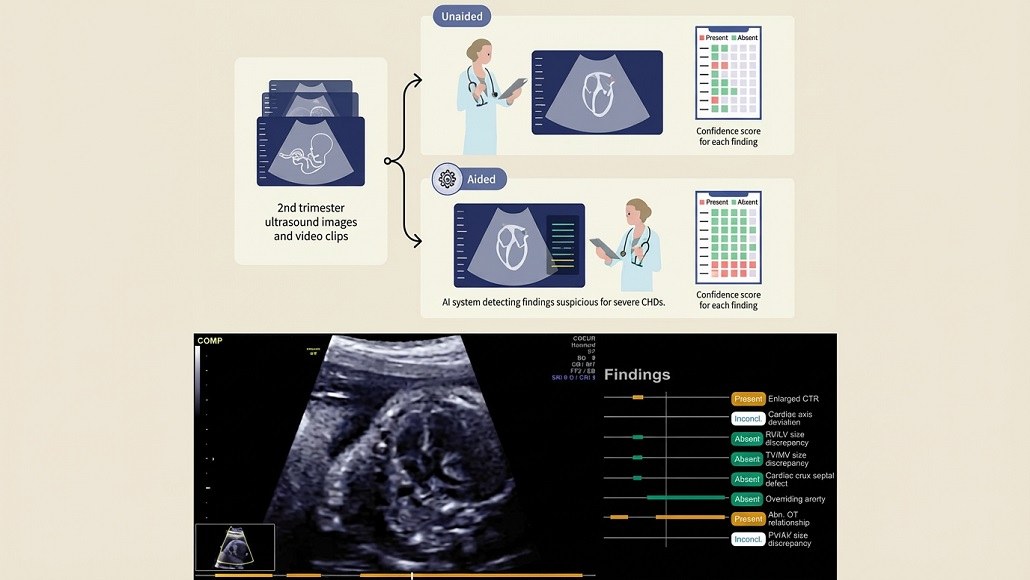
Mount Sinai obstetricians have become the first in New York City to use FDA-cleared artificial intelligence technology designed to enhance prenatal ultrasound evaluations for congenital heart defects, marking a notable advance in AI-assisted fetal screening. A recent Obstetrics and Gynecology study led by Mount Sinai West physicians reported that the AI tool identified more than 97 percent of serious congenital heart defects while reducing reading time and improving confidence levels among clinicians.
Congenital heart defects remain one of the most common abnormalities detected at birth, and about 1 in 500 newborns is classified as having a severe condition that requires urgent intervention, according to the National Institutes of Health. Carnegie Imaging for Women, an OB/GYN imaging facility affiliated with Mount Sinai, is the first center in New York City to adopt the FDA-cleared software developed by BrightHeart. The technology is now in use across the group’s three Manhattan locations, where clinicians are applying AI to improve the accuracy and efficiency of ultrasound evaluations at scale.
The study examined 200 deidentified fetal ultrasound examinations conducted between 18 and 24 weeks of gestation across 11 medical centers in two countries. Of these, 100 scans contained at least one suspicious finding. Seven obstetrician-gynecologists and seven maternal-fetal medicine specialists independently reviewed each examination, both with and without the AI tool, to assess whether the technology improved the detection of findings suspicious for severe congenital heart defects. The researchers found that AI assistance was associated with stronger detection of lesions, higher confidence scores, an 18 percent reduction in reading time, and a 19 percent improvement in confidence score, reinforcing the potential of AI-assisted fetal screening in second-trimester ultrasonography.
“AI assistance in prenatal diagnosis offers not only improved detection, but has the potential to offer significant improvement in workflow and efficiency benefits,” said corresponding author Jennifer Lam-Rachlin, MD, Assistant Clinical Professor of Obstetrics, Gynecology and Reproductive Science at the Icahn School of Medicine at Mount Sinai. “We, as clinicians, should embrace innovation and technology that is available, in order to maximize quality patient care. This technology allows for ‘leveling’ of the field of prenatal diagnosis to offer close to expert-level review of fetal ultrasounds, particularly in centers or geographical locations without fetal heart experts.”
Co-author Andrei Rebarber, MD, Director of the Division of Maternal-Fetal Medicine at Mount Sinai West, added that the findings “should prompt and encourage future research into AI-assisted software’s ability to improve detection rates, once integrated into clinical workflows, to reduce the variability and inequity of detection of congenital heart defects globally.”
BrightHeart funded the study, which brought together researchers from multiple U.S. and international institutions, including the Division of Pediatric Cardiology at the Icahn School of Medicine at Mount Sinai; New York University School of Medicine; Maternal Fetal Medicine Associates in New York City; Pediatrics – Cardiology at Stanford University School of Medicine; Palo Alto Medical Foundation, Sutter Health; the Fetal Diagnostic Center of Pasadena; Université Grenoble Alpes and CHU Grenoble Alpes in France; Medical Training Center in Rouen; Centre d’Echographie de l’Odéon and UE3C-Unité d’Explorations Cardiologiques-Cardiopathies Congénitales in Paris; Hôpital Necker-Enfants Maladies in Paris; Michigan Perinatal Associates, Corewell Health East; Wayne State University School of Medicine; Fetal Echocardiography and Perinatal Research–Valley Health System; the Division of Maternal Fetal Medicine at Pennsylvania Hospital, University of Pennsylvania; and Maternal Fetal Medicine, Perinatal Specialists of the Palm Beaches in Florida. Their collective work underscores the growing role of AI-assisted fetal screening as clinicians look to improve prenatal detection and care.
